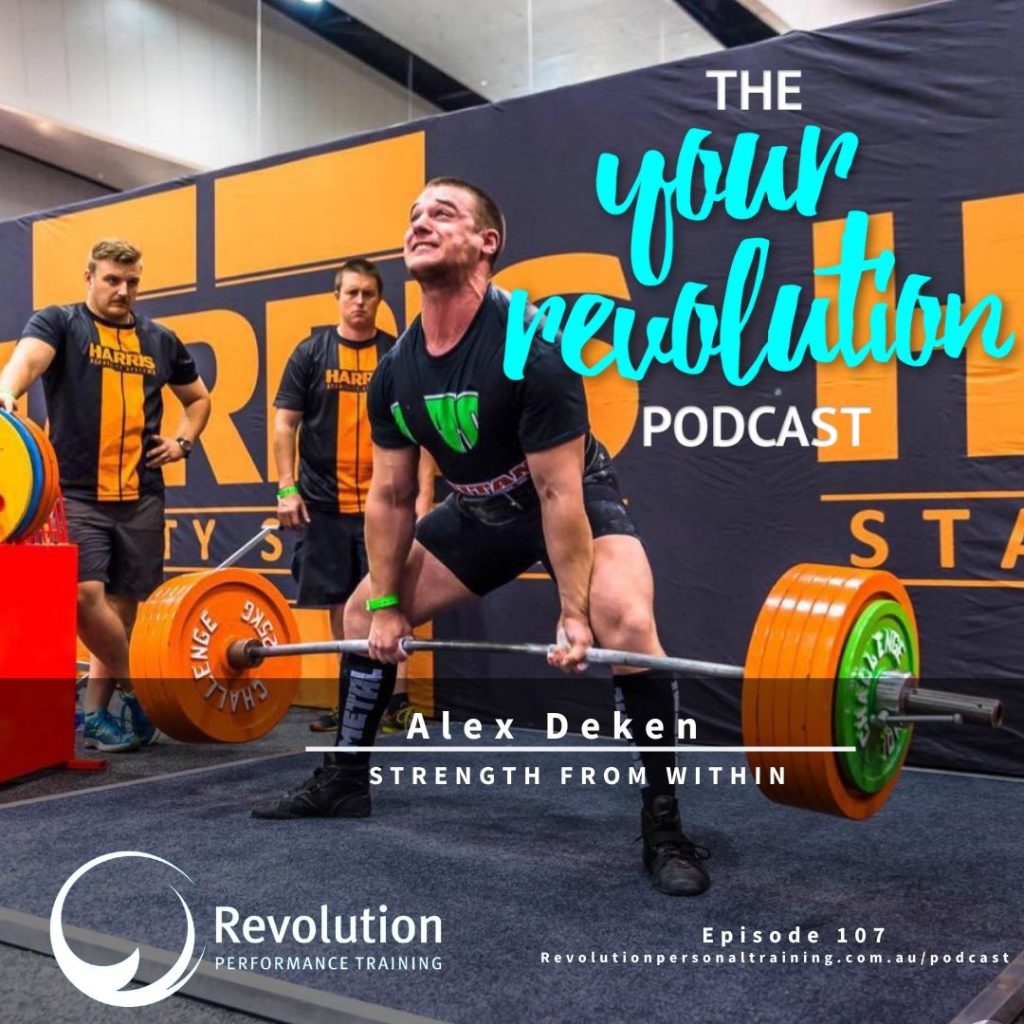
The Your Revolution Podcast returns with Episode 107! With Greg Kourpanidis as your host, Join him as he sits down with Powerlifter and Head coach of PTC Sth Melbourne Alex Deken.
The Sport Of powerlifting demands raw and maximal strength in three major lifts: Squat, Deadlift, and Bench Press. As a competitor Alex has achieved some fantastic heights in the sport which include:
-2018 GPC World champion in the 90kgs weight class
– Former all-time Australian record holder in the 90kgs weight class
– Has podium finishes at the GPC National championships every year since 2015 in three different weight classes (90,100 and 100kg weight classes)
Outside of competition, Alex is passionate about coaching, programming and developing the up and comers in the sport.
Tune in to an insightful episode as Alex dives deep into his roots of powerlifting, competition, mindfulness and his coaching philosophy.
About the guest: Alex Deken
Strength coach focused on building resilience from the inside out.
Episode transcript
Hello and welcome to the Your Revolution podcast. The Your Revolution podcast is a collaboration between Revolution, Personal and Performance Training in Melbourne and the MePer Project. The purpose of the Your Revolution podcast is to inspire you on your mission of betterment. Each week on the podcast you’ll meet game-changers who have created extraordinary lives and you’ll listen to stories and lessons to empower you to make the changes necessary to your life. The Your Revolution podcast is committed to fitness, health, nutrition, mindset, community and Head Coach of PTC South Melbourne. Alex Deakin here. Thank you for joining me and welcome to The All Revolution Podcast. – Thanks for having me. – Yeah, absolutely. Super excited to have you on today and yeah, really looking forward to this episode. Are you ready? I’m ready. Good. Awesome. So before we dive in, I thought it’d be a good opportunity for you to firstly give your listeners a little bit of an intro into who you are and your journey through powerlifting and fitness as a while. But yeah, I just got to a stage where I really wanted to do something about it. My mom and dad sort of didn’t really have the skills to go through or give me any advice with that. Yeah, so I had a mate that was going to gym, just a local gym and and I thought I’d just head down there and they’d put me on just like a surgery training thing. I ended up loving that and I’d sort of stay in there for like three hours just doing this circuit like over and over and over again. But I wasn’t allowed in the weights area yet so I was just doing these machines. I was too young. I was too young. I too young. You know, 16 or something. Yeah, and it wasn’t until I was 16 until they like wrote a program where I could go into the freeway area. And yeah, it just took off from there. Basically just sort of snowballed ended up going to like a ball serious gym. It was like more of a lifting area because you couldn’t even do dead lifts at this gym. Okay. There was no rack or anything you had to do squats in a Smith machine probably not proper flooring as well. Yeah walls upstairs. Oh, yeah. Yeah Donner disturb people down there. Yeah Yeah Then I ended up moving to a gym called the fitness factory in Pacnam Which was much more serious heaps of like hamstring equipment strength equipment, lifting platforms, squat racks and everything. And the guy there was really into just everything basically, he was just super enthusiastic fitness in general. So he was mainly into aerobic stuff, but as soon as I sort of started asking questions about strength training, he started like making, like he made the platform for me. He was out the back of Pachinam. There’s plenty of people with like properties and stuff. – There’s space. – Yeah, so he got one of the guys that come in and bring like one of their old tractor tires in and I’ve flipped that out like around in the end of car parking thing. And that’s where it really started with street training. Have you heard of Westside Barbell? – I have. – Yeah, so that’s my first introduction to powerlifting. They had all the YouTube videos, the squat bench, 10 lift manuals, everything like that. So yeah, that’s where it started. – Yeah, some great program. I think when I first started on the Westside and Skinny Barsters program was a big a real big train program I’ve like yeah followed religiously. Did you just think I won? Yeah that’s the one. Yeah yeah yeah yeah. I started with Westside and probably more so enjoyed the Westside for Skinny Barsters one because it’s just more athletic. Yes, the trial. Yeah, so that’s so when I couldn’t really find a powerlifting gym at that time there was PTC phrased him but it was like in the the phrased and dolphins change rooms. It was really hard to find. So I was like I’ll try this this other solo programming, so they did that for a while. And then PTC, Fraser, ended up moving to their current location in current downs, which is like a huge gym. And that’s when I did my first, like, during my first powerlifting team. – Okay. Well, very good. Very good. And, well, I, you did talk about what sparked your interest in powerlifting, but can you, so when you join this thing, can you remember your, I guess, your first session when you walk through the doors and want to, in your experience? – Yeah, well, I definitely remember my first session at PTC headquarters. – Yeah. – ‘Cause I made me max out on every lift. – Okay. ( hazing period of the year. Yeah. Well, it was like they had this percentage base like linear, linear, linear periodization type programming. And they needed a max to base everything off. Sure. Yes. So yeah, I remember squatting 170 high bar, like, arsed to grass. A bench 155. So my bench was always pretty good. Oh, wow. Yeah. And I deadlifted 220 conventional. So, okay. Yeah. And just to, for everyone to know conventional, that’s the two hands on over the top. So no overhand. So the grip just goes. Oh, no conventional as in feet together. Oh, feet together. Ah, runs on the on the air so as opposed to sumo desert which is oh sure sure that’s the style of user moments. Oh okay. Very good. Awesome. Now I’m sure we were probably gonna get maybe I’ve got to ask this a lot maybe not so but in your own words how would you describe what is I guess power lifting as a sport in general and I guess how it differs from other strength sports such as Olympic Lifting or Strongman Training? Yeah, well, so it’s the same as Olympic Lifting that it’s a similar format where you’re working up to one-run maths, except that Olympic Lifting is much more, I guess, or I would say it’s harder, just because the lifts are more complicated, having to sort of transition from getting the bar to the floor and then into the right position for the clean and then overhead, much more technical. You’re not gonna see as bigger weights lifted in Olympic weight lifting. – Sure. like I think I’m probably gonna get this wrong, but I think the biggest cleaning jerk at the moment is like 267 something like that. Whereas the biggest squat is like 500 kilos or 505. Sure. Okay. Yeah. And then with thinking about the strong man, strong man, you’ve got that you’ve got the static strength component, but then you’ve also got that dynamic strength component where you’re sort’re shifting loads like doing farmers walks and carry carries and all that sort of stuff. Okay yeah and in terms of the actual lifts itself so you’ve got three lifts facing on a bench press, a deadlift and a squat. That’s right. So now the only thing I get something I don’t really know as much is in terms of competitions is when you suppose you see ones that say they’re raw based or I guess not what some of the difference between that. Yeah, so there’s a few different categories. Yeah. So you’ve got and it depends what federation you’re in. So if you’re on the IPF and you’re competing in raw, that or classic that means you can wear a belt and you can wear knee sleeves. So like there’s like knee-aprate knee sleeves. Like what’s it material? And that’s it. And then if you’re competing in Raw in GPC, which is what I compete in, you can wear a belt and you can wear knee wraps. So up to two and a half meter long knee wraps which basically you can squat weight more on them. Like I think I can probably squat maybe like three, ten in sleeves and like three, forty in wraps. Wow okay that’s quite a difference yeah. Yeah so there’s a full technique to it it well there’s lots of different techniques and approaches actually to putting these knee wraps on and getting them off as well yeah yeah yeah yeah yeah and then you’ve also got a cryptopal if you as well mm-hmm so the best way to sort of or the best example of that is high jump to pole vault. It’s basically the same thing except using equipment to do more. So with with with the equipment power lifting, you can wear these really tight squat suits, which are like this like canvas sort of material. And then you can, and then in the bench press, you wear these bench shirts where the arms almost like sort of stitched on the front and they sort of walk out like with the arms in front of them. Like a T-Rex. Like a T-Rex. Like a T-Rex. Like a T-Rex. Like a T-Rex zombie or something. Okay. Yeah. Oh wow, okay. A crude power lifting isn’t something I know a whole lot about. Yeah. It’s not super popular anymore. But yeah. Okay. So wow, there’s quite a, there’s quite a few, I guess, sub or not categories of different, I guess these categories or competitions. But you primarily can pay in a more, is it the GPC? GPC? GPC? Okay. Okay. Very good. Now I suppose actually while we’re talking about your pallet and we should probably go over a little bit more of your experience so I thought I’d give a listen a little bit of overview of your accomplishments and I feel free to correct me if I’m wrong with any of it. So you are a former all-time Australian record holder in the 90 kilogram weight class in pal lifting. You were a 2018 GPC national champion in the 90 kilogram weight class, which I believe was the seventh highest total in the world at the time. It was just outstanding. You’ve also reached the podium and placed at all competitions such as the Arnold Classic and the 95 kilogram weight class and every GPC national championship since 2015 in multiple weight classes, 90 kilograms, 100 kilograms, 110. And your best totals, but is it 857.5 kilograms at 89.5 kilograms of body weight? Does that sound pretty? – Spot on. – Spot on? Oh, very good. I was going to jot that down right. So good. So I guess before we go more into your career and compare as a coach, I want to go a little bit more back again into the early days. Do you remember I suppose your first competition? And if so, can you share your experience?? Yeah, so probably about two months maybe after I joined PTC headquarters. Mm-hmm. So this was in 2013. Okay. Yeah, they so they hold novice coms most PTC gyms hold novice coms mm-hmm and so what okay, so not novice coms nowadays will will’ll just be like a, we’ll try and set it up as if it’s a real comp. So we’ll use like a mono lift, which is, do you know what that is? – No, so… – It’s just like a, it’s a squat rack where basically you can stand up and unrack in your squat stairs and people will release a gate and the hooks will swing like this. – Oh yeah, it’s hard, cool. – Yeah, yeah.. So I’m sure many people probably don’t know what that is. Yeah. Yeah. It’s pretty like specialized piece of recruitment. But, um, and then you’ll have all the refs and everything and everything’s, you know, it’s done by the GCS books and everything. But back then, um, they did the novice comps with just like a regular squat rack. So I had walk it out So I walked out 210 kilos in the wraps and I actually saw the video the other day like maybe a couple months ago And I like I opened my arse at the floor like and I definitely don’t squat that long Yeah Wow yeah, so that was pretty funny. I’ve benched 160 and I deadlifted 230 so I so I I totaled 600 kilos in my first column which was That’s pretty good. Yeah, mm-hmm. Yeah, they saw the numbers you’re expecting you should have like I guess a lot of plan But you think maybe okay, this is my target so I wanted to I had to really thought about my total before joining the powerlifting gym Okay, and so I hadn’t really been thinking about it that long until I set goals my coach at the time set those goals for me, so Okay, so he was happy he was happy. Yeah, yeah, yeah, they made a bit I didn’t know it was good Yeah, and but they made a bit of a deal out of the fact I took up to 600 my first comp so yeah, that was pretty motivating not awesome Now for us to clarify with in terms of like actually the novice competition in general is there or maybe is back then was there supposed to criteria in terms of level of experience or was it literally if it was your first competition you would go into the novice category. How would it? Yeah, so you… So mostly people that have been competed before will join up. But it’s not like… Like if you’ve done a comp before, you’re still allowed to do it. Sure. Some people might use it as a bit of practice. But not so often, to be honest, I think. If someone feels like they need a bit of practice, they’ll probably just do like a smaller sanctioned meet. Okay. And did you have, did I suppose you have any expectations when you first competed at all? Or was it really, would you say, because I mean, I suppose my last one, I’ll ever say was a Damien Jones strongman, he talked about… he thought the competition became a more like, he treated them more like his benchmarking. So obviously, you know, after a long cycle of training, is that how you kind of approached it back then? It was more like you’d done all this work and it was like, that was, I guess, just the test year. – Oh, like, just the expression of your work? – Yeah. – Yeah. I mean, when I did my first comp, I was just like, shit scared of competing in front of each people. That’s probably all I was thinking about, to be honest. Yeah, but I guess now when I’m competing, I mean, yeah, like I’m always just wanting to sort of chip away and I definitely know it’s a long game, but I’m probably thinking more about like placing and stuff like that. Sure. That’s probably what I’m thinking more about the competition of it. Yeah, which is hard because that’s not really in your control. Sure. Yeah, absolutely. So you sort of have to, I sort of keep that, I keep both of them in mind. – Yeah. – Like I’m gonna do what I can and I’m not gonna overreach just because to try and overreach and potentially make a mistake because someone’s beating me or something like that. – Yeah, sure. – But yeah, I’m definitely there to be competitive. I think that’s something that in powerlifting, because it’s so numbers based and people have all these goals and everything, they forget that it’s like a sport. And I guess because for so long, when you start powerlifting, you’re not, usually you’re not very competitive for ages. So you have this mindset of, okay, I’m just competing for me. But then it sort of gets to a stage where you are competitive and you have to sort of flip your mindset and go, “Oh, actually wait, this is a sport.” Let’s go for the win or whatever. – Yeah, yeah. So I suppose then, in that sort of sense, in is, I suppose the elements, like I suppose some of the weightlifting in the life I suppose is a strategy in terms of numbers at times and suppose what, I guess what attempts or how much would probably lift would that be, if it is fair to say? – Oh yeah, there’s definitely a lot of strategy going on. – Yeah. – Yeah, definitely, especially at the, so the IPF is like definitely the most like professional version of the sport and you’ve got like some of the comp day handlers. So in the IPF you’ll have like a team coach and they might not necessarily be that your coach, short day to day, but they’ll be the ones using all the strategies and everything and sort of watching the scoreboard. Yeah. And yeah, they’re really the experts with that stuff. Okay. So that’s another pretty cool aspect of the sport. Yeah, no, no, absolutely. Now, what advice would you give to someone that wanted to pursue powerlifting? To learn the basics first. Yep, okay. Don’t just sort of rush into it and feel like you need to start straight away with a barbell. Catabell can be like your greatest tool especially for the squad. Yeah. Just have just holding your weight out in front of you and having something loaded on the front you’re sort of like forcing like an abdominal contraction sort of kidney brace sort of allows you to really practice other aspects of the movement like you know your knees out and your foot pressure. And without having the pressure of having a weight on your back. So, definitely getting a coach and learning basics. Okay. No, no, for sure. And what about in terms of actual competitions, like would you recommend someone to compete pretty quickly or would, actually, I mean, much select because of those you would say that once they’ve mastered the basics but when ideally would you say in a time frame to do I guess a competition depends on their level of skill yeah I think like if they’re technically proficient enough to to yeah I guess it’s a hard one because it’s not like you have to go and recump in max out. Yeah. You know, like if someone really wants to sort of dip their toe in the water and they got a coach looking after them. Yeah, yeah, for sure. They might only be sort of a few months in. They could do like another comp where, you know, there’s, it’s fairly casual. And you can sort of just go in and put up some fairly sub-maximal clean looking lifts. Sure. Yeah. But I think for someone that’s maybe doing it on their own or whatever, I would say maybe it’s a pretty popular opinion to have at least like a years training under your belt before you go on a temp like a one-room max. – Sure. – So, yeah. – Okay. I don’t know, fair enough. Now, one area I suppose actually of your training itself, I really wanted to pick your brain on was the mental side of training. Something I’ve found noticed that you place a lot of emphasis and focus on. Can you share, I guess, some of your tips on, I suppose your mindfulness tips, actually. Yeah. – Sure, yeah, yeah. I started putting up mindfulness tips on my Instagram because I’ve always had a lot of anxiety in general, but mainly social anxiety.. Definitely like speaking and everything like on this and on different platforms. And even as a coach, like to go and put myself in a position to be a head coach was like really difficult. – Yeah, yeah. – And so to sort of deal with that, I had like a counselor, which then the role sort of turned into more of like a life coach. And through that, I learned a lot of mindfulness tips. And I started putting out the videos to sort of keep myself accountable. And I also think that it sort of sets a good example, especially like in such like a Typically masculine sport sure yeah, no absolutely But yeah, so some of the mindfulness tips that I’ll use day-to-day I Have like I have a morning routine that’s really important to me. So the first thing I do well Usually the first thing I do is make my bed, But now I have a girlfriend and she sleeps in way longer than I do. So that’s out the window. So my first thing that I’ll do will be I’ll do a 20 minute meditation in the morning. So I learned to meditate with my friend Jeremy Khan. He’s a meditation teacher. So I’ll either do that depending on the weather. Like if it’s cold like this morning, I’ll just sort of sit in the shower. But otherwise I have like a meditation seat and I love like burning sage and stuff and pala santa like the little wooden sticks just sort of creates a bit of an atmosphere for me. So I’ll do that. And then, so I use like a transcendental style meditation where I basically just follow like a mantra. And then after that, I’ll have, well, I’ve actually, it’s sort of, it evolves. So I used to have like a gratitude notebook. So I might write like three points after my meditation and sort of just do something to sort of Let the effects sort of flow on into my day. Mm-hmm like I don’t want to just like sit there for 20 minutes in the stillness and then Just like get up and put music on and start doing stuff and have a coffee and like carry on. Yeah, lose it. Yeah sure sure. Okay. But I’ve actually got like a drawing board. I’ve got like an A3 drawing board. Okay. And some paper and pencils and stuff. Because I always visualize a lot when I’m meditating and I visualize like different things and I thought it’d be cool to try and sketch them. Not that I have any skill whatsoever, but my girlfriend is incredibly skilled with that. My plan is to get her to ditch me. That’s what I’ve got going on at the moment with my mindfulness routine. I also make sure that if I’m reading a reading a book or for me I listen to it. Oh, yeah, it’s usually something about mindfulness like At the moment I’m reading a book called the golden sequence. Yep. I’ve heard of that. Yeah, I’ve heard of that by Johnny Pollard. So he’s he’s the the owner or CEO or whatever of one giant mind the meditation there and Just always trying always trying to learn more I guess. So yeah. Yeah. No, that’s very fascinating. And I suppose this month, did you, I guess, start this before, I guess you got into powerlifting as well? Or how did you implement this with your training and also your coaching or was this something you always did? Like how, when was it due? I started it in about, so I started seeing my counselor in 2015. Okay. And with the mindfulness stuff, like with the whole morning routine, I went through the start of last year. Okay. So not, not, not, not a very long time, but yeah. Yeah. But I’ve been really consistent with it. Mm-hmm. Well, actually the last couple months haven’t been Amazing, but um, but yeah, sort of getting back on track with it now. So sure. Yeah, no, I find that really fascinating. I think that’s something a lot of people can take out of them and even myself man I one thing I always try to make sure I make my bed that I sometimes find these early mornings, you know if I’m a bit rushed always, but just sort of like little things like that. – Yeah, just getting those little wins. – Yeah. – The day. Like I’m not like a, you know, some people just like real go getters, you know. And they’re always just thinking of the next thing. – Sure. – I have to put things in place to be like that. So if I make my bed, it’s like, yeah, cool. Like I did that. And I’m going to get a… What’s the next task? No, no, absolutely. No, I really like that. So she’s really fascinating. And I like them as well because it’s very, they’re very realistic. It’s not like these are hard things to do. Yeah. Like, all my scenes pointless. Yeah. And to start doing it and seeing the like the flow on effect it can have. Sure. Yeah, absolutely. Now as far as leading I suppose into the present now you are to the head coach of PTC South Melbourne. Can you talk about first for those who don’t know as to what I guess PTC is in general and I suppose yeah how you suppose you got into that role and your experience and a role? Yeah, so it’s a strengths training facility. Yeah mainly mainly for powerlifting. So as I mentioned before there was PTC headquarters, which is obviously the first one. Yep. And there’s plenty of other PTCs as well like in Victoria you got got like PTC, Elfan, PTC, Roville. There’s plenty of other gyms that have started off as a PTC and then sort of changed the name and done their own thing like in Perth and Sydney and… It’s more of a franchise? Yeah, I think there’s… I don’t know exactly but I think you just like pay for like one fee, like a once-off fee for the name and then that’s it But I don’t know it doesn’t seem that there’s no like franchise fee or anything. Okay So people end up changing their name when they sort of branch off and do their own thing, but sure each each PTC will usually be more powerlifting base, but you got strong man based ones like PTC MacArthur and all that sort of stuff But yeah, so PTC South Melbourne is is definitely more powerlifting. Yeah, we run Like basics programs out of there. We have like a powerlifting team for sort of more like intermediate advanced people We run sort of general classes as well. Yeah, and then, we run our own novice comms every three months. And we’re also just started to run comms for APU, the Australian Palifting Union, which is the Australian affiliate of the IPF. So the IPF is the global Fed and then in each country will have their own affiliate of that. Okay. Yeah. So that one is the one where you have to walk out your squats and you wear the sleeves and your feet have to be flat in the bench and all about. So it’s very strict. Yeah. Yeah. Yeah. Like you’re all the referees are in certain time. Oh, wow, okay. Very professional. Yeah, no, absolutely. So in all, I guess in a nutshell, it’s very much a performance sort of bass gym. Yes, absolutely. Yeah, no mirrors or anything like that. Yeah, one of those little gyms. No mirrors, no egos. Fantastic. No decay pot policy. Yeah, no, I Yeah, no, I love it. Now, as being exposed to head coach, can I suppose you, as you’re, I suppose your role, I suppose, are you very much, are you very still very hands-on, or do you have more of, I suppose, like, other responsibility as opposed to, yeah? – Yeah, very hands-on. – Yep. – So, my two main things will be the basics program, which I really love. That was quite challenging for me at the start because when you’ve been doing something for ages and you’re not really thinking about, or you get good at it. It’s like, you just do it. Yeah, it becomes autonomous. You’re not thinking about those little things. So when I had to teach these people that had absolutely no idea, it was totally new. Yeah, that was like, I was like, whoa, whoa, this is, I’m really have to think about this. But that sort of really improved my own understanding of powerlifting and the lifts and everything and appreciation for them. So the basics program has been awesome and I love it. But then we’ve also got a gold membership which is where people pay just like membership for the gym and then they also get programming and they have supervised training sessions with me. Like just like a like a like on a Monday it’s like four to nine sort of thing. I’m just there the whole time. – Like an open genius sense and you’re sort of over viewing in all like they could all have their own program and you thought I was just. – Yeah, because these people sort of know how to train, they know how to come in and warm up and everything they don’t need like, they don’t need me sort of counting their reps to do when they’re by us at Girls. – Yeah, yeah, yeah, absolutely absolutely. And then I have another coach, Shanae, who helps me out as well. And then my girlfriend, Isabelo, has also just come on and sort of started helping with technique and stuff like that as well. So, Jeremy, these sort of sessions, how many assessments would you have from these open gym – So, for, let’s say, at any one time, maybe up to 2025. – Okay, yeah. – But we’ve got about 75 that I program for on that membership, so. – Mm-hmm. – Yeah, wow, okay. – It’d be a bit of a handful. – Yeah, no, no, absolutely. I suppose you touch on a little bit of this, but I suppose what I suppose has been, I guess, the biggest challenge that you’ve found I suppose in, maybe I’ll just, in terms of like, I suppose coaching, but also, our competition competing as well. – Biggest challenge, definitely coming back from a setback. So I recently had a bit of a setback this year at the Arnold Classic where I was set to do really well, but I bombed. And so that means that I was disqualified. So if you bomb it means that you didn’t make any attempts out of one of the lifts Yes So you have to make at least one successful attempt out of the squat bench of deadlift to post a total sure Yep, and I failed all of my bench presses and this was because my bum kept coming off the bench mm-hmm and I wasn’t able to rectify that Mmm on the day on the day. Yeah, so I mean I was on the last one, but then on the, so, could you say you get three attempts? – Yeah. – And on the third attempt as I pressed the bar dipped, so the bar can’t change directions once it’s being pressed. – Yes. – So if the bar dips it doesn’t count. – Okay. – And because I put that expectation on myself and I’d sort of, year like with all the mindfulness stuff like I was feeling like amazing like I’ve really felt like I really transformed myself as a person. Yep. Oh hit this massive setback and that really knocked me about mm-hmm and Put a lot of doubt and sort of uncertain uncertainty in my mind and and of flowed on into other aspects like coaching and everything. So that’s definitely been my biggest challenge that I’ve faced so far with power of theme. And yeah, just sort of having to put everything back in place like how I said the last few months have made that great for me in terms of my mindfulness stuff. I sort of realized that I wasn’t doing enough for myself and that’s probably the last few weeks is where I really turned it up. Yeah, yeah. So I can get back on track. Part of that’s what I suppose you said is a very high standard or expectation in terms terms of you know going to place and always wouldn’t do well was that part of us boys why it was hard to That was definitely a lesson that I learned from that like it was all about It was all about winning that yeah, and Mm-hmm went here and then when that didn’t happen It was yeah, it was fairly No, no, absolutely. Yeah, no, I think that makes a lot of sense. Now, I suppose, in terms of not even just bouncing back from that, but in general, I suppose you have touched on a little bit, but what I suppose, do you have any other resources or influences or even people that, I suppose, helped you along, Not just with that but maybe just in general? Yep, yep, yep. So, well, so apart from my life coach Solomon, I’ve got like a really, really supportive group of friends, which I think, I mean, these guys are like that anyway, but we definitely breed a culture at PDC where it’s, like we can sort of feel safe to sort of be vulnerable and talk about things, especially with the guys and everything. And I’ve got, yes, some really supportive friends that sort of help me through those times. Yeah, those guys really break the mold aspect. – Yeah yeah aspect. No, I’m super grateful for that And obviously, you know, easy is great as well as well. It was great as well. I also sound like pretty I’m pretty spiritual and I and I have like a Reiki master Yep, and so sometimes like I might go there for some Reiki but other times I’ll sort of go there and Just just for a chat. She sort of plays a bit of like a bentor role for me as well. Yeah, so yeah, let’s say that they’re the biggest influences for me. Hmm. No, no great answer great great answer Now I spent on a more abroad topic here. I was one of the scuss boys powerlifting in Australia No, here’s one noticed, I suppose it’s not just with powerlifting but also I suppose you’ve got the strong manufacturing and crossfit. Things you have I suppose done it for quite a few years now. Can you talk about I suppose the growth of the sport particularly in Australia in more recent years? Yeah it’s been huge. Yeah. So if we just talk about GBC the first GBC Nationals was in 2012. Yep. And I think we had I think there was so I wasn’t even into it but at this age I was I came here later, but I think there was like nine women in the whole comp. Okay. Whereas and then by 2015 we had this crazy comp where there was like It went for like seven days in the Gold Coast and there was like 362 competitors and like, and I think it like 190 or 180 of them or something were women. – Wow, okay. – So it’s not only has it grown like in general, but like we have so much more women with reading as well, which is awesome. And Australia has like, like, well, yeah, in general, but we have so much more we’ve been competing as well, which is awesome. Australia has like, in general, some really, really impressive lifters, but especially the female lifters. I guess we’ve definitely seen the growth of the sport in our gym, and I think through things like CrossFit, the general population is introduced to the main lifts in maybe a less intimidating way. Not that a powerlifting gym is always intimidating, but I could understand how people might think that if they haven’t been in one. Yeah, so I could definitely credit CrossFit for that for sure. It’s funny because again, I’m talking about a lot of episode of Damien, Damien Jones and he credits a lot CrossFit for I guess the growth of powerlifting strong man. So weightlifting as well. Yeah 100% of that good video that things are just like Rogue, you know, some of those other big brands now or that have sponsored Reebok and whatnot. So what you say I suppose in the earlier there was a bit of a stigma with paladin because like you said we went from what eight or nine females to 100 and something which is just you know incredible in terms of growth. Yeah, you say that there was I suppose that at the start Yeah, yeah, I guess I guess I guess people think I think people always thought that palestas were just a bunch of fat guys But then you see like lots of like light away with this with yeah great bodies and stuff Yeah, and it’s starting to become more appealing and they’re like, okay well, you know Maybe maybe bodybuilding or what or crossfit or whatever. Yeah, this is the only way to get a great body Maybe I can do palesty and maybe just watch my diet. Yeah, yeah, I had a percent Yeah Yeah, so yeah, I suppose I guess part of that would probably be just because they work people see on TV and stuff with you know, maybe like the heavy weights I just think yeah, you have to be exposed like sort of big a real big unit or Yeah, well I guess that’s the way to see because they’re the biggest weights lifted by the way. Yeah, yeah, yeah, and then absolutely Now suppose when I speak of power lifting and wanting to touch on Nears I suppose very similar to you know the for my sport wrestling that I say it’s very I don’t know if you agree we probably still probably very volunteer based the male is he growing very fast and and what not what would you say I suppose the biggest challenges the sport faces at the moment because he did touch on there are I guess a few different competitions and federations there’s not exactly one body there’s quite a few isn’t there yeah yeah what would you say I suppose the one I guess part of it is the reasoning how that’s kind of come down so is the yeah so what is I suppose the I guess the challenge or the way I suppose the sport can improve. Well, look, there’s probably not much that can be done in terms of making everything one fed. Because powerlifting is like bodybuilding where you’ve got like tested federations and untested variations. And those two things are just never going to join. So mainly you’re going to have two main ones at best. Whereas say in America you got like nine or ten different like crazy manifestations. Where at least in Australia you sort of, there are a few, but I would say there’s three main federations. And the only reason that there’s three is because the two drug tested federations, so Pena left in Australia and Australian powerlifting union. Now, the Australia was the IPF affiliate, but then they got kicked out for a bunch of reasons. And now APU formed out of that. But PA still is very well established and still has a huge member base. So that’s why there’s the three main ones there. There are a couple of other ones, but they don’t have as big support. Yeah, so that definitely is a challenge to sort of get it. I think that’s the reason why it probably won’t ever be in the Olympics. It’s not in the Olympics sport. – Yep, okay, that was gonna be my next question. – Yeah, yeah, I definitely, yeah, I mean, I don’t really know, but I think I don’t think there’s much chance of that. The other challenges it faces are just being a more spectator friendly sport. So if you go to a local comp, like, so the GPC Melbourne Cup is next weekend at PTC headquarters. Sure. It’s two days. It’s over two days and it’s probably going to go from like 10 to a five. Okay. Both days. Yeah. So if you, if you’re going there to watch your, your mate or whatever and you don’t know anything about powerlifting, you’re gonna hate it. Unless you instantly fall in love with it and you watch like… I don’t know like 50 people like sort of squat in a row like you’re there to see your mate. So there are like, like, so you’ve got pro or power lifting, which are run, well, one of the concepts pro or at the Arnold Classic, and then they’ve got big dogs, which is at the convention center as well. So that’s in a few weeks. So that, so big dogs in particular is only like 15 guys. Just go on head to to head no way classes like they just invite the biggest the biggest and the best. Yeah, and they’ve also introduced another Category called Wildcats, which I think is like a lot of the names of these So that’s like under 75 kilo women, which is know she’s up there in terms of females, and I’m just a friend of her last name. her last name. But yeah, like, she was telling her weight classes in like the 63 kilogram or something. And like, yeah, I remember seeing like a lot of women like you said. – Yeah, those middle weight classes, like the, so when I say 75 kilo weight class, that’s a GPC weight class. – Yeah. – Whereas, so 63 would be IPF. So the 63’s, 72’s like around there are really competitive. All those middleweight weight classes. And same for the men, like the 90, 100, 110, they’re all super competitive. I think there’s just more people that weigh that much. So the pool is just bigger. So you just have more talent Yeah, whereas with a lightweight and heavy weight there’s less people. Yeah, sure. But yeah, so that anyway with the big dogs and Wildcats, I think that’s a more like a much more exciting Weight of view the sport. Mm-hmm. So okay with just sort of less competitors and just sort of head to head as much as you want want to like support the novices and stuff. Sure, yeah. Like for someone who’s not in the powerlifting, they don’t want to watch someone squat, like 90 kilos or something. Yeah. Okay. No, no, fair enough. Would you all say a store’s competition or shows such as like you said, the art classic or it helps as well in terms of the promotion and. Oh, yeah. Yeah. So this year, it’s called Pro-Roor. So this was Pro-Roor 11. Yes. And so at the Arnold Classic, we had the main area in the middle of the whole Expo, which is insane exposure for us. Yeah. And they had this huge, huge projector screen like above so like anywhere in the Expo you can see what was going on. So Yeah, so the art of classic is huge for power of thing. Yeah, no, no, fantastic Now I suppose one question I’d like to ask and you I guess you probably have touched on someone is but I suppose if you have any other strategies either I’d always like to ask everyone here, suppose they’re, how they work life balance and how I suppose they balance life from work and training. Yeah, what were the suppose your key strategies? I mean, obviously you mentioned the mind from the stuff, but as a sort of other things you are sort of implemented to, I guess, when balancing, I life from especially with like training as well Yeah downloading Google Calendar and scheduling when my training sessions are gonna be okay so realistically my training sessions never take Less than three hours. Yeah, I just take forever. Okay, and I prefer that I sort of want to get in and as I do my warm-ups That’s almost like sort of like a mindfulness routine. I’m sort of like transform me into this person that needs to you know shift these heavy loads before yeah, yeah, and So I’ll have at the moment. I’m only training three days a week. Okay, we’re usually I train four or five. So there’s three days a week where I’ve got like a three hour window and it’s always, always after 11 a.m. So I don’t do anything before 11 a.m. or maybe you said it today but usually nothing. – Which re-appreciate? – Yeah. Nothing before 11 a.m. – Sure. – That’s just my time. – Yeah. – I don’t want to rush into my day. I want to, sort of, yeah, I don’t know, nurture myself into the thing in the right way. – Sure. – And then training first, and then I always work like either three to nine or five to nine or something like that. – Okay. – Yeah, that’s how I sort of schedule things. – So Google Calendar. – Google Calendar. – I like it. – Yep, better color coding. – Yeah, that’s how I sort of schedule things. So Google Calendar. Google Calendar. I like it. Yeah, better color coding. Yeah, it’s funny is that I went to a private school when I was growing up and we were given the ways these diaries and I don’t think I ever used my diary once. No, it wasn’t. It wasn’t until I think it after uni and like you said, Google Calendar. Now I have everything scheduled and I yeah, how it took me I don’t know 25 years to you know now from Twitter now But it took me like 25 years or what it no years like the final like I actually was scheduled actually you know can follow something yeah, yeah Yeah, so it’s funny how I guess day and age works, you know phones and all that mm-hmm for – Yeah, very good. Now, I’ve got a lot of questions while going in more of that is, what’s the most important thing I suppose you wish you had known before, as you started your career? – Something that I wish I would know. – Okay. Probably, I wish I understood more about bracing. Yeah, like in the squat and the deadlift. Okay. Because that’s something I’ve had to sort of learn more about and I to me I learnt the hard way because in 2015 during I think it was like pro row seven I Missed to two of my big squats Because I wasn’t getting depth because I wasn’t bracing properly Yeah, my my my brace or my core or whatever was opening right up Yeah, and my pelvis was tilting forward and really sort of limiting how far I could get down. But I had no control in that area, but all this strength around it, like not squatting like 320 at the time. – Wow, okay. – And had no idea how to like, I had no core control at all. So I wish I knew more about that from a lifting perspective and then also a coaching perspective. – Sure. -, yeah. – Okay. – But maybe I had to learn that way. – Yeah, learn the hard way. – That was my path. – Yeah, yeah, yeah. None of fair enough. – Yeah. – Well, it says a little segue into another topic. All the other questions I would say is what would you say is your biggest failure and what did you do, I suppose, to learn from it? I I mean you did mention the setback. Would you say that was probably or was there something? I would definitely say that was it. Yeah. I feel like if I was coming up with something else it’d be for the sake of saying something different. That was definitely it. Yes. Yeah. That bombing at that comp. And then the aftermath and having sort of how I dealt with it. Sure. I don’t think I would definitely not let me reword that. I would definitely say that that’s not a failure. Yeah. It was just something I had to learn from. Yes. Yeah. Okay. No, good answer. Now, here’s a little curveball question I’d like to throw around every episode. If you were the podcast toast, what would you have asked yourself that I haven’t already asked you? Yeah, well… Not for the answer, as well. Yeah, yeah, yeah. It’s not an answer. I can’t’ll count it. – It’s usually a good thing if you can’t. – Yeah. I probably would have like maybe asked about like the style of training that I do. – Okay, yeah. – Only because I love talking about it. – Yeah, you’ll play. – Yeah, because like I had said, programming is something that I I love. I’ve had a few different coaches over the years or whatever, not only just to have some accountability but also to sort of learn and learn different programming styles. So mainly at the moment I mean we’re talking about it before when you and coffee but I am Most of my training is RPE based training at the moment. Yes, so which is rate of perceived exertion. Mm-hmm. So we use a scale of one to ten. Yeah, and it’s based on How many rips and reserve you have? Yes rating of ten would be yeah, no reps left. A rating of 9 is 1, 8 is 2 and so on. Yes. So I don’t actually get given a weight to do. My coach will say I want you to do three reps at an eight RPE. So basically doing three reps with a weight that I could do five reps with. So a sort of a way of managing intensity. And so that’s the style that he uses with me and then obviously I’ve been using that a lot with my lifters as well. So you’ve shifted from rep-based and point more into that RPE base. I use I think I think a lot of coaches sort of have like I get like this is my style Yes, but I think a good coach will be versatile because like IP is definitely not gonna suit a lot of people yeah because it requires a lot of self awareness most time Most of the time when I get someone to rate up here for the first time they look at me cross-eyedeyed like, “Oh, they’ll do a set of five.” And I’m like, “How many more could you have done?” And they’re like, “I don’t fucking know.” – Yeah, yeah, yeah, yeah. And so it’s definitely a skill for a more advanced lifter. – Yes. – So in the case of having a more novice lifter, or even in the case of having a lifter who has been at work all day, and they don’t want to fucking think about how it felt. They just want to do it. Yeah, we get a lot of others, but we yeah, that’s a really good. Yeah, we use percentage based stuff. Sure. And we can even use a mix. So for instance, with one of my lifters last night, she struggles to rate up here. I think a little bit out of laziness, but she doesn’t want to so with the protocol was I wanted to do her to do one rep at an eight RPE Yep, and then do three reps at an nine RPE. Okay, and then take off five percent of that and do two more sets of three She just looks at me just like I don’t want to do that. Yeah So what I got her to do was do one set of, so one rep at an eight RPE. So there’s actually a chart. So if you put in, there’s a calculator. So if you put a lot this weight at one rep and it was an eight RPE, it’ll give you an estimated one rep max. Then I just said I want you to do 85% of that one rep max for three sets of three. And then you don’t have to think about it. And I know that 85% for three reps should be fairly achievable. So you can mix it up a little. Okay, well actually, probably a little question. Something’s popped up now, because talking about rate percentages is, I suppose one of the big pal, we did talk about Westside, but I suppose the other real big pal is in Peru which I think is Used across many sports athletes is probably Jim when there’s 531 I suppose can you talk about is that training method you’ve used in the past and I suppose your thoughts on because that is very I mean that’s a little bit more percentage based But I find that was a very fascinating one because it was one of those programs where you are not actually doing your true one RM, like you’re doing like 90%. So I suppose it’s a way where you’re almost like, I guess a way I suppose working more with as linear, like you obviously improve quicker, like you wouldn’t, I suppose, plateau as quick. – Yeah. – Yeah quick Yeah, yeah, so 531 I actually can’t remember that much about it, but it actually was the that’s what I was doing when I when I was Just before I joined the that powerlifting gym Yeah, but I can’t remember that much about it and it actually it’s probably the most common thing you get someone so someone comes into the gym and they’ve been And they’re doing a consult with me and they’re already doing some powerlifting and I’ll say are you following a program? Yeah, I three one will be like the most common most common. Yeah But yeah, I think with any of those programs Like that they might work for a while. Yeah But they are sort of a cookie-cut program at the end of the day. And so eventually they’re probably going to grow stale. But I think if someone’s starting out and they’ve got a general, fairly good idea of how to lift, and they haven’t fun with it, and they sort of want to just do experimentalism programming on their own. I think it’s a pretty good option. Just not like a long term for me. Yeah, no, no, absolutely. Yeah, no, I think that was actually… I’d probably say that was my first experience when I actually started doing a little bit of Palakin, it was probably the 531. I know it’s released several different versions now, but Yeah, I did always find that very fascinating I suppose that it was definitely very number of percentage based that’s for sure like I remember like I’ve never seen so many Excel charts and yeah things like that, but yeah, I suppose very fascinating that you I suppose working off a Like yeah, you’re not actually working off your true one rep max initially. So I thought that was really really interesting. But yeah, I suppose he I guess that’s another influence, I suppose of I guess the growth of power from the training and suppose someone like Jim Winlow. So yeah, I’ve always been these methods and and whatnot. So okay. Yeah, I think if someone was looking to get into the powerlifting programming and they were gonna do it on their own, I think they’d be better off going to looking up like juggernaut training systems online. – Yeah. – Yeah, I think they have some really good programming templates. – It’s like a chaos, I can’t remember, I think I know of it. – I think there’s a few that you should a few that you get but They’re really great. So no, I don’t know if it’s generalism one called like the Texas method I can’t remember that’s a different one as well. There’s Texas method. There’s like five by five five. Yeah, that’s not like Yeah, yeah So like have you tried all the if you suppose that experimented with these programs itself at some stage or No, I basically just did the Westside for skinny buses and then 531 and then Yeah, yeah, yeah, no very good. Well glad glad you took that programming there because that’s very interesting Very good now. I suppose in closing, if I’m working on listeners firstly, if they want to reach you first, how can they contact you? And yeah, I suppose it’s a little bit of pluggy, you know, I’m searching things like your social media and where can they find it? Where is PTC and all that? Yeah, well, you can find me specifically on Instagram. So Alex Deakin, D-E-K-E-N, P-S-P-L. My email’s on there for coaching inquiries and stuff like that. – Yes. – Then PTC South Melbourne has an Instagram handle as well. – Yeah. – PTC’s on Facebook. – Mm-hmm. – I’ll say Instagram and Facebook. I own PTC, we have a really good website as well. – Okay. – You can find that through the email. on Now I did mention we’re going to go through the Revo PT signature 20 questions. So I said we got 20 questions, rapid fire, batch of short responses. Are you ready? – Yep. – Alrighty, let’s do it. Okay, question number one. Protein bars or protein shakes? – Protein bars. – Good. Question two, squats or deadlifts? – Squats. – You’re the first one, it’s squats. Everyone says deadlifts. I like it, I’m breaking them all. Question three, bench press or over head press? – Bench press for sure. – Yeah. – Hate over it. (laughs) Question four, barbells or kettlebells? – Barbells. – Question five, do pineapples belong on pizza? – Yes. – I used to say no and then I changed my mind. Okay. Yes. So question six favorite superhero. Oh I’ve been watching the boys. Have you seen that? No, I haven’t. It’s like where they go bad. Okay, superheroes go bad. So I don’t know if they’re real. Well, I mean, they’re all more severe as a real anyway, but true. Yeah. So I’d have to say on that show starlight Starline, okay, I have to look out for that one question seven chocolate or vanilla chocolate Question eight three things that you can’t live without Wall apart from obviously food water and hair Well bench press would have to be one of them. Not live without being out of bench press. House and disco music. – Okay. – Yeah. – Nice. – Love the party sometimes. – Yeah, yeah. – Good. – And… Coffee. – Coffee? – Yeah. Oh, very good. A bit of a coffee snob, so… No, not very good. Question nine. Favorite sports team? Essendon. Oh, Bompers Man, okay. Very good. Question 10. Most annoying habit. Most annoying habit. Whenever I walk into a room and like I like subconsciously want attention I’ll walk in and like clap. I do. Yeah, that’s like a thing people notice to me. They’re just like, yeah, okay, Alex, we know you’re here. Yeah. I like it. Christian Lennon favorite movie. Laura biting citizen.. Oh good film. Yeah, good call good call Question 12 favorite song dance for that. I’ll just give you a favourite song. – Yeah, done. – Basically anything by Shaka Khan. – Okay. – Yeah. – Nice. Tell you that question. – I know that wasn’t like a specific answer. – No, no, but it’s… Shaka Khan, alright. Question 13, burrows or tacos? – Burgers. – Good man. Question 14, one word to describe you. – I’ll say strong, not just physically, mentally as well. – Very good. Question 15, what three things would you take on a desert island? I feel like the obvious answer is you just have to take like a how long you on this island for? I passed away and assume like I passed away two years on a well two years worth of food and two years worth of water. All right. All right. Christian 16, favorite holiday destination Iceland okay nice anyway specifically Well just in Reykjavík the main town that was definitely my favorite mm-hmm very good do you ever see the then perform the Viking clap there? Nah, no I didn’t. And I actually wasn’t even into power the thing then. So I don’t even you’ve got like half Thor Bjornsson like yeah the mountain. Yeah, I’ve got his own gym and I haven’t even I didn’t even I did I went there when I was 21 So I’d love to go back for that reason as well. Mm-hmm. Now that I’ve got like more of an interest in, in Sten training. – Are you big game of thrones fans as well? – No, not really. More to the fan of Thor. – Fair enough. – Very good. Question 17. Signature dish. – It’s a good one. Pancakes. – Okay. – Yeah. – Well, it’s only my signature dish because it’s the only dish I make for my dinner. So I have like a guy who makes like prepared meals for me. Yep. And so the only meal I make is pancakes for dinner, which is like four eggs, but it’s banana, sugar-free, maple syrup and peanut butter and all that stuff on it. Awesome signature and only dish. Yeah, very good Question 18 what it’s the best of Wi-Fi name you’ve seen? I Remember seeing a ridiculous one once, but I’d be making it up because I can’t remember. Okay. She said you’re pretty big one. Yeah, obviously. Fair enough. We’ll take that. Question 19. Do you have any superstitions and if yes, what are they? Yeah, I definitely don’t walk on like a crack on the sidewalk. Okay. Yeah, like that’s like, I don’t know, it’s just what I’m walking on, like so aware of like what lines I’m walking on. I’ve always done that since I was like in primary school. Okay. I’ve just never, I don’t know if that’s like a superstition or just like a habit. No, it’s nothing, it’s nothing attached to it. Like I don’t think it’s gonna happen, but yeah, that’s what pops to mind. Yep. No, no, no. Uh, next question. Uh, what makes you bored? What makes me bored? Um… Just like general, like, stagnation, if I feel like I’m not doing anything to, to challenge myself. Mm-hmm. Yeah. Yep. No, no, no. Uh, question 21. Favorite word in English? Discombobulated. Okay, I like it. I don’t know, I just always thought that it was a funny word. Yeah, it was a good, good, great time. Discombobulated. Okay, last question. What is the most ridiculous fact you know? This is a good one almost. Yeah, well, I mean, imagine it’s good if I know a fact. But um… God, last question, I’ve got to give you something. Could be a powerlifting related thing? Would be a sports related? Well, in terms of like ridiculous as an like amazing… Yeah, like with powerlifting. Have you heard of Ed Kahn? Yes, I have it. He’s like the greatest of all time powerlifting. lift and if you read his stat sheet Mm-hmm like he’s totaled say in weight classes going from like 90 mm-hmm 82 and a half 90 I think is even 75 let’s say 82 and a half 90 100 110. Yep. He’s totaled over a thousand kilos like 34 times Wow, he’s, he like squatted like 455 kilo or like over a thousand pounds, like a bunch of times like benched like up around like 250 to 60 like it’s like crazy. – Seriously. – And just like for not, ’cause a lot of people would power the thing they’ll sort of like pop up in and sort of be good for a few years whereas yeah on was good for like like a decade or so. So yeah. Okay. So his stat sheet is always I actually have it saved in my phone because it’s I just think it’s like it’s ridiculous. Yeah, it’s amazing. So okay. And what sort of period as well as was he, Don, was it like, I think I’m not exactly sure, but it was definitely like 80s, early 90s, I think. Something like that. I’m sure I haven’t got that exactly right. Sure. Yeah. So that was when powerlifting was so you could wear those suits and stuff I was talking about, the tight suits. So technically it was equipped, but the technology they had back then was like the suits weren’t very tight. Like it was basically like wearing the suits, the singlets I wear now. So it’s more relatable to raw powerlifting. Sure. Okay. No, fascinating. All right, well, we’ll call it there. So I said this is episode 107. So like I said, for once again, so if anyone wants to come find you or get in touch with you, you’ve got your, so it’s Instagram, which is… – Alex, Dick and P.L. – P.L. And obviously you can find you through, I’ll show you my Facebook and also PTC or… – Yeah, mainly through PTC or Instagram. So yeah, brilliant. All right said so this episode 107 likes if you want to tune in for a more future episode just head on to revolution personal training.com and go under podcasts. So thanks Alex and yeah stay tuned for next week. Thank you. Appreciate it. Thanks so much. (upbeat music)
Listen & subscribe
Browse all Your Revolution Podcast episodes, or listen on .
Train with RevoPT
Inspired by this episode? Explore personal training at our South Melbourne studio.
Listen & subscribe
Catch every episode of the Your Revolution podcast on your favourite platform.
Listen on Spotify More ways to listen