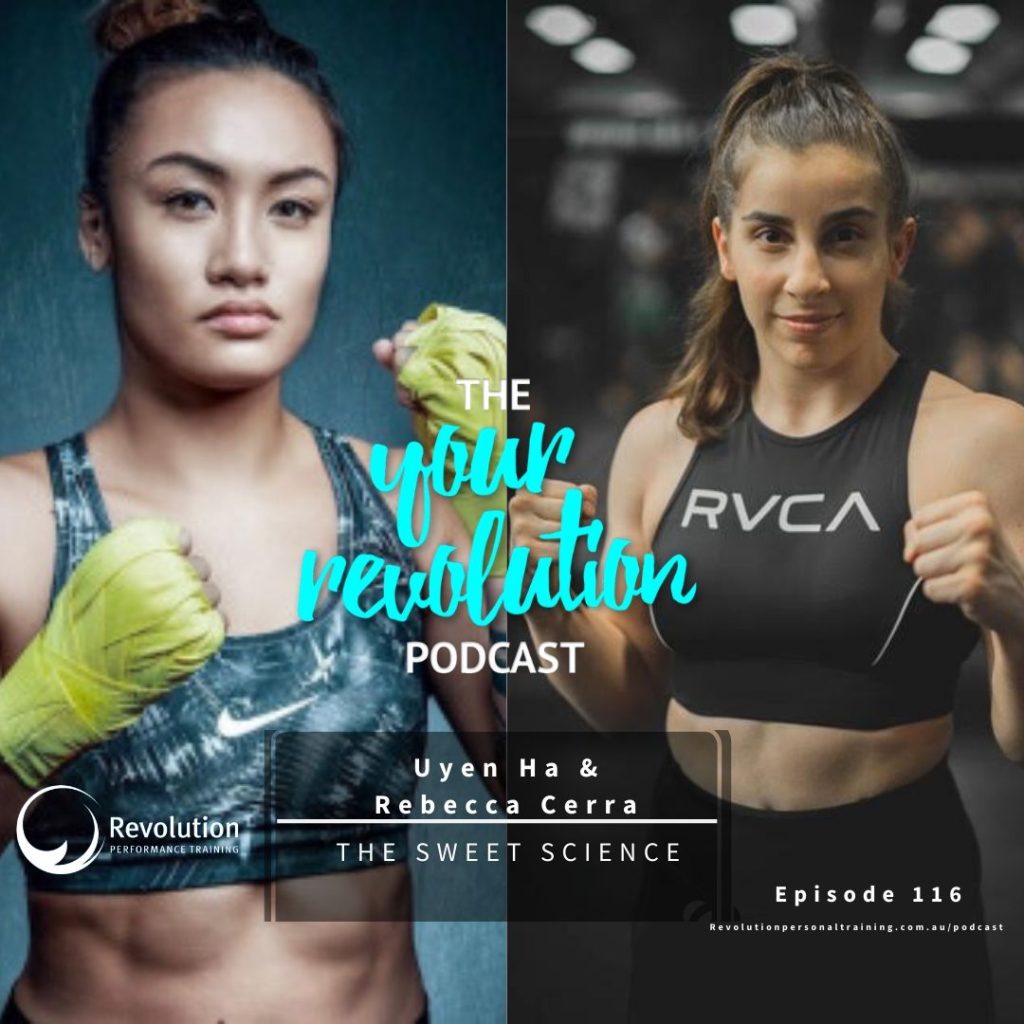
The Your Revolution Podcast @revopt is back with Episode 116! With Greg Kourpanidis as your host, join him on this special episode where he speaks with current Mixed Martial artists and coaches from Tribute Boxing Uyen Ha and Rebecca Cerra.
Uyen is a Professional Mixed Martial Arts fighter signed to One Championship’s One Warrior Series, a Sponsored fighter at Tiger Muay Thai In Thailand, a former wrestler for The Australian National Wrestling team. She has a record of 2-1 Pro MMA and 2-1 Pro Muay Thai record.
Rebecca is a former Muay Thai fighter who transitioned to MMA and has trained for 3 years out of Absolute MMA Melbourne with an amateur record of 3-2. Rebecca Is currently awaiting to make her professional debut. Along with her training, She Is also a performance trainer and currently coaches athletes to fight.
You do not want to miss this episode as they both sit down with Greg and discuss and talk all things from Martial arts, coaching, and females in sport and drawing from their experiences from their own personal journeys and unique backgrounds. With two guests featuring we will unravel what the sweet science is all about!
About the guest: Uyen and Bec
Coaches in combat-sport preparation and the science of getting fight-ready.
Episode transcript
Hi guys, my name is Greg Corbinidis and welcome to the Rev. T. Pogmaster, which is brought to you by Revolution Performance Training. I’m an avid trainer and fitness coach, who strives to learn the very best in the world of health and fitness. Join me in this episode and expect a game changers in their chosen fields to share in their story of passion and success. For all podcast related things, please leave a please subscribe and check us out on Revo PT/podcast. Enjoy this episode. Okay thanks for tuning into episode 116 of the All Revolution podcast.
Today we have two guests on the podcast from Trivia Tox Docklands, Melbourne, both are current trainers from the Tribute Stable and I’m super excited to welcome them both onto the podcast. So let’s welcome Tiger Moytai, one championship fighter and former Australian national team wrestler, Wen Ha and MMA fighter and trainer, Rebecca Cher out from absolute MMA. Welcome to your revolution podcast. time and it’s supposed to be like a personal trainer as well as being difficult but yes just making the adjustments as well so I’ve actually still got a lot of clients that are still wanting to train at the start I think because it was so unknown with the virus and all that they were a bit hesitant to really train bit but now things have eased down in Australia so I’ve picked up a lot of PTs also a lot of new clients wanting to train just get fit and healthy as well.
So just being doing it out in the park. Sometimes it’s difficult with the weather, leaning into winter now, but I still got clients that will come and it’s rainy. We’ve got like undercover, but no excuses for them. But yeah, you’ll find in ways. Yeah, fantastic. How are you self-wint? It’s definitely been hard, like all the gyms are closed, so we can’t get our normal training in, but we’ve been able to film a lot of workout videos at tribute boxing, so that’s been really nice. So just be able to get in and get a workout in as well.
And also I’ve been trading, have a few PTs, so it’s good. How do you find the weather adjustment again? Is it relevant to how you remember it or? Look today wasn’t a great day weather wise it’s it’s definitely an adjustment from living in Puket for five years but you know in Puket we get rainy season which you know torrential hurricane you know weather but here it’s it’s not quite the same but it’s very on and off and I forgot about that. Yeah I think four seasons in the day fantastic. Alrighty so before we dive in I thought it’d be a good opportunity for both of you I guess to give a little bit of introduction into I guess who you are and yeah I suppose you’ll guess your journey really we’ll start with you in.
Right so I started training in May when I was 16. I had never done any martial arts before that and I always wanted to watching action movies and all that jazz. So when I first started at Absolute MMA in Melbourne I fell in love with the sport and it gave me a real family. And as soon as I started training, I knew that I wanted to fight. When I was 18, right after finishing high school, I went to Thailand for three months and then trained full-time and that was one of the best times of my life. And then a year later, I moved to Thailand full-time.
I was responsible to try to at AKA Thailand and then Tiger Muay Thai. I fought professional Muay Thai and Amashia MMA and then made my pro debut at One Chanships One Warriors Series. So I’ve moved back to Melbourne now as of about three months ago and I’m a coach at tribute boxing and still signed to One Warriors Series and I mean it’s been a little bit tough training for the past few months. So. Very good. And yourself back. I started about six years ago and I was 20 years old. So a little bit later I played team sports almost my life like basketball.
It was a big part of my life. I started at five years old that. But then I picked up my first land kickboxing. So there was a new gym opening up at the time and then I just started going to classes and then my coach at the time was brought me over to a fight gym. Then I just really enjoyed the training from the kickboxing into more Muay Thai. And then yeah, just the training started ramping up and I really enjoyed it. Just the challenge of something new, especially coming from a team environment to something where it’s just like you inside of the ring or cage.
So I trained like Moi Tai for three years and then when I met my partner, actually he kind of showed me MMA and I was like I just fell in love with MMA and just all the disciplines like learning that you constantly have to be growing as a martial artist and yeah, just like the other sins Very good. So obviously both were hooked on it from a early age I suppose going back to this is child growing up. So you both sort of mentioned we both very sort of like active kids of the obviously played lots of sports What other sports did you guys play before I suppose you got into martial arts?
I played pretty much everything. Like I dabbled in everything when I was in year seven. Throughout primary school I didn’t play any sports. Just to go home and still in the couch and watch TV. In year seven when I went to high school I started trying out all the different sports but none really took my fancy. Like there were none that I was passionate about. I enjoyed soccer and lacrosse but then You know after a while mornings in the cold Melbourne weather just wasn’t worth it But then when I actually started MMA I was doing earlier mornings in colder weather.
So I guess it’s what you’re interested in the most Yeah, none of you fairbaked. – So yeah, like I mentioned, I started basketball when I was about like five years old. So I continued that tool. I was about like 20 and then I wanted to take my Muay Thai seriously. So I made the shift, but basketball was a big part of my life. I also played like mixed basketball as well. I played volleyball, netball. I did long distance running as well throughout high school. So, you know, that was my journey. But yeah, I wanted to, a new challenge.
So that’s why I made the shift across to martial arts. Yeah, none of very nice. Now, I believe both of you also have done a bit of study in that as well. Can I suppose you both share? I guess, yeah, you guys have kind of been been studying and I suppose how you’ve been able to balance it with I suppose your training and your martial arts. So I’ve been studying doing double degree in law and international relations at ANU. I started in 2015. So, but in 2016 or so I moved to Thailand. So I’ve been doing it part-time since then, thanks to the athlete program, which means that they give me concessions and help me out with my study.
But now, since I’ve been back in Melbourne, I’m starting full-time again and, yeah, I have a couple more years to go. – As that transition going from, I suppose, full-time, part-time study must be quite difficult. – It’s not so bad. I’ve only picked up one extra subject, so it’s not full full-time. – Okay. Fair enough. And yourself, Beck? – Yeah, so I studied a Bachelor of Business majoring in Human Resources and Management and also did Miners in Psychology. So yeah, I I did that full time and then I was still working casually, still training as well.
So it’s when you have that passion in time for it. So whether it’s waking up early in the morning or feeding that session in the evening, always make time for it. But yeah, I found that was really good to help set up. Then I went into my personal training, so kind of having that business and then bringing that across that knowledge, helping me with my personal training. – Oh, so you feel like you’ve taken those skills pretty well and stressed, been a quite a good transition? – Yeah, especially from business wise, but also learning psychology as well.
‘Cause mindset is a big part of being an athlete as well, but a coach helping clients through that. Yeah, no, fantastic. Now can you both talk about some of your, I guess your early influences through martial arts? I’ll start with you back. Switch it up. Yeah, so my influences in terms of MMA, I really love Kabib style. I mean you just the fundamentals, you know the basics. People like okay we’re going to do this but they’re still unable to stop him but I just like his hard work ethic as well. And I think it’s just yeah keep on finding the skills that you have and keep building it up.
So yeah I I just like I also, Holly home as well, being a striker. And you know, how she came from that striking background into MMA. So, yeah. Yeah. Real models. Nice. And your self-win? I like to say that my biggest influences would be Mike Tyson and Jessica Andraj. I really like that they’re short of fighters like myself. So they really have to get in the pocket with a lot of aggression, a lot of power and a lot of like slip and movement. So I love that style, you know, just getting in there. You must be pretty excited.
Uh, Mike Tyson making a potential comeback. Yeah, crazy. I sell into it. Yeah. No, I saw you guys, I mean, I’m sure it was you back who’s been working on the the slip combo. Yeah, pretty slick. Yes, I love Mike Tyson for one of my boxing influences. I train a lot of his style and I can try and cooperate that into MMA as well. But yeah, I love using like the pikaboos, like,oboos, the different combos from that. So yeah, it’s been great to learn from you, Mia. – Nice, they throw good. Now, I suppose, I suppose getting a little bit of insight for those who don’t know, I suppose what, I suppose, mixed martial arts is.
I guess you can go kind of explain, I suppose the discipline of it and how it sort of differs to, you know, boxing, wrestling, kickboxing. Yeah, I guess in your own words, starting viewing. I think martial arts, mixed martial arts is basically what it sounds like, a mix of all the disciplines put together. And back in the day, let’s say 20 years ago, it was literally people from different martial arts backgrounds being put together and to see which martial art was the best. But now MMA has become its own style. So it’s really its own sport now.
Yeah. Self-back? Yeah. So basically what Wing was saying, you know, especially at the start when the UFC kind of started, it was kind of introduced to all of the Jiu Jitsu, like the Gracie’s and all that. But I think now it’s important to be kind of like a well-rounded fighter and to have, you know, a good solid understanding of all martial arts, you can bring it together. But again, it’s from like, you know, your boxing and Muay Thai, because those type of stances you can’t necessarily mean to your MMA That’s where you know when you come up against a boxer or like a moi tie fighter, it’s very upright and to take it down and easier so I’ve got seen, you know, those striking styles and then if you’re wanting to MMA Continue with the grappling and and take down the training.
Yeah, no, no, absolutely. Now in terms, I guess the training demands of mixed martial arts, how would you both describe as the training, whether it was your own style, I guess what it involves and why I guess it’s so rigorous is some people like to put it starting for you win when it’s very expensive, like Beck said, you have to learn all the different disciplines to be a well rounded fighter. So at most teams, they will have a Jiu Jitsu class and Muay Thai class, a boxing class. And you really have to go to all of them to get the fundamentals of each and then bring it bring it together to make your own style.
So you can’t just go to MMA class and that’s your style. You have to learn every discipline as well, which makes it a lot harder. And it also means, especially with your time management, if you have a full-time job, if you’re studying, you have to choose which one’s the most important for me to learn right now. – In terms of like, I suppose the strength conditioning, how do you incorporate that sort of stuff within that too? Because it’s obviously– – Yeah, well, there are a lot of strength conditioning coaches that are well-knowledge in MMA now, so they’re getting on the scene and helping us out.
– Okay, and self-baked. – Yeah, it’s definitely hard to kind of fit it all in, but you just have to work out that balance of getting your sparring in, whether it’s like MMA sparring and then striking your grappling as well, Jiu Jitsu. And also your strength training. So I guess it’s like looking at your schedule to see where you can put certain things like form myself. When I’m doing like my strength, ’cause I might be like working on my power. So lifting heavy, I kind of don’t put on the days out. I’m going to spark.
But as I feel like my energy is all gone. So it’s understanding how you perform well and how to rest during your training sessions. That’s actually a good segue into my next question. It’s kind of going in more in terms of the structure is, I how do you balance the light? What would a typical reach for both of you in the quiet from a train perspective? Maybe it’s a little bit different at the moment, obviously granted what’s going on now. But in terms of like, let’s say like, how would a week look different? So as we prepare for a fight, let’s say not prepare for a fight, like how would it look in terms of balance training sessions?
Yeah, so basically my training or when things are normal my training stays pretty consistent and then if I’ve got to fight the stays consistent until the last week basically just so you don’t get injured but yeah I want to my aim is you know sparring so I probably get like two MMA sparring sessions in one striking like a Muay Thai sparring and then also just grappling jujitsu and like I said I try maybe put my like sprints or if I’m doing cardio and all that on a day kind of like with my sparring and then I’ll just make sure I split it up as well.
So I’ve got time to recover. That way I’m still able to perform as well. But it’s also hard being a PT. You have to find that balance. You know, you’ve got clients wanting to book in it at certain times. – Or try them when you want to try them. Yeah. – Yeah, you have to work around that. Especially it’s been a big adjustment ’cause I was always used to waking up early, like training in the morning. So for myself, I’ve actually performed better in the mornings, but now being a PT, I’ve kind of had to adjust that. So yes, and now like my spine’s at night and it’s been like a big change, but the other part of the challenge and yeah.
– No, no fair enough. I feel it sounds like you’re managing it pretty well. We have it yourself For me my training is pretty different during flight camp and off-fight camp So during flight camp it’s a lot of fight specific stuff and you know Only the things that we will be using during the fight. We’re not learning anything new unless it’s specific to the opponent So to be a lot of pad sessions a lot of very specific things as opposed to outside of that fight camp. I can tape it down a little bit, have a little bit of fun, do stuff that I wouldn’t do and work on slowly like in my own time the things that I did wrong in the last fight or whatever, like I might do more no gear, I might do gee jiu jitsu and which I’t do, and I wouldn’t do ghee during fight camp.
So it depends, you know, it kind of eases up and I get to experiment a little bit more outside of fight camp. But even then during training, it’s very structured, especially at Tiger Muay Thai. We have such a big professional team. There’s 4pm training, pro training every week day, so Monday and Friday is firing Tuesday, Thursday is wrestling and Wednesday is technique and then you can fit in what you want in the morning usually boxing or no-ghee and then add your strength and conditioning in that. So that’s usually the same and then in Fight Camp we also have Fight specific strengthings sessions.
Okay, so it’s pretty regimented as it is and obviously if there is like I suppose a fight or something coming up things can slightly change but it’s pretty structured from there on really. Yeah, okay. And for you both sort of I guess preparing for a fight I mean look I must say it probably would be hard in some sense one obviously at times maybe even get fights with people and still stop like actually, but is there a specific sort of like time period you sort of like to give yourself like we’re in the eight weeks, 12 weeks or yeah, does that matter?
You’re starting if you win. – I usually start at least with a four week fight camp. That’s like the minimum if I’ve booked a fight quickly. Four to eight weeks would be good. I think six weeks is an optimum at a time. – And your soft bet? – Yeah, probably that six to eight weeks is optimal would be great. But especially if I know there’s a fight coming up, kind of like a state kind of have that in my mind so just in case you do get a short notice and you’re always that very weak and your body’s ready and it’s enough time since your last fight as well so sometimes I’m going to it that way so as long as I’ve faced it out since my last fight to now yeah yeah, that’s another way I look at anything.
And I think like it’s probably the same for Beck, but you know, we’re always training hard anyway. So even if a flight opportunity were to come up, you know, we’ve been training all year, it doesn’t really matter. Obviously we get in that camp, we up it a little bit more, maybe a little bit more cardio, but for the most part, like, you know, we’re good to go. It’s not like we’re going from, you know, sitting on the couch every single day to, oh, no, I’ve booked a fight now. I have to train super hard and lose 20 kilos.
Yeah. I think that’s a mistake that a lot of that some fighters make or something will make. I suppose they’re not supposed to stay in shape the whole year round. Yeah. Yeah. Definitely. , well that kind of goes into another, I guess that’ll be part of my question. So I suppose if I mix martial arts unique in the sense you have weight classes, which obviously in terms of the, I suppose the science of all with weight cutting, do, as those can you both sort of explain your own or talk about your own sort of experiences, whether do you both do like, think sort of white cuts or how you’re supposed to, yeah, what’s your strategies really?
I’ll start with you back. – Yeah, so at the moment I’ve been fighting on a cremation part of Hexa amateur one. So it’s been waiting in the morning of the fight and then you’re fighting the evening. So knowing that you can’t do a big wake cut otherwise you know your body will really feel it by the time it’s the evening so I probably you know try to walk around at like 65 and then leading up you know each week to the fight as well and a taper off for a bit terms of calories. And then maybe that last week I might only have like two kilos, two and a half to go.
And then that’s quite easy to lose. And then I’m still, well, especially the first fight, you know, it’s kind of the first time. So you don’t want to do a big weight cut. And then you want to also make sure you’re able to perform at that weight as well, comfortably when you fight. So you’re taking from my first fight, what I’ve learned, and then just feeling good about that and then doing the other fights. So it sounds like you don’t do too much weight cutting as it is. Like you pretty much stay pretty close to your natural weight.
Yeah. Okay, very good. And you’re self-laying. So previously I did a normal weight cut with wrestling and amateur fights, which was day before way in. And yeah, just hit the sauna. I try to, I try to diet as much as possible and just kind of shred it all off before. So I don’t have to be in the sauna or the bathtub a long time because I’m not about that but thankfully in one championship weight weight cutting is banned so we have two hydration tests basically if I fight on a Friday I’ll weigh in the first time on Wednesday it’ll be a normal get on the scales and a hydration test to see if we’re dehydrated not and it’ll be exactly the same the next day so basically you have to come in around your walking weight which is perfect for me I usually when I start camp I’m a little bit heavier but it all kind of comes down really easily once I start eating cleaner and then you know I have dinner I’ll have lunch on the day before way and the day of way and then I’ll just walk with you.
Exactly. No that’s good. Now do you think in terms of the direction of a white cut like would you much rather see that sort of more on your natural weight and so I was doing those sort of big white cuts? 100% weight cutting and dehydrating yourself is so unhealthy. There are so many athletes that have had to go to hospital or have had liver problems I think it is or not really sure. But it’s so bad and the only reason you do it is to get a physical advantage over the other guy because you know that your opponent is also cutting weight.
So if you take off that, you know, you take off the ability to to dehydrate yourself. You know that your opponent isn’t going to come 10 kilos heavier than you. So you’re not going to do it as well. It’s just a more sensible and safe way to do it. Hmm. No, very good. Now I suppose both but if you’re not supposed to, you have to immediately start MMA, was it kind of, was it what you expected? Or was there anything else that surprised you or, yeah, starting feedback? – It was just a big difference, probably just the size of the gloves and then getting used to the MMA sparring, for example, especially when you come in like Muay Thai.
So you’re still like wearing the 16 ounce bigger gloves as well. So when you block, but then going into MMA sparring, you know, you wear your seven ounce gloves and there’s much more room to like that shot through. So yeah, that’s probably the big difference. But yeah, I knew it was quite challenging. You know, just you know at the start learning different martial arts and yours quite a challenge, but yeah, that was probably the only makeup call. Yeah. Okay, and yourself, like for me when I started MMA, I actually had no idea what it was.
I didn’t know what the UFC was. I kind of just I literally googled martial arts Melbourne and absolute came up. I had no idea what MMA was. I didn’t know what the UFC was. I kind of just, I literally googled martial arts Melbourne and absolute came up. I had no idea what MMA was. Not for like another six months, honestly. It’s a bit embarrassing, but I was 16, so whatever. So when I went into the gym, like I had no idea what I was doing and I didn’t really have any expectations. I was more working on my confidence because it was a scary place.
It’s not scary in a normal sense, but it was just like a lot of boys. And for a 16 year old girl that started, it’s kind of scary. Well, I suppose actually that’s actually again, I was going to get into that with my later questions. My last question now is I suppose being exposed, you know, two girls was like training in, I guess a sport, which is maybe most years, maybe the male sort of like dominated or did you find that quite sort of intimidating early on or not really because I’ve got two older brothers so I was so used to like playing sports with them all the time and their friends as well so like footy basketball but when I first started it probably wasn’t as many women in martial arts so you know you always to like, you know, a guy, like sometimes I’m not like, we’re not afraid, we’ll go up, we want to spar, but then they’ll be like, oh, I don’t want to hurt you.
But, and then you end up hurting them. Then they’re like, okay, you can fight. But yeah, I guess just having your coaches as well that I say, believe you, they trust you and put you in no sparring and all that, so they believe in your skills. But I think it’s been great now seeing a lot of women come through martial arts. So it’s more, yeah, for us to spar. And I think men now as well can kind of appreciate our skill sets and can learn from us as well. So yeah, absolutely. When can I anything into that? Yeah, well, as I said, when I walked into the gym, I was pretty scared, but I had a really supportive coach.
He was very, you know, he looked out for me. And after my very first session, he actually told me to talk to one of the girls. Her name is April and she had been trained Jiu Jitsu for one year and you know, my coach just wanted to for me to have a chat with her and just see what it’s like being a female in an MMA gym and you know during the session I really wasn’t sure if I was going to come back, but April really talked me into it. You know, she was like, it’s great. I’ve done this. I’ve done that. I’m having so much fun.
And I was like, oh, you know, sounds pretty cool then. So I’m really glad that I was able to have great female influences in the MMA gym, even though there weren’t that many, there weren’t that many females in the gym, the females that were there were very strong and very intellectual. Yeah, no, great. Now, I was so slightly fast-wing from that. Can you both, I suppose both share, I guess, your, what do you remember from like your first fight that you ever had and the, I suppose the experience that you both took away from it.
We’ll that, you know, and then that just motivated me more. And then I went on to the second five, and you continued on. So I guess it’s not letting kind of like the obstacles or challenges bring you down and just having your head up and forward and learning from those experiences. Yeah, so seeing you straight away, you wanted to get right back in there, even though I was lost here. No. Yeah. So, yeah. I would have ate it. ” Like I’ve been training for two years of my life and I love every moment of it, but what if it’s not for me?
So when I finally did have my first fight, that was a multi-fight in Thailand in 2014. I won TKO in the second round and I had so much fun and I was like, “Yeah where I’ve alung this is so me and I love this so it really reinforced all of my doubts you know that I’ve been training for so long without any fights and I was like yeah this is what I love doing so that’s what it gave me. Okay no nice and what advice I suppose would you give to someone that wants to pursue martial arts? I will start with you. keep coming back, you’ll see the improvement.
I was never a talented athlete or like, you know, naturally talented, but I just worked through everything and I just stuck to the gym. So, you know, I kept coming every day and I’m not the best now, but I’ve come a long way. So don’t give up. Just keep coming back, even if it’s weird. Yeah, fair enough. And yourself back? Yes, so it’s going to be consistent with your training. You’re going to have good days, bad days as well. But martial arts is always just about learning and just keep that open mind as well. Even now, I’m still learning new techniques, new skills.
So it’s only where you constantly constantly have to keep growing. Yeah, 100%. Now slightly switching gears. So you’re both said, I touched on the start episode, you’re both out of our troopy boxing. Suppose can you both talk about how that sort of opportunity came to, came to be? I’ll start with you. Then I remember actually went into the interview a week from like out of a fight as well Yeah, and I got the job opportunity and yes, I’ve been there since September last year And yeah, I love it there I get to share my passion Train a lot of people as well to fight we do a fight night there So the end of last year was the first fight night I was involved in I was lucky to be be able to coach your team.
So we had like 17 fighters. So I coached your team on side another coach. And it was great seeing, you know, some of them start their 10 week camp with no firing experience whatsoever. And then they get the fight in the ring. So it was great being a coach as well on the other end and seeing their journey. Yeah. I actually was at that event. So I know exactly when you’re talking about it. Would you sort of recommend that’s probably a good experience for someone who really wanted to suppose, you know, put a foot in the water and I guess see what it’s all about?
Yeah, definitely. So we do match ups that like all of us coaches will get together. You know, we’ll say we’ve got this match up at this way. We do it so it’s fair. We’re not going to have one person. Okay, they’re clearly going to win. We want them to enjoy the experience as well. But it’s great. You know, you get that team building with everybody as well. So, you know, we put a lot of time with the team and help build their confidence up. And by the end of, they’ve loved it win-lose or draw. They’ve come out a winner.
But yeah, definitely a great experience. I’ve got new people wanting to fight and all that. So I said, this is a great stepping stone for them. Yeah, no, it’s amazing atmosphere as well. I remember I was they have that whole crowd overall crowd experience too. So no, that’s great. It’s like I’ve been to MMA shows their Muite shows at the Pavilion, but this is like packed. Yeah. What about yourself, Queen? How did you find this supposed tribute boxing? So I haven’t been there very long. I moved back to Melbourne in mid-feb.
So only a few months ago I had seen people post videos of tribute before so I’d known of it a few years back and I decided you know probably try to earn some money. I haven’t been working for a while. I don’t have any job back in Thailand. So, you know, come back here and study and work and train. And yeah, I sent them a message and that was it. Went for an interview and checked out the GM, did a few trial classes and it’s been great. I mean, I only worked there for two weeks before I got shut down. So far it’s exceeded expectations.
It’s a really good vibe. I really enjoy it. All the coaches are great. So I’m looking forward to working there when it opens up again. I suppose can you both talk about the transition to I suppose biting to coaching? Has it been I suppose a difficult one or challenging or whatnot? I’ll start with you. At Absolute, we always did a lot of partner work, a lot of pad work and partner drill. So I had always known how to hold pads. In Thailand, I never held pads. So I was a bit rusty when I first started at Tribute, but the more that I’m doing it, the more confident I’m getting, the more smooth I am with it.
So it takes time and we’re getting there. From fighting to coaching, I think some people can be great fighters. That doesn’t mean that they can coach at all. And some people who aren’t great fighters can be great coaches. And I think I’m doing all right because I’m not a dickhead and I’m not too sniffy or awkward. I’m pretty personable. So it’s easy, especially as a female, it’s a lot easier to connect with other females when you’re coaching them because I know where they come from. – Yep. Okay. But yeah, you’re a lot better hitting the pads than they on the receiving end.
Sounds like it. Yeah, I’m getting used to it. I’ll be good in like two months. Yeah, no, that’s awesome. How about yourself, Bec? So yeah, I kind of quite easy. I always did a lot of pad work helping train my partner as well. So he’s a pro MMA fighter. So that got me sharp on the pads. And then also just working alongside other creatures that tribute has been good. So how they cope. But then also being able to bring my fighting experience from MMA, what it’s like to be on the receiving end of a punch. So it’s good kind of experience.
And then you can help the fighters with their journey. Yeah, absolutely. And And that’s with how, I suppose you both have sort of a, how it’s supposed to describe as your training style or like coaching style. Like would you say they’re quite similar or they’re quite different? We’ll start the view there. – I’ll say they’re quite different. So like my fighting style, I suppose it always depends on the opponent and then kind of how you assess and like, you know, what openings are there. But I would say my style is quite aggressive.
I do like to come forward a lot. I like striking coming from that striking background. And also when I work with, you know, fighters, I want to see kind of their strengths and how I can bring that up more and work with their style rather than just change them to be like me. So yeah, it’s just helping them mold them into what they feel comfortable in with their style. Do you really encourage them obviously to have their own sort of style and not kind of mold them into as close? Yeah. Especially all us coaches at, you know, we have different styles, but you know, something for me could work for one person one fighter but not the other whereas they could get something from another coach but You know, it’s just yeah giving them, you know all the skills and then working with them and seeing how they feel comfortable with what techniques and skills.
Yeah, yeah, how about yourself when I think you have to take into account what kind of client you’re working with or the kind of person they are if they’re only doing it as a hobby or if they’re looking to fight or if they are a fighter. So you can obviously push them a lot harder if they have a fight coming up. And I think that would be my preferable coaching style, just kind of push them to death death. But obviously I do that if they’re just running this weight or something. And I personally, I don’t ever teach anything that doesn’t work for me.
So everything that I’ve learned from my fighting, I will bring to the table with my coaching. But I do encourage them to experiment around and see what works for them and see what kind of style they’re like. Now, I suppose from a beginner or a teaching point of view, what would you both say as opposed to the most sort of important thing or aspect when it comes to martial arts start reviewing? What do you mean, sorry? I thought like a beginner or even something at any level, what’s probably I’m sorry. wrestling wrestling.
Yeah, obviously. I mean, that’s the best base that you can have for MMA. If you’re a good wrestler, you can dictate where the sport where the fight goes, you know, if you’re against a striker, you can take him down and you have a great base for that. So against a Jiu Jitsu player, you can not get taken down. You have great defense. So for me, wrestling is number one, not biased at all. But wrestling also teaches a lot. It teaches a lot of discipline. You need to be strong and you need to have good cardio as well as technique.
So what you learn in wrestling is all very transferable to MMA. And I think a lot of fighters, especially in Australia, they do skim out on the wrestling as well as Jitsu players. So even now, you see Jitsu players who have done wrestling or who incorporate wrestling into their game, they’re a lot better than the guys who don’t. And there’s a reason for that. – Yeah, that’s a good answer, your self-vex. – Yes, you’re probably looking from a complete beginner, if I’ve got a new client starting now, for me, when I’m teaching them, it’s just to get that mind in sync with the body.
Yeah. It’s the most, you know, um, and making them more conscious about, you know, the technique that involves, um, so then, you know, they can pick up on, okay, I need this. I need to change this. I need to move my foot and all that. So that’s probably one of the housing’s teaching a beginner, just everything in sync and in moving. And then, yeah, you can just add that onto the other disciplines as well. So I think the mind and body in martial arts. Yeah, not very good. In terms of, I guess, for yourself, for both of you, actually, what sort of one thing I suppose you wish that you sort of had the loan or I suppose you started mixed martial arts?
I’ll start with your back. I guess for me, I just kind of wish I started earlier, younger, to be honest. I kind of watched before I went into martial arts and you also I kind of knew and face value what it all was, you know? And then I knew I guess being older as well like starting at 20 years old I was kind of up for the new challenge and you know I’ll do whatever it takes I’ll put in this amount of time and my training to get it done because this is my new goal now so Ment mentally I was driven and like motivated.
Yeah, I just wish I started earlier. Okay, fair enough and yourself win. This is a hard question because I’m not really sure I’ve taken all the steps that I’ve wanted to take and had to take during my career. And I started pretty early in your passing to others, but you know, you wouldn’t hurt to start a little bit earlier, although the fear with that is, you know, if you start something too early, then, you know, you might drop it off later. Or so I know my mum forced me to do piano lessons and I absolutely hated it.
So, you know, not quite the same, but, you know. – Yeah. – Okay, no, no, that’s fair enough. Now, I suppose a little bit of a curveball question, I’m going to start with you in. If you could step into my shoes, so let’s say you were the podcast host, what would you have asked yourself that I haven’t asked you already? And you have to answer it, of course. Put me on the spot. Yeah, that’s the. Um, does Beck want to go first? Oh, she’s got an answer. She can go first. Yeah, I’ll go first. Um, probably if I were to ask probably just any athlete in general, like, um, in terms of their mindset and their motivation, happy day always, and I keep that going.
That’s for my question. For myself, I just constantly remind myself of the goal, what I want to achieve. You know, you have ups and downs in training, but you just have to keep on reminding yourself, okay, I have this goal, I’m doing it for this reason. As long as I put in the work, you know some days I know I’ve done the work but as long as I put in the work I know that will help me achieve my end goal and I guess when you want something so bad you know you just have that motivation and that mindset just to keep pushing through and participating.
So that’s what I like learning from other athletes as well, just more about their mindset, what helps motivate them in their dreams. Yeah, that’s a great answer. All right, we in last. Well, I’ve got my question. I would ask how to handle loss. So I got knocked out in my last fight. And as expected, it’s not fun. It’s not great. But for people who go through losses and who go through a loss that’s being live stream around the world, it’s kind of embarrassing. It’s humiliating, especially if it’s your first you know, the way I see it is everybody loses at some stage in their career or in their life.
And you just have to bounce back up, right? No one cares the next day. Like, I think you’d rather someone who lost and but puts all, you know, all of their effort into that fight. And then comes back and the next fight as a different animal as opposed to someone who has a winning streak loses and you never see him again or someone who just plays a safe victory all the time. So for me, it’s more about performance and you know, sometimes you’re on the bad end of it. Sometimes you’re on the better end. That’s just life.
That’s how it is. Mm hmm. No, both very good answers. Uh, now I was going at present with so much unknown and uncertainty. So how many kind of goes in some of these questions in a way? How are you both sort of managed to stay motivated? And do you suppose have anything lined up or any sort of upcoming plans? I’ll start with you, Beck. and then Glee when all this is over and then fight start, all promotions start saying, you know, they’ve got dates and then I’ll be ready for the lucky move go. But it’s been like, I’m making the most of this time and kind of build up my PT business as well.
So that’s given me a good opportunity to spend a bit more time doing that. – Folks in some other areas, yeah, no, very good. How are you self-wins? – Yeah, I’m doing what I can. I’m trying to get into tribute as much as I can and get some working and also hitting pads with the coaches. And in terms of fighting, it’s a little bit tricky because we don’t know how it’s all going to go. I actually talked to my manager last night, so looking at fighting in a promotion in Korea and the Korean organizations all backed up and running their no restrictions in Korea, which I found very, you know, a little bit concerning but interesting as news to me.
So they’re actually holding a event end of this month. I said, look, I’m very interested. I just am physically not allowed to leave the country. So basically once the restrictions ease down and I can get out of Australia, then I’ll be ready to go. There you go. No, awesome. And I suppose, look, obviously, maybe in terms of the current situation, again, the circumstances, but for both of you, what I suppose is the secret or how do you both maintain a good sort of work-life balance or, you know, not even that, I’ve been able to say, yeah, it’s managing sort of social life, your training, actually your work, like painting, how do you also put it all together, start with you, Beck?
Yes, so for me, just having a structure and and schedule I find even during this time, you know, it’s important for myself. So that’s what we’re going to do is at the moment we’re launching a to be connected online, you know, tribute. I’m still being able to put in some work hours there and then have set hours for my PTs. And also make myself as well to become my own goal. So it’s just this having that schedule in place. No, great. You’re so fun. Yeah, I’ve always been good at balancing things out with a lot of things going on in my life.
So it’s no different now. I’ve got a schedule that I keep just keeping to it giving enough time to each each different thing. Now before we do like to call the Revo PT signature questions which we’ll get onto at a moment but where I suppose can our listeners find you both a shoon you both have like social media or a website where yeah know where can people reach out to you. We’ll start with when. com. Like and subscribe. Brilliant. And back. I’ve got my Instagram you can find me on there. This is my full name, Rebecca and then my same name is Ewwrai, one word.
So I try to produce a lot of content workouts on there and then also trying to build up my YouTube as well, which is my name, Rebecca on YouTube. So yeah, check me out. – Brilliant. Okay, so we’re going to do the scene to questions. So I’ve heard you do the signature question. So for each of our 20 questions, this can involve really short, sharp, sort of quick responses. We’ll go, we’ll go a few back first for all. And then when you can follow it, essentially, it’s rapid fire. Are we ready to go? We’re ready. Okay.
Boxing or kickboxing? Kickboxing? Boxing. Speed bag or heavy bag? Heavy bag? Heavy bag? Heavy bag? Hill sprints or sled push? Sled push? Hill sprints. Row of ski? Row. – Ali or Tyson? – Tyson. – Tyson. – Joshua or Fury? – Fury? Joshua? – Double leg or single leg? – Double leg? Double leg all day? – Drive will navigate Drive. Drive. Favorite cheat meal. Pancakes. KSC. Sonra. Sonra. What’s up? Most annoying habits. Alright. Pass. Yeah. Right. Well actually now we’re changing the world. Let’s go to the wind and mix it up.
Okay. What’s the best Wi-Fi name you’ve seen? Oh, I don’t know. Wi-Fi name. I think I love to pass. I didn’t really pay attention to them. Yeah. You just want the wires to get on there. All right. Yeah, that’s a nice one word to describe you. Small. Kind. Three things that you can’t live without. – Dog fighting bed. Family, friends fighting. – Beautiful. – That’s nice. – Go back to the three. What are three things that you would take to a desert island? – A book. Maybe, oh, jeez. My dog and a dooner. ” – Nice. Two books that everyone should read.
– “Mindset by Carol Zwick and Outliers, Malcolm Glower. – Nice. – Andapples belong on pizza? – No, hell no. Yes. We’re fighting. And I’m Italian too. Yeah, I actually know that’s really simple. Yeah. All right. What do you say, Greg? I used to say yes. But now, now you’re off it. Wow, that’s interesting. Okay.. So yeah, I was on the fence for a little bit and yeah, not anymore. This is why I didn’t know any better. So this is obviously when you’re talking. – Now I’m eating Italian, actually Italian pizza. So yeah. All right, last question.
Okay, if you had two superpowers, what would they be? Speed and flight. Nice. Let’s say, um, strength and invisible. Nice. I like it. All righty. Well, thanks for, uh, obviously joining me. Uh, I’ll leave you with, if you guess with the final word, we’ll start with you, Wayne. – Thanks so much for having us. It was really good to talk to you and share our experiences and stories. – Very good. And back. – And yeah, thanks for having us. I really appreciate talking to you and then the rest of your viewers as well, sharing a little bit about myself with them.
So yeah, it’s been a really great experience Awesome. Awesome. Now I should probably all mention because obviously both said where they can find you but where can they find tribute boxing when it’s all up and running? Yeah, so we’ve got two locations So we’ve got our dock lens one and then also ab. And then we’ll also launch in Tribute Connect, which is our online platform. So you’ll get basically a lot of classes, technique as well. You get to know a bit of the trainers as well. So everything from your strength to fundamentals in boxing will share on there in classes.
So at the moment, the Tribute Connect will be launching very soon and then Land’s Reflections Ease. Make sure you come visit us down at Tribute. – Oh, no, awesome. All right, so I’ll set what this is. Let’s set this our latest episode of episode 116 with Rebecca, Chera and Winhar. Thanks for both of you for joining me and yeah, we’ll stay tuned for next week. Like all episodes, I hope you are leading with some great things that can help you in your life and journey through health and fitness. Get after it and as always, train with purpose.
Listen & subscribe
Browse all Your Revolution Podcast episodes, or listen on .
Train with RevoPT
Inspired by this episode? Explore personal training at our South Melbourne studio.
Listen & subscribe
Catch every episode of the Your Revolution podcast on your favourite platform.
Listen on Spotify More ways to listen