The Your Revolution Podcast returns with Episode 106
With Greg Kourpanidis as your host, join him as he sits down with Revo PT’s very own Marina Martic.

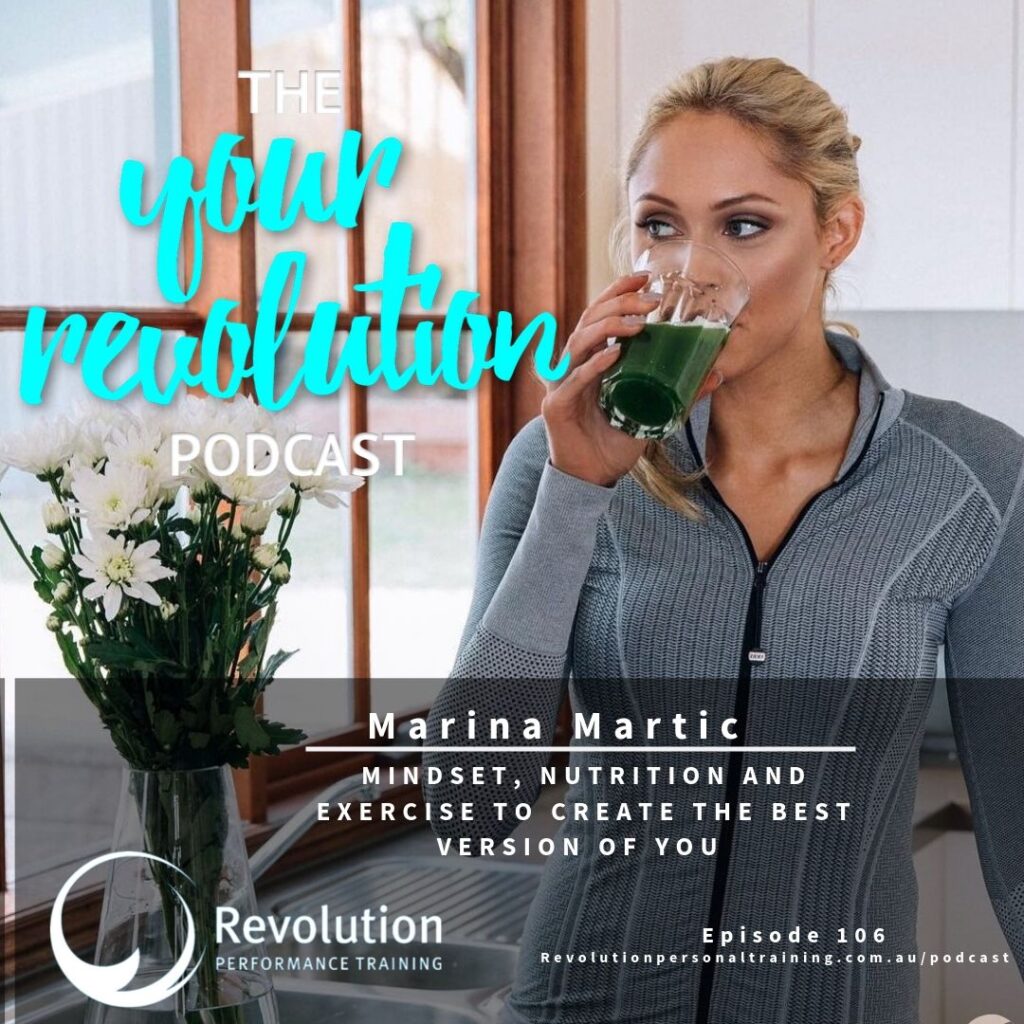
Marina is an integral part of the team here at RevoPT and is a highly experienced and skilled Clinical nutritionist, Personal trainer, Health coach, and speaker. She has a holistic approach to health and is able to assist all her clients to reach their true potential and take back control of their health.
She is known for her motivational coaching ability and is a firm believer in all elements of health including nutrition, mindset, and exercise. You do not want to miss this episode!
Tune in to one of the most insightful episodes of the podcast yet as Marina tackles some of the biggest health trends within the fitness industry, separating FACT from FAD and her no BS approach to create the best version of you!
About the guest: Marina Martic
Coach helping people build the best version of themselves through mindset, nutrition and exercise.
Episode transcript
Hello and welcome to the Your Revolution podcast. The Your Revolution podcast is a collaboration between Revolution, Personal and Performance Training in Melbourne and the Meeper Project. The purpose of the Your Revolution podcast is to inspire you on your mission of betterment. Each week on the podcast you’ll meet game changes who have created extraordinary lives and you’ll listen to stories and lessons to empower you to make the changes necessary to your life.
The Your Revolution podcast is committed to fitness, health, nutrition, mindset, community, education, empowerment and betterment and we hope that you can take what you learn here and apply it to your very own revolution. (upbeat music) Thank you for having me on. I’m excited to be here. Awesome. Well, I say we’re excited to talk about health and fitness.
So you’re ready to get into it. Let’s do it. Nutrition. Yes, that’s it. So we have a whole bunch of questions lined up for you. And I guess a lot of it is to get your expertise. It’s particularly on a lot of topics which I suppose, I guess, way out of my sort of scope. And yeah, I’m sure all the members are going to really enjoy it. Enjoy it. Yeah.
Absolutely. Absolutely. Yeah. I guess before we start is I guess maybe if you give us a little bit of an intro into your self and background. Yeah, a bit of background. I guess you got into the industry and yeah, more broadly into your nutrition. Yeah, excellent. So I guess my kind of journey started when I was young. So I’ve been really interested in health, well-being and nutrition from a really young age.
And I think my story kind of journey started when I was young so I’ve been really interested in health while being a nutrition from a really young age. And I think my story kind of begins with my mum being quite overweight growing up. So I guess I kind of always had that, a little bit more of that empathetic approach to that loss weight loss nutrition overall.
So for me, I remember being a kid and us walking down the street next time mum and I was, you know, I remember saying to, you know, looking across the street and there was this lady who was really obese. Often people will be very quick to say a couple of negative things about that person across the road. But straight away I was like, “Mom, I really want to help her.
I feel like I could help people like that as I got older. ” So I had that real connection to really help people’s quality of life. I really wanted to do that and be a bit of a coach. So that’s kind of where the love of health and wellness kind of began I guess you could say. And it wasn’t until I got to about, you were living in 12 when I kind of really decided, okay, what do I want to do with my life?
Where do I want to head into? And I’ve been training a lot. I do martial arts from a really young age. I was always interested in the health and wellness space. And then I decided to do a nutrition degree. So I did a university degree of nutrition sciences. I integrated psychology into my studies as well. Obviously for that health coaching side of things.
And I was always a firm believer that the mind plays a pivotal role in the achievement of of our health goals and just standing those health goals. So I really wanted to be able to go you know that one step further as a practitioner as well to be able to provide that really solid coaching side of things as well. With that said as well I’m also a personal trainer so I’m very interested in that kind of full holistic approach.
– Yeah, fantastic. – So, you know, you know, firsthand as well, being a fitness trainer, how interrelated the two are. I guess as well, I can probably touch on a couple of my own little health journeys. – Yeah, sure. – So for me, you know, I probably had a little bit, nothing major, but a few hiccups along the road when it comes to health. So health so you know looking at hormones and stress and kind of probably neglecting myself in a couple of key areas you know along that kind of big study load and you know working a lot and studying etc.
So I guess the biggest thing for me was if your foundation isn’t solid in terms of house nutrition movement and the body can become really affected from stress, even if it’s perceived or not perceived. So whether it’s stress from you or whatever it is. So for me, I had some fuzzy hormones and at that stage as well, it was really interesting because I was training better than I ever had.
I was eating amazing, I thought. Which even to this day, looking back, I was. What I wasn’t addressing was that kind of stress in mind for this approach that I really holistic side. – Yeah, absolutely. – And I guess before we wrap that little intro up about me, another thing that really got me interested in the clinical nutrition side of things is that individual approach to nutrition, which I’m sure we’ll chat a little bit more about later.
But for me personally, I do have that kind of autoimmune component, which for a long time I’ve suspected that it’s only been in recent times that I’ve realized that I actually do have it. So for those who don’t know much about autoimmune, it’s a bit of a dysregulation with the immune system. So the body can sometimes start to attack itself, whether it’s rheumatoid arthritis, celiac disease, et cetera.
So I actually started getting signs of alopecia ariata. So that’s a bit of hair loss. So it comes out in patches and often it is related to stress. But with that said as well, for myself, I was really lucky to be able to heal my body a bit and really focus on nutrition and lifestyle overall, which has really helped get my hair back on track, my health back on track as well.
So it’s just amazing how important nutrition is. No, absolutely. No, great, great intro, great response as well. Would you say also that’s made you quite empathetic as well? Empathetic? Yeah. Absolutely. I think sometimes things happen to us to enable us to be better at what we do, So to a certain point when it comes to health conditions or they’ve tried to lose weight for years, et cetera.
It can become a very emotional topic. So when sitting down with someone, I do feel like that I am quite an empath and I think as a practitioner, that’s been a really strong point for me because I get what people, how they’re feeling, what’s going on with them and people just wanna be felt and listened to and understood when they’re coming to you for their different health reasons.
So yeah, absolutely. No, not sure. Now, I guess, I’ve got one question you’ve probably get asked a lot, I suppose, is what a clinical nutritionist is. You’ve got dieticians, you’ve got nutritionists. I guess like in your own words, how would you describe what a clinical nutritionist does? Yeah, a really great question. And it’s when I get asked. – Yeah, I’ll show you what, yeah.
– Yeah, so basically, the overarching principles of over dietitian clinical nutritionist, and just, and nutritionist, it’s all based on the prevention of oral health and focusing on nutrition and a food first approach to maintain and achieve good health. With said, though, obviously there’s different modes of study that’s involved. And I guess to me, a clinical nutritionist, if I was to, you know, describe it in my own words, is that holistic approach to health?
It’s also that approach to health where you take a very individualized stance. So, you know, you’re looking at that person individually, you know, you’re seeing what they’re presenting with, you’re running health histories, you’re taking a very kind of nutritional therapeutic approach to health services, you focus on diet and those principles, many planning and consulting, they send that, but you’re also deciding whether nutritional therapy can be very beneficial as well in terms of supplementation, etc.
So dieticians do your very similar kind of approach, their motor study is a little bit different, their philosophy can be a little bit different as well following some kind of government guidelines etc. So that’s just a little bit of difference in terms of philosophy I guess. But I find yeah, clinical nutritionists and naturopaths are quite in line in terms of their kind of philosophies Would you work a line yourself closely as to like GPs and doctors as well?
Sorry, I’ve definitely worked very closely with integrated GPs Typically GPs tend to go towards dietitians as they’re covered with Medicare Yeah, so that’s probably one big difference between you know your dietitians and Cleveland nutritionists is that they are there do you have Medicare rebates for the public and they can also work in hospitals as well Okay, I’m good answer there you go.
I actually didn’t know all that so I can keep going on if there is a lot not to say that they’re overarching principle is that nutrition is the game and we’re all trying to improve everyone’s nutrition when we can. Yeah, sure. Now, I suppose you have touched us a little bit, but more broadly, can you sort of, I guess, describe if someone’s seeing the sort of the type of work you do with a patient or a client?
Absolutely, great question. So obviously, there’s a lot of different patients that I might see on clients. There can be different health conditions. It can be they may have anxiety or they simply just want to optimize their health and well-being. But typically I will see someone for an initial and I will go through a pretty thorough introduction. So I really want to know about the person in front of me what their goals are.
So you know the goal setting side of things is really important to me and also for the person in front of me so they can get clear on what they really want to achieve. With that said, going into the health histories a phenomenal tool because you’re able to you know go back to even when they’re a child and figure out what symptoms have popped up along the way, different occurrences, lifestyle habits, etc.
Which can all really formulate a really great picture for you as a practitioner to kind of support that client in front of you the best you can. So you’re using their data to lead the kind of path to their treatment plan. Yeah, not very good. It’s a very thorough… It’s very thorough as well. And then often, you know, depending whether it’s a, you know, they’re after that loss or they’re wanting to improve, you know, they’re having tolerances or allergies, et cetera, you’ll formulate that plan based on them.
So that they’ve got something that they can go with and utilize straight away, post appointment and keep working and building on that. – Like a treatment plan. – Yeah, sure. – Yeah, exactly. – Okay, fantastic. Now, so let me talk about, I suppose along the way, because even now, I guess some of the resources or influence that you’ve had, is that you, like, did you have, I suppose, like, any role models or any one, you suppose that you worked with?
– Yeah, I think a really good question. I think for me, I’ve always tried to look at the research. So it’s day really current and you know, look at the latest findings, etc. Because the one thing with nutrition and really for most modalities in the health industry, science changes all the time. So you know, you really need to be up with it and figuring out, you know, what’s going to be the most beneficial thing for you to be using with your patients or clients.
I’ve definitely surrounded myself with people in the health industry. I’ve had different colleagues and mentors that I’ve worked with, which have been a phenomenal inspiration and learning curve for me as well. So it’s about really getting into in there and kind of, you know, raising the different health professionals so that you can kind of build that network to support each other, learn from each other, but also challenge each other.
Because not all practitioners will have the same philosophies. And that’s completely fine. So long as the health of the person in front of them is put first, but absolutely there’s a lot of nutritionists that I know or naturopaths or dieticians that do have some different philosophies and that’s okay as well. So long as they’re doing those good outcomes for their patients.
– Yeah, absolutely. It all comes down to the client and the patient. – Yeah, and I think in terms of resources as well, continuing study, good e-learning courses, I’ve done a lot of courses online, I’ve gone to a lot of seminars, and I just try and challenge myself and learn as much as I can. I’m like as fun, I love learning. I’m always open to being challenged and learning new things.
So for me, it’s about just making sure that I continue that kind process. Yeah but I think my biggest mentors and resources have been with people I’ve worked with. No great answer I’d like to relate to that being a my therapist as well like initially when I started I actually worked with multiple sort of like clinicians and professionals probably at the time I didn’t appreciate it but I started to realise it’s actually quite a good setting when you’ve got so many people you can go to.
Yeah, I would have really learned from different minorities as well. I mean, and I think in the same way we’re working, integrative clinics and settings where you’re referring different patients to each other, you’re collaborating and chatting about different modalities such as Chinese medicine, you know, that eastern side of health and medicine. And it all kind of interlates to some extent, but yeah, it’s just really fascinating to learn from all of those different modalities as well.
– Oh, no, absolutely, absolutely. Now, what advice would you give the someone who wants to pursue a similar career or path to yours? – Yeah, I think it’s a really good question. I mean, I kind of really struggled with the direction of what to do once I finished uni. I was like, okay, I’ve got this degree. I’m passionate. I’m really ready to go. Where do I kind of begin?
So, and I think a lot of people like that once they finish their study, I think there’s probably not enough support to kind of lead from that tertiary or different modes of study to then go into the workforce. So it would be good to have a bit of a pathway there for people, even investing in business mentors or people in that industry. There are a lot of programs out there that I probably wasn’t aware of back then, but I know they exist in Melbourne.
Probably a lot of other places as well, so that you can get the support to then think about, okay, what now, what can I do? I think get you know, get well informed, chat to people in the industry, email them, you know, rock up to clinics, depending on what space you want to work in, whether it’s, you know, the food industry or in clinics, whatever area you’re most interested in.
And just talk to people, get that conversation going, learn from other people’s experiences as well, volunteer, that’s always a really big one when you’re studying as well. I think there’s much experience as you can. And yeah, just don’t be scared to try. Just jump in, try different things, because you probably won’t stick to the first thing you’ve tried, but that’s a little experience and you only learn from that.
– Yeah, great answer. Unless you get a little segue over my next question, because as you mentioned, you are a fitness trainer or a personal trainer as well. Can you talk about first of all how you tie in your skills in that with your nutrition? And would you also say that’s, I suppose the more area you feel like more focusing more in terms of working in gyms or like a gym setting or you try.
– Yeah, a really good question. I try and do, I’m doing a little bit of everything at the moment. – Yeah, I can see that. – Yeah. – As you know. – Yeah.. But for me, look, I do really enjoy working in gyms and the fitness kind of setting. I find individuals who I work with are really highly motivated. I love that. I love working with high performing people to bring out their genetic potential to take them to that next level.
And people often don’t realize how amazing they can feel and how great they can feel by tweaking their nutrition or their movement, etc, to just take them to that next level. Yeah, so, sorry, can you just go back to that first question? Yeah, I was just asking about how to actually find your fitness trainer to get a fitness trainer. So I guess it ties in together pretty easily.
I mean mean those who are interested in health and want to improve their fitness or strength, they want to know about nutrition and vice versa. A lot of the time people are interested in nutrition, interested in training. So it does work hand in hand. Obviously, in terms of recovery, nutrition, and play the big part in knowing that nutrition principles play the big part in terms of recovery when you’re in the gym.
So yeah, it’s good as well because I’m able to kind of take that individualised approach. So, if I feel like someone is really struggling with the fat loss side of things, for example, I’ll be able to really delve into the diet, figure out what’s going on there. A lot of the time people are just underestimating what they’re doing, it’s not in simple fixes, but a lot of the time sometimes my clinical hack comes on and I think, “Okay, what’s maybe going on with your thyroid health?
How’s your sleep? How’s your energy? ” Are there things that are that could be impacting my metabolism? So we need to investigate that a little bit further. You might look into getting the blood test done through their JP and helping them through that or looking at getting some different functional testing done as well. So that’s another thing that clinical nutritionist does is get functional tests that you can order for the patient to get done to look at things like gut health or hormones, etc.
Okay, well, no, we are going to get into some of that. This is actually another way with blending sort of topics is supplements. So I’ll see you talk about gym work. Now, I suppose, I might be even first to find myself, but it’s pretty confusing to people because you’ve got these days so many different supplements. Yeah, I way oversaturated qualities.
I guess the places where, where don’t you see start before that? And the certain supplements you, as those to certain like people because I find that’s where a real big one for most people like I mean that’s a question we get asked here a lot is what protein powder you take or what just to take I’m sure you’d have for big clients yeah absolutely I do so I think a good point to start off with is that a food first approach is always my number one go to So, you know, you cannot out supplement a bad diet and lifestyle.
Yeah, stop. Yeah, so you know, I always Make sure the individuals are focusing on their lifestyle factors. You know how solid is their nutrition plan Are they meeting their quota of their vegetables and all the basics if the basics aren’t right then the supplements aren’t going to really do that much. Obviously, vitamins and minerals are better absorbed as well when we’re ingesting them through food.
So that’s another thing to note as well. But with that said, I mean, it’s, you know, I do meet a lot of people and it is rare to see someone with that amazing, diet with no gaps. So where appropriate I will definitely say supplementation can be a very phenomenal thing. It can be lightened day for a lot of people even speaking about anxiety, depression, nutritional therapy in that sense is the way of the future I think.
It can be really beneficial for those who are interested in recovery nutrition as well. You know, magnesium is a big one for those who train really hard. What he does is up through magnesium really quickly. So that can be really beneficial. But I think working with a practitioner to actually figure out what you need. Once you’re not wasting your money getting the best quality ingredients is a really big one for me as well.
I only recommend practitioner grade supplements because there is a difference between the quality of the ingredients and a lot of different supplement brands as well as the clinical tests that are involved. So practitioner grade supplements you would need to go through a practitioner will go through a health clinic typically but you know that there’s rigorous testing being done on these supplements and they are a bit of quality.
Whereas like once are on the care of a town are we? Yeah, I mean they often you know they can often use for the cheap ingredients which aren’t necessarily that great. You absorb by the point anyway. So that’s a big thing to note there. Yeah, absolutely. And you know even in terms of the poorer quality so things like Zinc’s citrate is a much better absorbed quality of zinc compared to like zinc oxide, etc.
So it’s about knowing there is different kind of, um, forms of nutrients as well. So I’m happy to just kind of help you through that too. Sure. No, no, great answer. Uh, and it was like pretty obvious thing. I suppose you would say that all some supplements can be taken incorrectly and obviously can cause more harm than good as well. That’d be pretty fair from the same.
Yeah, absolutely. That’s why I’m so passionate about individualised approach. If you’ve got different health conditions, you don’t want to be mucking around too much for all these different supplements. There is an upper limit because they can do all that hard work for you and let you know what you mean. – Like guesswork. – Take out the guesswork as well.
In terms of nutrient therapy though, a lot of these practitioner brand supplements can be in high doses to really have that therapeutic effect. So then again, that’s when depending on the condition or the presenting issues of that client, a practitioner can work you through that. So you’re getting a lot more benefit potentially from some supplements compared to others.
But I think also as a bit of a go-to for people, probably a handful of things that can be beneficial to fill in some nutritional gaps, a good quality multivitamin, magnesium like I said can do really good. Our stress busting mineral, we all seem to be super stressful, it can add that really calming element to people, magnesium glycine is a beautiful calming form of magnesium.
You know, zinc can be a really big one as well, but you know, again it’s really important to make sure you work with a practitioner to get various doses. Absolutely. Would you say all supplements are created equal? Definitely not. Yeah. I think we’re kind of covered that. So, obviously it’s the form of the nutrients, the ingredients that they’re using.
So, you know, getting the highest quality possible is absolutely paramount in my books. check this in a GP or maybe I think sometimes I just come after them they say oh my bone density isn’t good enough or something you know I do I need to drink more calcium or yeah I suppose what how would you use approach that sort of snare is it’s really supplements I mean most people probably think there’s a drink milk or something but it’s a I mean most that’s a really good good point.
A lot of people just think you know drink more milk and just get more calcium. Yeah, something more. So a really important thing to note is that nutrients work really synergistically together and they’re often in groups that work the best when they work together. So in terms of bone density, you know, it all begins when like kids basically. So in childhood that’s when you can do your best work in terms of building up that reserve for long-term gain of bone density.
So as we’ve hit about the age of 30 to 35, we started a client in terms of bone density. Now with that said, you can implement strategies to build up some of that bone density loss or preserve what you have to prevent things like osteoporosis as you age. So you want to know this one, good strength training is obviously really phenomenal for bone density, movement and fitness in general.
And what’s really interesting about our skeleton, you know, research in the past suggested that it was just a structural, you know, it just kept us upright basically, but didn’t do much else and kind of just keep our posture up. But what we know now is that it isn’t endocrine gland basically and that it sends different kind of messages around the body such as glucose regulation and metabolism etc.
So if you’ve got a solid amount of bone density and good overall bone howl that’s going to be really good for your metabolic system as well so your metabolism etc etc. So in terms of nutrition, we touched on physical health and movement being a really big asset. But in terms of calcium, it is the most abundant mineral in the body and is definitely important for overall good health.
But I’ve also got these other nutrients. So that’s just in isolation. That’s not going to be doing much in terms of really preserving good quality and very mass and structure and function and form. So vitamin D, D3 is really really important. Research actually shows that it’s the vitamin D that can do wonders in terms of maintaining good overall bone health.
In Australia the statistics are huge. Yeah I’ve actually read that. I mean particularly around winter I’ve had a lot of my clients come with me with really low D levels. So obviously that can impact also their energy and their mood etc. But obviously they’re growing health. So you’re making sure that you’re, you know, if you’re getting a supplement you want to make sure you’re getting a really good quality one.
You know, touching base with your practitioner always laser is a well to make sure it’s right for you, but calcium combined with vitamin D, vitamin K, magnesium, even bar and vitamin C, but those first few are probably the most beneficial for burning health. Yeah, and that can kind of help preserve and keep them healthy. Now, can the actual process, can it be as though as rebuilt or reversed?
You can definitely build upon your brain density and improve it. There is research that suggests that. So obviously your strength training, also keeping physically active is a huge one. You know, making sure that your vitamin D levels are up to scratch. So you know, be proactive with your health, get your vitamin D levels, check through your GP, make sure they’re up to scratch.
So calcium and isolation and research suggests it doesn’t necessarily do wonders for building growing density, but when taking in conjunctions, all of these other things, that’s when some magic can start to happen. It’s really just interesting to note as well, a lot of the Asian cultures and population typically don’t have much dairy and they often have higher vitamin D levels so that their bone density the research suggests that it’s actually a lot higher even though they’re not drinking a lot of dairy etc.
So it’s just interesting to know that. Yeah, no, no absolutely. Is there a conjunction is of different nutrients together? Yeah, sure sure. Is there a suppose well, would they say is there some certain one particularly supplements that you probably would recommend? Yeah, so I in terms of brands is that yeah, yeah. Thorne. They do a really great range of practitioner based supplements.
So they they can have very specific ones even for bone health, etc. Biostudicals do a great range, metagenics, orthoplex, pure innovation. So they are just a handful of some really great quality practitioner brands that’s available. But I often say as well, you know, you better have going into a health food store compared to a supermarket to get your supplements if that’s what you decide to do.
You just know you’re in a little bit more trusted hands hopefully. Yeah absolutely. No good answer, good answer. Now I was talking about a novel topic here is gut health. Now it’s pretty, this is probably a pretty broad question to start but how, I don’t know if it’s silly or not but how is suppose, can you tell whether your gut is healthy first of all?
Yeah that’s a really really great question and it’s a very broad question as well. I don’t know. it’s silly or not, but how is for us, can you tell whether your gut is healthy first of all? Yeah, it’s a really really great question. It’s a very broad question as well. I don’t know. We could be here all day today to wake up at health. It’s an amazing area and it’s only growing as well as a new emerging research and a lot that we get to find out as well, which is exciting at the same time.
But realistically, a gut is a cornerstone of our health overall. So it is connected to basically everything. So some signs and symptoms, if you’ve got health, it may be a little bit out. I mean, there is a myriad of different signs and symptoms, but bloating, flatulence, irregularity with your stool formation, stools in general. Even things like thyroid health, skin is a big one, acne, rousei, shardomatitis.
Yeah, general feelings of fatigue, poor sleep, energy, you know, there’s so many different symptoms. I mean, that’s the difference to a lot of things, these things can overlap into other conditions. But it’s about just really taking in that health history and that person as a whole and you’re trying to determine this. But you know, you can definitely see it’s quite quite clear there’s a lot of functional testing you can do as well to get some pretty amazing pictures for overall health in terms of your gut health as well.
And can you talk about how you’re able to work with clients that have let’s say like intolerances or allergies or the strategies that you… Sorry again it is a bit of a broad subject but in terms if I had someone in front of me who let’s say they had a histamine intolerance, they didn’t handle histamine very well. So histamine is a naturally occurring response in the body.
So you know if you get hay fever you often have a lot of histamine kind of surgery in around. It’s all starting in Melbourne now. But what’s really interesting with that is that nutrition can really up-regulate that histamine response as well and then also down-regulate it. So what that kind of means is that there are a lot of foods that can be naturally a lot higher in histamine.
So things like your sauerkraut, fermented foods, your wine, etc. So it’s not to say that you can ever go on a low histamine diet because you basically eat nothing and that’s not sensible. So you can start to reduce some culprits. So for example, if I’m working with someone, we might look at their diet overall and figure out what’s causing discomfort for certain for you in terms of symptoms, etc.
Yeah, absolutely. But they’re not getting that reaction to the histamine. But yeah, I mean, there’s different supplements, nutritional approach we do to kind of help really support the body to be able to best, yeah, to reduce the symptoms, I guess. – Any products that you’d recommend that comes to gut health, I mean, why don’t they hear, or why don’t they get to throw an outlet such as like apple cider vinegar, for example, something like that.
– Yeah, yeah, yeah. So, I mean, there’s a lot of different things I should probably say, you know, focusing on a really supportive diet is by far the easiest and best thing you can do. One of my favorite things and easy go to is to tell my clients is, um, fiber. Yeah. You know, it’s something that we all don’t get enough of. That’s probably one of the best things you can do to support your overall gut health and mind-rebound.
So looking at that diversity picture of, you picture of lots of beautiful fresh fruit and veg, I’m a big advocate for ancient grains and non-gluten grains as well, with that fiber content, so like Ekeumler and Amaranth etc. Just adding diversity and colour so that you’re feeding, I’ll gut bugs different things to enable to flourish. Okay, good answer.
Now let’s switch gears here and let kept talking about gut health. It’s okay, we need to have so much to cover today. Exactly. And it’s really interesting because it’s such a buzz thing at the moment. You’re coming into spring, everyone’s looking at doing a spring detox and clean, etc. So when it comes to detoxification in the body, it is a natural process.
So there’s not one product that is just going to miraculously detox your body. It’s happening every single day. So we excrete through the lungs, through the lymphatic system, the kidneys, the colon, et cetera. And probably the major site of detoxification is the liver. So it’s really interesting to note as well because a lot of buzz, you you know teas and supplements claim that they can you know really detox the body well But I’ve really big and I’ve never really understood it because for me I know as a practitioner through the research that nutrients are needed to be able to activate the different pathways within the liver to Best detox and support the body.
So, you know, you’re always detoxing, but we do get overloaded with a lot of toxins, be it environmental, what we’re eating, sugar, processed foods, you know, the chemicals and deodorants that we’re using on our body. So a lot of different things can kind of put that overload and overburden on our system and our detox pathways, liver, et cetera. So by supporting it through nutrition, you can actually help kind of stimulate and support that process better to boost your detox processes.
Yeah, okay. Now, I speak actually touch on about cleansing as well. Now, I suppose I find detoxing and cleansing they’re quite using the change of bleed here. But there’s a difference. Yeah, there is to a certain extent. I mean, it’s such a big fraud. Yeah, a fraud area, but ultimately, there’s much, much of a muchness. It’s about kind of doing more of the good and, you know, getting rid of the bad kind of thing or reducing the bad.
So for me, when I look at detoxing cleansers, I mean, there’s a big hype on social media and Instagram, et cetera. A lot of people begging on about it. But it’s really about just really just reducing a lot of the toxic kind of burden or that overburden of not so good few foods. So to speak that can kind of create that same kind of overlapping you know toxicity whether it’s a cleanse or a detox.
So much of a muchness between the two. Okay, fair enough. And so I can talk about what the approaches you take when it comes to detoxing or your clients. Definitely. So I mean, naturally, you’ll improve your detoxification through cleaning up the diet a little bit more, making sure that you’re really nourishing the body well, you know, good quality proteins and healthy fats, lots of fibrous vegetables, colour, getting in that diversity with your food is really important to naturally support your detox system.
Obviously reducing your load of toxicity, whether it’s in environmental at work, your beauty products, your makeup, deodorant, like I said. And yeah, I could go on a little bit more about it. It’s a lot of different things, but it doesn’t have to be hard. make up, do you know, get this happening. And then other people prefer to do that slowly. So that’s when that kind of empathetic point of view comes in and I can gauge that client and see where they’re currently at as well as making sure that I provide them with the best advice of what I think is going to be great for them as well.
But in terms of strategies, I mean, cutting back on sugar is a huge one. It does draw up inflammation as well. So we want to be reducing that toxic load and that burn on the body to give it a breather. So sugar, typically I will cut things like processed foods, gluten. I tend to cut back that and some of my detox kind of protocols and it’s really focusing on getting the foundations right over a really solid clean diet.
But with that said, I should kind of talk you through the different phases of liver detoxification so you can kind of understand why these teas and detox products are exactly amazing for us. So when it comes to liver detoxification, obviously I touched on it before but there’s different phases. So you’ve got phase one, phase two and phase three of liver detoxification.
So one kind of needs to go into the other and to the other in order to be eliminated from the body. So in phase one, so toxins are often changed into water soluble molecules so that they can be used in phase two. So toxins can sometimes become even more reactive in the body when liver detoxification phase one is really taking place. So that’s why nutritional support and having that really optimal foundation of nutrients is vital to be able to kind of compact combat some of that reactivity and that kind of free radical damage that’s going on from toxins and kind of getting a little bit more reactive than what they were before.
But this is okay so long as you’re, like I said, supporting the body with good nutrients. So in phase one one some really good key nutrients are things like your B vitamins vitamin C Vitamin E zinc magnesium Selenium which is another antioxidant mineral So these kind of support the body to protect it against any kind of reactivity going on from that toxin disruption as it begins its process of elimination Now then from from that you enter phase two.
So this involves binding fat soluble substances with water soluble molecules. This kind of deactivates the toxins from phase one to then be excreted by the body. So some other really key nutrients needed is NAC. So emacidol cysteine, zinc folate, glutamine, glutathione glutathione, etc. and sulfur, which is another really big one. So one of my favorite little health hacks is including a lot of sulfur compounding vegetables like Ecrusid for us vegetables, broccoli, cauliflower, if well tolerable by you to then really support that phase two detoxification and give your body that beautiful, yeah, sulfur far compounds to aid that phase two detox pathway.
And then phase three is just your elimination. It’s where all the package toxins kind of get together ready for elimination by a bile, you know, whether it’s excreted, et cetera, in different pathways. But yeah, some other key nutrients, even for the third one is, third one is milk thistle is a great kind of liver stimulating detox. Addition, glutathione, again, is a master antioxidant created in the liver.
So as we age that decline, it’s important to be making sure that we’re looking after your glutathione potential supplementation if necessary. Exercising fitness can support this antioxidant as well. So that’s just to give everyone a quick run through. and jumping on a tea cleanse and not having a solid foundation of good nutrition can kind of be a bit pointless in my books.
You want to really be making sure you’re focusing on good nutrition. But with that said, I’ve run a lot of detox programs where you can do typical kind of a little bit of a juice cleanse and then you might go into a bit of a protocol where you’re just giving them a bit of a plan your clients to get rid of some of the foods that are not allowing the body to function as well.
So again, some of the things I eliminated earlier in that conversation and then for 28 days I might just have a bit more of a restricted diet because it just cleans a little bit more and just support that naturally, toxification better things firing in the body. Yeah, absolutely. Well, great answer. That’s actually a really good release. Now. Now, actually, nothing that ties in another topic is intermittent fasting.
– Yeah. – So that’s, I guess, a real popular method. – It’s really fun. – Yeah, it’s just most people, I mean, I’ve done it myself. I know most people will at least, they tend to even not aware of it or hear it all the time. First, would you best explain what it is first of anyone doesn’t know? And what would you say is the effectiveness of it. Yeah, really great question and so why don’t I get asked a lot.
So intermittent fasting is basically abstaining from food for health benefits or for religious beliefs, cultural beliefs. So fasting has been a big part of our human history for years and years and years. But in terms of the health side of things, it can be really beneficial for our health, which I’ll get into in a second. But I think what’s worth mentioning is the different types of fasting.
So basically time restricted eating is probably one of the biggest ones that I find work for a lot of people I work with in clinic. So time restricted eating it might be like a 16-8 timeframe where people are fasting for 16 hours and they have their 8-hour period of where they’re consuming their food. Basically you have also, so that’s not technically intermittent fasting but it has those elements to it.
It follows more of that kind of circadian rhythm of the body’s natural rhythm, I guess. – That’s like a Ramadan, like some polling. – Yeah, exactly. So by a time restricted eating, you’re kind of getting some benefits of that intermittent fasting by giving the body a bit of a rest to renew, to replenish. But it’s as long as I’ve been to meet a fasting which should go for like 24 hours and then your prolonged fasting which grows for about 48 to sometimes even more hours.
Now I don’t suggest people do prolonged fasting unless under the supervision of a GP or practitioner but time restricted eating is quite a popular method and I guess it can be beneficial because from a body composition perspective a lot of people find just having that kind of guideline for themselves stops them from overeating a lot at night. But just as a side point, time restricted intimate fasting is not a superpower kind of thing for fat loss or weight loss.
It’s always energy and energy out kind of thing, no matter what diet or your approach to food you’re doing. You’ll always come down to that. That’s a good point. That’s just, you know, just to know, because I know a lot of people think that it is the best news for fat loss. And again, some people at work for them and that’s awesome. But for some for some people it doesn’t and then you do something that works for you.
Yeah sure. Also so obviously the boy composition side of things we spoke about now from a kind of cell house a toffee have you heard of that? No I haven’t actually. So that’s a big one in terms of intermittent fasting so looking at the proper intermittent fasting as well as that prolonged fasting. So that’s kind of the cell health. So and this is the big one with fasting that people really are enjoying the research emerging because it’s showing that that kind of prolonged fasting can help with cell renewal.
So kind of cleaning out the dead cells so to speak and replacing them with good, with good cells. With that said as well, it can kind of really, you know, fasting overall can help with algalicose metabolism, sorry, our insulin sensitivity. And just going back on to time restricted eating. So before we jump into some other things that time restricted eating, how I mentioned it works with the circadian kind of, you know, wake life, a life, wake cycle.
It can be really beneficial for that kind of insulin response and becoming more sensitive to insulin as well, because, you know, as you wake, you know, you’re more insulin sensitive in the morning. So those, you know, when you’re breaking your fast, it can be really beneficial in that sense to, you know, consume foods, them. With that said, as well, it can help people sleep better as well, in terms of having that kind of shut off period where they’re not consuming foods all throughout the night as well.
But then with that said, this is where individualised nutrition is important. Some people do really well having carbs later on in the night to help them sleep as well. So it’s a one-size-fits-all approach. Now, so you’re talking about the salvignol, that’s obviously a big point of it. But what a bit of a premise with fasting as well is that by abstaining from food, you’re allowing your body to kind of down-regulate M-tore and IGF-1 growth hormones to enable to kind of replenish cell health.
So they can kind of, you know, they say stimulate. So they are important mechanisms in the body for so for muscle synthesis and growth, et cetera. But, you know, research does suggest that it may also impact things such as treatment growth, et cetera. So by down regulating them for a period of time, it can be beneficial for our health. Okay, it’s interesting.
Yeah. So fair to say, it’s a pretty case by case of prodigy, would you? Yeah, absolutely. I mean, you know, it’s not for everyone. Yeah. And some people who do it absolutely love it. They can feel a lot more energised after a fast, feel absolutely amazing. But with that said, it’s definitely not something I would say someone has to do. Personally, I don’t do prolonged fast, it’s something I might do for myself in the future.
I kind of probably follow a little bit more of a time restricted eating pattern, but with that said, it’s not every single day. I think for people, it’s really important to get the basics right. If your lifestyle isn’t right and your basics aren’t right, overall health might be as good no matter how much fasting you’re doing. Yeah, good point. Now, I should actually sorry interrupt you.
Yeah, of course. Well, I get a couple of little questions to do with intermittent fasting whether coffee is okay or whether you have to break the fast. I think the listeners might be interested in that. So you’re curious about that actually myself. It’s an interesting topic. So obviously when you’re breaking a fast it is a good idea to have protein and a little bit of carbohydrate.
Now I mentioned before M-tore and IGF-1 as a mechanism in the body so that kind of growth hormone perspective. So to now I mentioned as a good point to it and not so good point to it but once you down regulate those two mechanisms you do want to up regulate them for new cell health and new growth of the cells. So amino acids protein actually helps stimulate agiophone and mTOR.
So that growth response. So by breaking a fast with having a bit of protein can be really effective as well as a little bit of carbohydrate as well. But with that said as well after not eating for a little bit you might find breaking into some easier foods, maybe beneficial, it might be too much on your system to just jump in a nice steak or something that requires a little bit more digestion.
– Absolutely. – Smoothies, soups can be another really good one, but yeah, that’s just a quick little tip there. And obviously coffee I mentioned as well, whether that’s okay. Look, the research does show that if you’re having coffee with milk, for example, your almond milk or your oat milk or whatever milk you’re doing, is caramel milk? – I’m not gonna go ’cause we’re paying off.
– And we were chatting about the almond milk. – So I’m trying with that, yeah, but. – And we’ve been in Dubai. So that is calories basically. So there is some, you know, some form of breaking of the fast air that is happening. So, but research shows that your black coffee may be okay. So I’m sure that’s going to make a few people happy to hear that.
There is a little bit of metabolism going on through the gut and the liver when you consume in coffee. But the research isn’t clear cut. So begs the question, what would happen if you didn’t have coffee wood for example glucose metabolism be it a bit better if you didn’t have coffee during your fast but then you know the the research is showing that there are still health benefits even if you are having coffee while fasting as well.
Sure, sure. Now just are there any as far as contraindications thought some was to do fasting or was there conditions or the yeah, obviously diabetes, etc. would be no-go zone. I wouldn’t recommend that. That’s why it’s important to touch base with a practitioner if you do have blood sugar dysregulation going on. But fasting can be really great for those who do have, you know, you are overweight and obese who want, you know, some metabolic syndrome issues going on to kind of regulate and support that insulin sensitivity again because as we know, insulin resistance can occur.
So the body is not able to manage glucose as well as at once did with those type of conditions. But again, definitely touch base with a practitioner, your GP and find out if fasting is okay for you. – Did you say pregnancy? – I see, I personally wouldn’t. I always prefer to think, you know, just nourish that little bubble growing inside. But again, you know, it’s probably not an area that I’ve looked into enough to really give a definitive answer on it.
But yeah, that would be my eye probably wouldn’t. – Yeah, okay, fair enough. I got asked that a little while ago and I was like, “natural way I said no, I would do it. ” – I mean, the time restricted eating wouldn’t be a huge deal at all because it’s only that shorter amount of time that you’re not eating for. – Yeah, yeah. – But like a prolonged fast would be for me and I’d go zone.
absolutely and even I’d be questioning intimate fasting for 24 hours a bit time restricted eating I mean that’s pretty straightforward. You just you’re still eating daily. It’s just you within that kind of time frame window. Yeah, exactly Now it’s first of all clove it closing questions So what is one thing as opposed you wish that you’ve known as before you started your career?
That’s a really good question. Something that I wish I had of known. I probably wish I had of known the different pathways and opportunities there were to develop myself as a practitioner and… You did touch on that a bit more. Yeah, so I think like, you know, some business development and resources for newbies coming into the health industry to figure out all the different options and things that they can potentially do.
I think that probably would be the biggest one, but with that said, I mean, it’s all learning isn’t it? You just jump into different things and learn as you go. And sometimes that’s just life, that’s just what happens. – Absolutely. – I mean, it would be a cool concept for that to be a little bit more mentoring for those entering the health industry, I guess.
– No, good point, good point. What would you say as far as your biggest failure? And how did you learn from us? – Biggest failure, it’s another really good question. – Does that feel like work or career related? Yeah, I think sometimes, you know, and I think this is what I’m so passionate about the mindset picture for a lot of people because I think for me, that’s probably one area that I’ve struggled with a little bit myself.
So keeping myself in that really clear, you know, productive mindset for myself. So I think as practitioners at times you can neglect yourself in terms of your own needs, health and well-being. I mean, personally, I love to practice what I preach. I don’t feel relatable unless I am. But there has been times along the way that I think, you know, you’re helping everyone else, but are you also helping yourself to the best standard?
So I think for me, you know, not that it’s a failure, but it’s something that I wish that I had paid more attention to along the way. And it’s a work in progress. I mean, we’re all working on ourselves each and every day to try and get better and better. Probably another thing is just that belief system, believing in yourself enough. You know, and I think that’s stemmed from me as a child, really, just believing in myself enough to achieve amazing things and challenge myself and know that I have the ability to do it.
I think we can all sometimes get stuck in our head. We’re good enough to do this. Can we do it? Can I do it? And I think, you know, by the oath we can, we just have to believe in ourselves to do it enough and push through that barrier. Because what’s the worst thing that can happen? You just learn from it. Absolutely. That’s that’s how you grow and I think for me there has been times where I have jumped into the deep and when I didn’t think I could possibly do something and it’s been the biggest thing for me as a person and as a practitioner to grow from.
Grow from, yeah, good answer. Now, so another thing, because I like to say it sounds like you’ve got a lot on your plate and treat your personal. Yeah. So what is your, what is your key as opposed to how you’re able to, I guess, not only tire if you’re in both associated balance area. It’s a really good question. I mean, and it is really, really important too because we all, we all are juggling a million different things, but it all comes down to priorities.
How, you know, how much does health mean to you? How much does your wellbeing mean to you? How much does it mean for you to be your best self to really unlock your genetic potential to be the best you can? So in terms, you know, and for me that’s really important. You know, I’ve always had big, big importance around that. So in terms of organizing it for myself, I need a plan, I need a bit of structure, but I do really well with routine.
Sometimes that’s not the case because at the moment I am doing a lot of different things. And that’s okay. But I think, you know, meal prep for me is a really big one, making sure that I exercise and remain, you know, physically active throughout the week daily. I mean, that is so amazing for my mental health as you know, as a trainer as well. If you’re not training and your clients will probably tell you the same thing you know you don’t you know feel mentally as good as what you could no absolutely um you know with that said as well nutrition is a big one for me so I touched on earlier in the talk as well about optimal foundations so your body’s able to handle a lot more stress and a lot more going on going on you know with you and on your plate if your nutrition is up to scratch you’ve got those nutritional elements there, you can create this foundation that kind of gets you through that little bit better, whether it’s stress coming from work, family, kids, balance, et cetera.
So focusing on good nutrition in terms of food, hydration is a really big one for me as well. I need my energy to be high. So focusing on getting two to to three litres a day is really important but yeah it’s just really that just prioritising really that’s what it comes down to prioritising me yeah making sure that I get the stuff done as well no that’s a great point because even I mean I’ve been involved through times as well it’s probably the most frustrating when I’m like for example not exercising when you work in a gym for example and for example.
And then you’re not even training or exercising. Like, you’re literally in there, you’re not doing it. Yeah. And it comes down, you know, and it’s, you know, deep down, you want to be doing it. It’s just that times life gets in the way, but it’s just about taking a step back, having a breather and just reassessing, you know, what are you doing to really optimize yourself as well?
Re-juggle things, you know, set non-negotables. That’s a big thing. It’s on my clients. If you don’t have time to go for a walk on meal prep, I don’t believe you. You know, set those non-negotiables like a meeting. You would not miss at work. Tuesday night, one hour, hit the gym. Go for a walk. Take a salsa class. Do something that you bloody love and get that in because it’s that consistency piece that consistency piece.
Don’t be black and white thinking that you need to have a perfect day. Just do a little bit each day, get that consistency happening because that’s what maintains good health. – Great, that’s all. – And another one too, be happy and try and stress less. I think that’s a really big part of good health and overall well-being. – Absolutely. – Why are you trying to salsa in there?
– Yeah, well that was a reference to you. – I thought that was definitely a reference. I was like, was definitely a reference. Very good. Now here’s a little curveball question I like to throw around every episode. So because hopefully one day you will be a podcast host yourself. But let’s say you are the podcast host now. What would you have asked yourself though Lari, how like for you?
What are you kind of eating? What are you kind of doing in that sense? So some practicality, maybe, you know, so obviously sleep is a hugely important thing. And I think you know, you can be having the best diet, best diet you know in the world eating organic nourishing yourself like you wouldn’t believe but if the if your lifestyle isn’t right if your stress isn’t right you’re not going to be absorbing and assimilating all of these amazing things and nutrients if you’re not focusing on that holistic approach so do things that make you happy focus on that lifestyle balance get up in the morning set, do something of a health habit that you resonate with that’s going to really set the tone for the day, whether it’s journaling, whether it’s a workout, whether it’s, you know, drinking, you know, first thing in the morning, having a nice glass of water with some lemon or some ACV, I’m going to start a vinegar if you’re into that.
Breakfast isn’t essential. People always ask me that, but I find for a lot of people setting the day out with a healthy breakfast can be a really good thing. So nourish yourself whether you’re having leftovers as smoothie and omelette, a green-free granola with some coconut yogurt, whatever it is, start your day off well. For lunch, just be prepared, try to get into a habit of planning some of my go-to’s leftovers.
I’m a big one on that because I like to be time savvy. So milk, rice and leftovers are always a good thing. Pre-preparing salads, some diced chicken that I’ve cooked with some roasted vegetables. I’m just gonna spit it out. Here’s. – Sure. – Packing some go-to snacks, getting up and moving throughout the day, getting that incidental movement up, hydrating well, and just doing something funny in the days, well I mean, life’s short, let’s enjoy it and just try and be happy as well and do things to make us enjoy life as well each and every day.
Doesn’t have to be a constant grind. – Yep, absolutely. A lot of of people at the leftovers one, they have this, my older grandma had this raw we live together where whenever we cooked food, we always cook once eat twice. I have a percent, I use that philosophy. Yeah. And I have a European background so I’ve always, yeah, so my family’s Croatian and I’ve always loved food.
Yeah. I’m a big foodie. But we cook really, we cook a lot of food. Yeah, you know, waste food. Yeah. We don’t waste food, but we cook a lot and almost too much. So I naturally overdo it and then I’m just like, “Great, leftover is easy, done. So last night we made a healthy cottage pie and ended up having leftovers for lunch, which was fantastic. ” – It always says better as well.
– It does, yeah, because the flavors marinate. – There you go. – There we go. – Why is that really? I – Really great question. So I do have a website, so I’m really excited. I have been super busy as you guys can probably gather, but I’m really passionate about education and content. I love creating it. I love speaking about it, you know, and educating the public.
So my website is www. marinamartic. com. So I do have some health articles up there, recipes, and there’ll be lots more coming, which is really exciting. You can also connect with me and follow my Instagram page which is nutritionist. marinamartic for health tips and tricks, recipes etc. And my Facebook page, nutrition Facebook page is marinamartic, functional nutrition and fitness.
And what’s really exciting is I consult here with you guys as well. – Yes. – So revolution. – I’ve seen. – Yes, come down and have a chat as well if you want some tailored advice and optimising nutrition. – Thursday nights. – Thursday nights. – Yep. – Yep. – Here at Revo. – Here we go. Awesome. All righty, so the closed office that we have the Revo PT signature 20 questions.
So 20 quickfire answers. Alright, let’s do it. Are you ready? Let’s do it. Alrighty. Question number one. Apples are oranges. Apples. Question two. Sweet or savory? Savory right, question three. Do pineapple’s belong on pizza? – Negative. – Negative, but now, question four, mountains or beaches? – Veaches all the way, some of go. – Question five, barbells or kettlebells?
– Barbell. – Question six, three things that you can’t live without good nutrition. Let’s just throw that out. Yeah. Good quality food and water. I’m very grateful to be able to have access to all of those amazing things. I’m probably my family and friends. Yep. Very generic, I know. Very good answers. Yeah, very good answers. We’ll take it. Question 7.
Favorite sports team? Look, I’m not a huge sport team person, but I’m going to say the pies. I might get some up-wood-turn noses, but I don’t have a dirty tire supporter, sorry. In black and white as well today, so yeah. I was very shuttered about the loss the other day, but I don’t know what it is. Yeah, it is. Question eight, most annoying habits.
That I have. Ind. – Okay. – Yep, I’m indecisive for myself. I’m decisive for others, but no good when it comes to myself. – Does that go food as well? – Food, I’m good. Food, I’m decisive. I know what I’m doing with it. But when it comes to some decisions, I’ve had a lot of people say, “Oh gosh, Marina, you’re indecisive. ” I’m like, “I know. ” – No, no, no.
Yeah. (laughs) – There you go. Question nine, favorite movie. – Ooh, favorite movie. Oh gosh, I don’t really have a favorite movie as such. I like Denzel movies. – Yeah. – I have to say, he’s great. Oh gosh, I can’t even really think of the top of my name. Man of Fallout, “Trandy Day. ” I like the drama and action kind of movies. They suck me in. American gangster is actually one of my favorite movies.
That’s a very good movie I have to say. Yeah. There you go. So is that anything you’re dead in the world? Yeah, I don’t mind, Tim. Yeah. I’m a bit of Leonardo DiCaprio, Brad Pitt, you know. Yeah, he’ll love it. We’ll go with that. That’s fine. Question level. Go back to food here. Uh, burgers or tacos? Probably gonna say burgers. Okay. Very good. Any particular one?
Any chain? It’s not really. I tend to, as you can imagine, I tend not to go for them too often unless I’m making them myself. But I’m gonna say as long as it’s’s grass-fed beef. – Yeah, right, very good. Question 12, one word to describe you. – Passionate. – Okay, good answer. Question 13, what three things, I like this, three or three things, what three things would you take on a desert island?
Oh, okay, great question. Water. Good water. Maybe some electrolytes in the water. Optimal hydration of the cells. I’m going to save food if I’m allowed to, if I can save that. Yeah, sure. And I might as well take some gym equipment or something, just to get myself occupied. Yeah, you’re busy. Sure, absolutely. Well you’re on your own island. Let’s get a squat rack and get some squats out.
You’re in question 14. Favorite holiday destination? Oh look, I mean there’s so many areas in the world I’m yet to discover and travel to. But anywhere where there’s a beach tropical relaxing, I’d be up for. – You’re up for? No, good answer. Question 15, here’s a good one. Signature dish. – Oh, well I really love cooking. I’m really passionate about cooking and I find I’m quite relaxed when I cook so it’s a good little meditation thing for myself.
Signature dish, I have to say, my immune boosting soup. Every time I make that, any person, they absolutely love it and they feel really amazing when they have it. So it’s a really easy soup and it’s just delicious. I usually use a bit of like bone broth, you know, organic stock. It’s got heaps of veggies in it. It’s got ginger and turmeric. So all beautiful anti-inflammatory herbs and spices.
I usually add a bit of protein, sometimes chicken, etc. And I just love it. So I probably say that’s off the top of my head at the moment. – Mark, you bring in all the Thursday night. – Yeah, Bruce, that immunity. – Yeah, it’s absolutely. All right, you had question 16. What’s the best Wi-Fi name you have seen? – That’s great, I love it. I’m thinking of something really inappropriate, so I’m not gonna say that one.
(laughs) Oh gosh, that’s Wi-Fi. I probably can’t think right off the top of my head now, but I’ve seen some pretty funny ones. We’ll go with that. We’ll go with that. Fair enough. Question 17. Do you have any superstitions? And if yes, what are those? Not so to speak. I think we can go with the whole karma thing. I think being a good person, you get back what you put out.
So my philosophy is just to try and be the nicest person I can be. Yeah, probably say karma. – Nice, I got that. Okay, question 18. What makes you bored? – I need to use my brain so I don’t like, so I need to be learning, I need to be doing things. So not kind of utilizing my brain to this force capacity makes me bored. I’m not one to just binge watch TV.
I need to be up and doing things. So I’d probably say that. Yeah, no fair enough. I’ll be the same question 19 favorite word in English. Favorite word in English? These are some good questions. I don’t even think about favorite word in English. This is some good questions. I don’t even think about it. Favorite word in English. The first word that popped into my head was happy.
Because I think that’s what we all kind of strive to want to be. Oh, I like it. That’s a good one. Yeah, let’s go happy. All right. Question 20 to close it off. What is the most ridiculous fact you know? Oh my goodness, ridiculous fact I know. Let me think about this. I’m sure you’ve got a few. Oh you know what, I’ve probably got a few but a little bit of sleep deprivation is kind of shortening the neurons in my brain at the moment.
Crazy as fact I know. I’ve got completely blank. Have you got one for me? No, I don’t. I don’t actually blank as well. I’ll have to get back to you with that one. I think I’m trying to think. Um, craziest fact. Give us a nutritional one. You want a nutritional one? Okay. So there is so many I’m trying to filter. Give me a nutritional one then maybe.
Alright, you want a nutritional one? Let’s try a nutritional one. Okay, so give me a topic. Okay, I’ll give you one something that we’ve spoken about with. Yeah, I’ll get some very one of the topics. With a kind of detox. I’m looking that cruciferous vegetables. Ah, you are, yes. Okay, so you know, you’re broccoli, can we just call it a little file?
So let’s say to really boost their kind of health properties, adding must and seed powered up on top of them when you’re cooking them activates the sulfur compounds and research does show that they may have some anti cancer biting properties. So adding must and seed powered up. That’s a good fact actually. It’s a bit different. I wasn’t expecting that.
That’s actually where we go on. I don’t know why I just popped in my head but I know there you go. Just had to think of the nutritional one. We got one out of all that. Alright well thank you very much for your time. This is episode 106, your revolution podcast. So you can find Marina here at Revo on Thursday nights and obviously it can be found. Is it on Instagram, yeah, website as well.
So just again, it was www. marinamartic. com. Give my Instagram page a like as well. It’s nutritionist. marinamartic. Do you have a Facebook nutrition page as well? Which is marinamartic, functional nutrition and fitness. – Boom. All right, awesome. More like we’ll call it there. And thank you for tuning in and we’ll catch you next time. Thank you.
(upbeat music)
Listen & subscribe
Browse all Your Revolution Podcast episodes, or listen on .
Train with RevoPT
Inspired by this episode? Explore nutrition coaching and personal training at our South Melbourne studio.
Listen & subscribe
Catch every episode of the Your Revolution podcast on your favourite platform.
Listen on Spotify More ways to listen