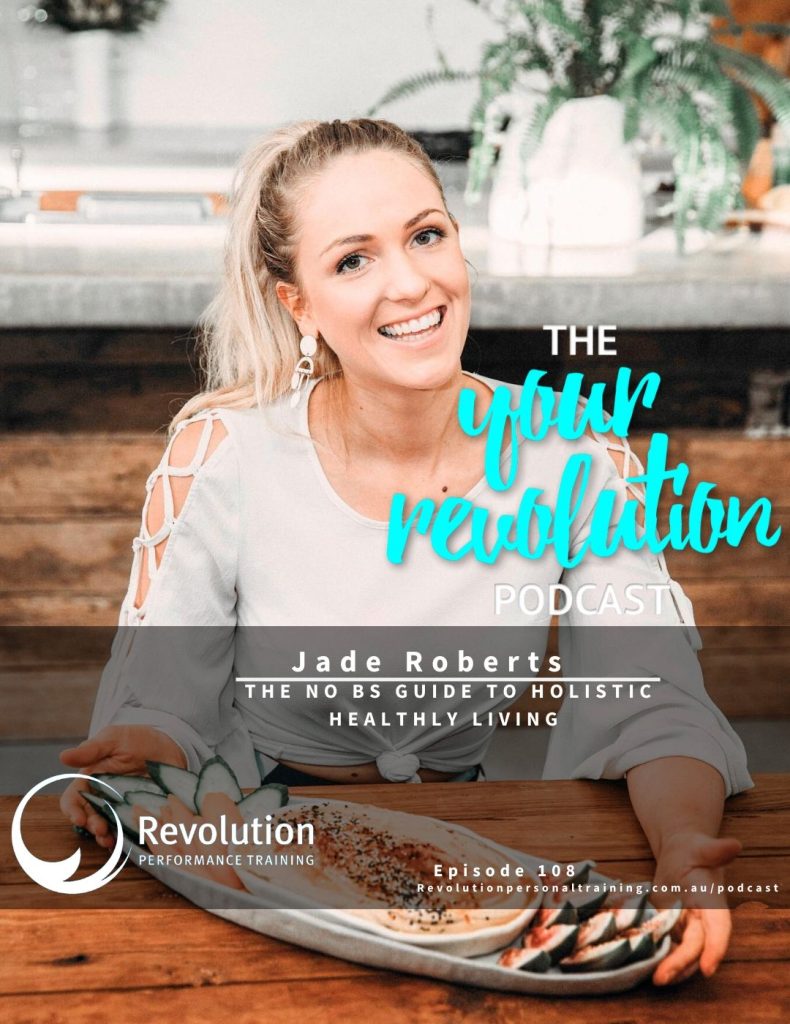
The Your Revolution Podcast is back with Episode 108!
With Greg Kourpanidis as your host, join him as he sits down with Naturopath, Tea maker, and host of the Jade Walker way podcast Jade Walker.
Jade is not your average Naturopath with an evidence-based approach and a passion for herbal and nutritional medicine. She is known for her no BS approach and empowering her clients to optimize their health.More recently she has launched her own podcast “The Jade Walker Way” with a keen focus on
Energy, Gut health, Female health. Mental health, Mindfulness, and meditation
Tune in for an entertaining and insightful episode filled with humor, science, and a whole lot of knowledge on all things health.
About the guest: Jade Walker
Coach and educator championing sustainable, holistic healthy living.
Episode transcript
Hello and welcome to the Your Revolution podcast. The Your Revolution podcast is a collaboration between Revolution, Personal and Performance Training in Melbourne and the MePer Project. The purpose of the Your Revolution podcast is to inspire you on your mission of betterment. Each week on the podcast you’ll meet game-changers who have created extraordinary lives and you’ll listen to stories and lessons to empower you to make the changes necessary to your life.
The Your Revolution podcast is committed to fitness, health, nutrition, mindset, community, education, empowerment and betterment and we hope that you can take what you learn here and apply it to your very own revolution. (upbeat music) me on the podcast. That’s it. We are super excited to have you on today and really looking forward to this episode.
Are you ready? No. No. I am definitely ready. I’m really ready to go. Awesome. So before we dive in, I thought it’d be a good opportunity for you to firstly give our listeners a little bit of an intro into who you are and I suppose your journey through health and fitness. Oh, that’s a loaded question. It’s a very loaded question. Okay. Yeah, so I’m a naturopath.
The difference being that I’m a qualified naturopath. So I have a Bachelor of Health Science and I basically if anyone doesn’t know what a naturopath is, we’re kind of like a nutritionist plus herbal medicine and we have a very holistic approach to health so that we look at the whole body and the nutrition, the body, the mind and the environment as well.
So we really look at everything. – All bases covered. – Exactly. – Yeah, no, I like it, cool. And I suppose can you talk about, this is what sparked your interest in wanting to pursue a career through health and fitness in particular as an alternative medicine. Yeah, good question. So it all started probably it’s getting close to, you know, eight years ago where the first spark started, I guess.
I so I started off as a journalist living the kind of, you know, just young, slightly unhealthy life where I ate a lot of crap, I guess you could say, not necessarily like I was never a McDonald’s person or anything like that. I was more of the gourmet person. I loved the locally made sausage rolls and like the locally made cream buns. And I was a sucker for the butter chicken and naan bread down the road from the local Indian place and and so anyway and that became because it was a very stressful job to be honest as a journalist we had a lot of deadlines we all hated it we were all stressed we hated our editor so we all those little things it was kind of like what a cigarette is to a smoker The food was to me.
And so we would eat at our desk all the time and Naturally I started to get a little bit away, but also if I’m being honest I had an unhealthy mindset and lifestyle outside of work as well. So I would party a lot take drugs and I wasn’t happy and What really set me me onto my path was, and there’s a long story behind this too, but I initially went vegan and I’m not vegan anymore of course, but that was what opened my eyes to nutrition.
And so long story short, I found myself, I moved from South Australia up to Townsville and started studying a Bachelor of Science. I wanted to do zoology or marine biology. But I actually started working at the Happy Herb shop, which is a, as the name suggests, we used to be called Happy High herbs and that was, it has all your herbal medicine. And so with that, I started to learn all about herbal medicine and I’d never actually heard of all these herbs before and how they can help and that opened my eyes.
So yeah, and because I was also very interested in nutrition and it was really everyone else around me that was encouraging me to do it. So in the end I enrolled into a Bachelor of Health Science in Naturopathy at Endeavour College of Natural Health. And here I am now. That’s the shortest possible way I’ve ever explained that. You’ve actually done a pretty good job.
Well, I have actually listened to, as we did mention earlier on, Jay actually has her own podcast, the Jay’d walk away. So really recommend you have to listen. And that first episode was a, it was a, yeah, it was a really good one of them. It was really, obviously, it goes into a lot more detail into that as well. So there’s a little, there’s a little plug there.
So you have it, having listened to it, listened to it. So now, so let’s go on back. You did touch on what a naturopath is, but can you explain your own words, how you differ from a dietician, a little more a a Nutritionist because I think a lot of people kind of will get those three mixed up absolutely yeah so and interestingly I’ve worked in a clinic with all three of us like a dietitian nutritionist and a lot yeah and actually there were five natural paths at this clinic oh wow and oneian.
And we all still, you know, had clients. But anyway, so there’s a question I got asked a lot. And I mean, first of all, the biggest differentiation between myself and both of those others is that I have the herbal medicine. Yeah, they don’t. Um, however, like we all have our benefits. So obviously I still do nutrition and personally I have a really strong focus on nutrition Whereas like some naturopaths are really strongly focused on herbal medicine.
Yes So I guess it comes down to a little bit of individuality But just to compare like for example when I worked with Marina She would she was really she would she would really hone in on getting people the good nutrition, the dietary plans and exactly what they should be eating for breakfast, lunch, dinner, that kind of thing. Whereas I would be more so just like, it was a little bit more broader and obviously I would touch on the nutrition, but I wouldn’t necessarily be writing them an actual like diet plan.
It would be more about okay you’re your diet at the moment is quite process carb heavy we want to reduce those process carbs and replace that with more like complex carb hydrates and protein and then I’ll give them a few pointers and like I do have a lot of resources I give people one way to go. So look it’s a little bit individual but certainly the herbal medicine part would be the main differentiation.
Yeah no no that’s quite I should also mention just quick on Marina. So Marina was on my a few episodes ago episode 106. So she is the clinic called nutritionist, actually works at Revolution here Thursday night with myself. So yeah, just so everyone make clear. Marina is Marina. Now I really did touch on this word some of your methods, but can you answer this talk how you’re able to just certain ways of you diagnosed of you diagnose health issues that I might present you.
Do you have certain tests, like health tests around particular or do you, as I prefer to, I guess another practice, a GP, do you get certain sort of test HAT-HELM? I spoke to you. Yeah, really good question. First of all, a little disclaimer, naturopaths will never diagnose. We’re not actually allowed to, although certainly we steer people into the right direction.
– Very similar to myother. We call it a, we frame it like a clinical impression. – Yeah, I like that. We don’t use it, but I like that. So often though, as you would know, you get pretty good at it and you’re like, look, I’m pretty sure it sounds like endometriosis, but I just want you to see your GP and go to a gynecologist and get a referral like that kind of thing.
So in terms of answering your question, though, on like, you know, what are we doing? What tests are we doing? That kind of thing. So the difference between a naturopath and say, you know, I don’t even want to bring in names for other modalities because I don’t want to sound like I’m bashing on anyone. But there are some modalities where it’s literally in and out.
It’s like five or 10 minute consult. Whereas an initial consult with a naturopath is one hour. And the reason why, and to be honest, that goes so quickly and sometimes you’re like, ohOh, we need an hour and a half.” But it’s because we’re taking the time to go through absolutely everything. And so just for example, say someone comes in and they’re getting a lot of food intolerances and bloating, first of all, I still want to look at everything else, not just the gut.
So we would be saying, “Okay, what happened in your medical history? Were you born Caesarean or vaginally? Were you breastfed? Were you not breastfed? Did you have antibiotics in the first couple of years of your life because research shows that that can affect your metabolism and make you more prone to allergies? So there’s all these things that can start from the moment you’re born even when you’re in the mother’s belly.
We want to look at all of that because that’s going to affect where you are right now. And so if we can backtrack and figure out, we like detectives of the body. And so we don’t just stop it. Oh, this is your symptom. Here’s a band-aid. Yes. We want to figure out where’s that root and how do we pull it out? Or how do we nourish it to grow in a different way?
So that would be in a nutshell. I really like that point you just made about, I guess, not offering it. So it’s just like a band-aid solution for one. But I suppose you do touch this a little bit, but it sounds like, because my next question was going to talk about it, just to give us an idea of what an initial cold salt would look like, but it sounds like it’s very much, very thorough, it’s going through all your history.
I guess trying to get as much information as possible. And it sounds like even some of the information, maybe they don’t see it as very relevant, but there could be things Yeah, like the small thing like you sort of said coming from breastfeeding anything I could really anything absolutely and for some people and this is what I really try and like gear up my clients as best I can before they start the process so that they know what I’m doing because For someone who’s never been to a naturopath before it can be a little bit alienating and also just confusing it’s like because it’s like why do you want to know like what my nails look like you know because they are all signs of your health and your vitality so and you also asked about what kind of tests we do as well yes I did yeah and so in clinic I mean I do a lot of remote consults now, like, which is great.
You know, I see people via Skype these days. So anywhere in the world, people can see me. But when people do see me in person, I may do like blood pressure and temperature, those kinds of things. We do a lot of observation. And this is a technique that is really, it’s a lost art. And like you were saying with how hands are so important, it’s the same thing as like, you know, if I were to look over your body, there are 20 different signs that I could look on your body right now and know what’s going on in your health.
Like for example, and just for listeners, this is not what I’m saying, but as on Greg, but like for example example I might look at his nails and notice that there’s horizontal ridging in the middle of his nails and that will tell me that perhaps a month ago you were really sick or if there’s a lot of indentation and pitting in your nails that could indicate that you’ve got some mineral deficiencies.
And this isn’t just like woo-woo, this is science. It’s in the science, there’s actually research papers that show like there’s one paper that has something like 20 different signs you can pick up on the body. Like there’s another one that shows if your ear lobe has a crease in it, which you start to see in the elderly, you have a higher risk of cardiovascular disease.
So there’s so many different signs we can look and like it’s a lost art. There’s a really good TED talk from a GP who actually talks about how much that’s a lost art in doctors. So yeah. Quite right. And in Bhimashita’s Maya therapist, and something we always got touched on is all tour by lecturers is Really looking at the person as soon as they walk in the moment actually doubt the chair some I must say I probably do forget it sometimes because maybe I’m just thinking of like The obvious sign like maybe they’ve got like a link for example, but it’s a lot more than that.
So you’re right. It’s a right it’s very much a lost art. Now I suppose going back to your expertise what are some of the areas that you particularly specialise or are really passionate about? Yeah so big ones for me are so when it comes to gut health I have a big focus in SI which stands for small intestinal bacterial overgrowth, which is accounts for 80 to 90% of IBS sufferers.
And so a lot of people with IBS don’t even know that the reason why they have IBS is because of SIBO. And the reason why I’m so passionate about it is because I’ve had SIBO myself. And I had to treat it three times to get rid of it. And apart from that gut health in general, however, every holistic practitioner such as naturoplasts and nutritionists will always have a strong focus on gut health because it is at the root of everything just about.
Then I have a strong focus on women’s health particularly and demetriosis, adenomosis, PCOS, which is polycystic ovarian syndrome. So those particular conditions are quite rife these days and a lot of women don’t realize they have them. And because I’ve personally suffered from certain things in my life such as excruciating period pain, I actually just found out the other day I have a fibroid that no one cared to tell me about.
And so I feel like I guess you could say a voice for women who don’t know where their rights are with their body and what they’re entitled to know because for example with myself like I’ve been going on this journey for 15 years of trying to get answers and no one’s ever giving them to me but I knew that it wasn’t what I was going through wasn’t normal but everyone kept trying to tell me that it was.
Wasn’t we also we’d say more like you’re misdiagnosed a lot of the time as well? Not even I was not diagnosed with anything. Just not even those going that extra steps and trying to find out a little bit more or. Yeah so for example so example, so I suffer from extreme period pain, which is what we call dysmenorrhea. And it’s not just like, “Oh, I can just have a little heat pack on there and I’ll be right.”
Like this is, I’ve been to the emergency department twice for I had to leave a yoga class once, like breaking out in a sweat in the most agonizing pain, I had to drive myself hospital like so it’s like it’s intense pain and like 10 out of 10 and you know I so when I was younger like my mum was a nurse and she was like Jade you really need to get this investigated it’s your body you know this isn’t good enough because I was constantly going to my GP and granted my old GP and like not being sexist but to be honest The male GP’s back then often didn’t understand what woman was going through and anyway, so they would often like Quite literally say to me.
Yeah, but you’re a woman you go through that every month Yeah, which is just bullshit because no, that’s not normal to feel that someone’s cutting out your uterus every month. Once a month. And so I had ultrasounds, they kept telling me everything was normal. And then finally I pushed for a laparoscopy, which is where they put the scopion and actually physically have a look.
And at the moment that’s the gold standard for diagnosing endometriosis because it’s the only way you can figure it out. There’s no blood test, the ultrasound might pick it up unless it’s really severe. Anyway and like even the gynecologist was saying like I don’t think that’s necessary. I don’t think we need to do a laparoscopy. Do you think the choir hands itive to do it?
Well, back then they were because there is this explosion in research and an awareness around endometriosis now. There are more gynos that are becoming a bit open with that said. I’m still coming up against bricles when I speak to GPs and they don’t even bother to ask me, you know, like, I’ll bring it up and I’m like, I really think I’ve got Ndone.
They’re like, okay, anyway, moving on. Like, they just don’t want to talk about it. – Yeah. – Meanwhile, it affects one in 10 women. – Wow, yeah. – And it could even be higher because a lot of women are walking around not knowing they have it. – No, no. – Yeah. – That’s a good point. Okay. – Like we talk about that one. – No, that’s for sure. Yeah, absolutely.
Well, obviously we are going to obviously touch in some of these areas that you have obviously very passionate about. So absolutely later in the podcast. I guess not an area of slight deviant. Can you just talk about some of the resources that you’ve used or there was also people or anyone’s influenced you or you along the way and I suppose also Leon’s another little side segue is some of the products you also use such as your large tea line.
Can you tell me as well what kick start and interest in that? Okay, I feel like that was a three part question which which was the first time. I suppose let’s where I get a lot of my extended information from. Obviously I had the four year full time degree and there’s you know always further education that I do but a couple of my favorites I love the ATP project podcast, so the ATP science guys.
So they actually do have a product range, which is really good. Like I personally use practitioner grade subs, but they do have good stuff. That’s not what I’m here to talk about though. But they are amazing with the information they talk about every kind of condition. I get a lot of my education from FX Medicine podcast. and they are solely targeted towards the complimentary and alternative medicine modalities.
They’re really good. And probably one of my favorites as well more specific to women’s health and Dr Lara Bright. And she’s a naturopath who studied her PhD in women’s health, particularly around like PCOS and she’s got a really good book called the period repair manual and I swear every woman has to read it. Okay, we might put that in the show now.
It’s actually for sure. Definitely. Now, suppose the influential people because we actually experience this low and you did kind of a little touch on terms of podcasting is we have Hamish and Andy. Oh my gosh. Great little story. So we, before we actually started recording this, we caught up for coffee. I was like almost an hour late. But that’s not a thing.
But, and as we’re going to, as I was whispering, I didn’t actually full catch it at first. But yeah, we ran into Hamish and Andy just on the street in South Melbourne and obviously I found that they were a big influence for you. Oh my god I’m still reeling from the fact that I’m a Hamish and I literally hugged them like I’ve been like got a photo from them and how good were they?
They were such a chance. Yeah. And they like picked up on our name straight away and we’re using like they’re like so jage like dah dah dah. So what are you guys doing? And they were awesome. But yeah, so I guess I understand why you brought that up because quite literally Hamish and Andy were the first ever podcast I listened to when I was younger.
Like I’m pretty sure it was like 14, 15 years old. And this was when podcasts first came out and no, not many people were really doing it. It was usually like the big guys. And I used to listen to them all the time, like I would put it on to fall asleep. Like they were just so funny. Like literally made me laugh at that. And I always used to think to myself, I I’m gonna do that one day.
I’m going to have my own podcast. And I told Hamish and Andy that and I laughed and then Hamish joked and goes, “And you figured out it’s pretty easy.” Yeah, it is. Oh, it’s so funny. Although that was absolutely goal Just before we were about to do podcasts. – Literally, yes. There’s literally just four about to begin. – Unbelievable. – Yeah, we bumped into them.
So yeah, that was the thought I mentioned that little story. So now it’s gonna be actually going into topics now. One of the big ones, which I think you know, should have a lot to talk about is gut health. Now, I actually asked, I posed this question to Marina when I had her on the podcast, but I always like to think, I think I’m to ask it again only because people may think it’s a silly question, but how can you tell if you actually have good gut health?
– That’s such a good question. So it’s multi-factorial and it can present in different ways. Obviously the first and foremost thing that is pretty obvious is like, do you have bloating, reflux, intergestion, discomfort, constipation, diarrhea, hemorrhoids? Like, do you have any one of those things? Because if you do, then there’s something wrong with your gut.
So to flip that and say, how do you know if you’ve got good gut health, you don’t have any of those things. Like questions. So, you know, naturopaths always joke because we love talking about poo. Like we genuinely, and people are like, “Oh no, this is really gross to tell you this.” And I’m like, “Dude, it’s fine.” Yeah, like tell me, like what colour is it?
What’s in the store? And we have this thing called a Bristol store chart that we often get people to look at and it’s basically like a chart system that’s like, you know, like it starts off with really constipated and works its way down to really watery. And it’s like type one, two, three, four, five. – There’s scale. – Yeah. And there’s like little images that people can point to so they don’t have to just go on.
– Oh really? – Yeah, literally. And yeah, it’s a really useful tool. It’s been around for a very long time. And it’s really useful. – Really interesting. – Okay. – But actually just to quickly go on though. So like I said, they’re the obvious ones when it comes to gut health. However, some people may not have any of those symptoms, but they’re getting a lot of skin conditions.
Okay. So quite often like even eczema, like flare ups of eczema, acne, just weird hives and patches, they are golden signs of bad gut health. – Gut health. – Yeah, that’s really it. – How poor are you functioning too? – Yeah, of course. – Mm-hmm. – I was first thinking of expanding on that. Can you, I suppose, talk about the, I guess the favorite impact of gut health and how, I guess it can really impact, like.
You mentioned it seems that it hasn’t really impacted someone’s energy levels and I suppose their emotional mental wellbeing. – Oh, very good question, something I’m very passionate about. So two-part question there, first of all, energy. So I, as I said before, I have a big focus on chronic fatigue syndrome. And this is a condition that’s not just like a general malala is here and there, it’s like proper unrelenting fatigue for more than six months.
And so with CFS, people will tell them those who are suffering from it, that it’s a life sentence and there’s nothing that they can do about it, which is a lot of shit. And that’s because no one’s healing their gut. So the reason why poor gut health can cause problems with your energy levels is multi-factorial but first of all it very simply if you’re not absorbing nutrients effectively then your energy cycle or the Krebs cycle will not be able to turn effectively.
So for example, we know that certain B vitamins are essential to make ATP, the energy currency. And so if you’re not absorbing those nutrients because you’ve got poor or compromised gut health, then your energy is not going to work properly. The other thing as well is that you’ve got leaky gut syndrome or more technically termed intestinal hyperpermeability.
And that means that there are certain undigested particles, toxins, proteins, that kind of thing and bacteria, endotoxins that are getting absorbed across the gut wall into the bloodstream and wreak havoc on the body. So that’s where they cause brain fog, poor energy, just feeling crap basically. Okay. No, very interesting. Yeah, actually, you, I suppose you did kind of touch this as well.
So I mean, I’ll, I’ll, I pose the question anyway, but you did mention about, I suppose the potential symptoms and well, I found that was really interesting because obviously there’s real obvious ones, but I just thought you could go a little bit more into those more, I suppose, complex ones as well. – Oh, yes, so we were gonna talk about how mental health and gut health.
– Yes, yeah. – So there is a lot more people who are coming familiar with the term the gut brain axis. And that is where there’s a bidirectional link between the way your brain works, so your mental health and the way your gut works. And the reason why it’s bidirectional is because they can both trigger each other. And then they get into this vicious cycle.
So anxiety, depression, and it just that general not feeling quite right mentally can be because of something going on in your gut. So particularly IBS and anxiety are very intrinsically linked. But at the same time, like it could have been stressed, a stress that caused the IBS. – Stress related, yeah. – Or it could be IBS that triggered the anxiety and then all of a sudden they’re in this vicious cycle and they keep triggering each other until someone comes along and like stops that chain reaction.
That’s really interesting I can go from like two different angles. Yeah exactly and and the way just to go on a deeper level of how that works it’s a connection connection of, so the vagus nerve that connects the two. It’s a stimulation of that. And so there’s research that shows that the bacteria actually stimulate the vagus nerve and can control what you want to eat, the decisions you make.
So if you have bad bacteria, the bacterial, that bad bacteria will stimulate Your brain to say give me the sugar you know, so it’s pretty interesting No, absolutely there’s another interesting fact of I’ve kind of read you know for a population like Australia, you know go a little over about 20 million people You know I say as at least one and two people that have some sort of gut issue.
Can you, I suppose, further talk about the potential triggers to this and I suppose ways or strategies we can to combat these sort of gut problems? Definitely. So obviously lifestyle is a huge one. At the top, like I always have this visual iceberg in my brain. So the top is always like what you see going on. So like, you know, your signs and symptoms.
But like underneath, there’s all these triggers that you weren’t aware of such. And to be honest, the biggest one is stress. And because from an evolutionary perspective, stress, obviously, you know, it was the fight or flight response. And when we are in fight or flight, we release cortisol and adrenaline. And that was a protective mechanism to help us get away from a saber tooth tiger.
And so our body nowadays in the modern world, where we’re not being chased by an animal, it can’t differentiate between the stress of that and the stress of our shit job. Or having a family to look after. Or, you know, all those things. I doesn’t know the difference. It’s still going to say to the body, I don’t have the energy to invest in digesting properly or being fertile or having a good immune system, I only have the energy to get away from danger.
And so if we continue to stay in that fight or flight response, suddenly your gut becomes compromised because you don’t produce digestive enzymes anymore, you don’t produce enough hydrochloric acid to break down your food. Therefore, you’re not assimilating your nutrients effectively to take those on, which will help with your health. On top of that, obviously, we’re all eating a lot of processed food.
We put all these chemicals on our body and spray them around us. And like, you know, there’s car fumes, we’re breathing it. I mean, look, you can go down a rabbit rabbit hole and I try not to focus on that too much because there’s a lot of things that are just out of our control unless we live on an island. So you just have to do the best you can but there’s so many factors.
Would you also say I suppose it’s also taking a more of a proactive approach as opposed to I suppose reacting suppose, reacting to it. – Yeah, absolutely. There’s so many things that don’t actually have to cost that much money that everyone can do. Because a lot of people think that to be healthy is expensive, and that’s just so untrue. And not only that, but it’s same with your industry, it’s like, is the priority, isn’t it?
It’s like, what is a priority to you? Is it a priority to have the fancy car and like a Louis Vuitton handbag and be really unwell? Or is it a priority to just have, you know, the things that will help you get by, but in order to be able to have the funds to be able to fund a healthy lifestyle. Okay, no, that’s next one point. Next one, little one part of your actual podcast release that I was really fascinated about and it’s probably something I think I caught a thought about it but it kind of ties really well to gut health is I suppose your strategies of combat overseas travel infections and pains.
I mean that’s an area which like a lot of people when they go traveling you know they experience there’s always some story everyone’s got some story where they went to some country like in the other country in Asia or South America or somewhere yeah I was just kidding further extent because some of your key strategies you use to combat those issues and I suppose things that you need to be aware of when traveling So as I said conch and such as Asia or South America.
Oh, that’s such a good one So I mean, yeah, definitely like the Asia South America that kind of place there are certain Obviously firstly their water quality is not as good. So naturally there it’s a breeding ground for parasites and so that’s the big one, the parasites. And unfortunately even if you try and only drink bottled water and wash your hands and stuff like because they use it to wash all their fruits and vegetables and stuff like that naturally you could become exposed.
But what’s most important is that because obviously there are plenty of people that go to Southeast Asia and they don’t get sick, and then there’s people like me who was always so vulnerable, I’d get sick every time. And that’s because you’ve got healthiest compromise. So honestly, if there’s one take home, everyone needs to get from this, go see your naturopath four weeks before you go overseas so that I can actually prepare your gut for what’s about to come.
Because there’s so many things you can do to strengthen your gut but also little things you can take with you whilst you’re overseas that will help to prevent those things. And again it’s probably going that more that sort of proactive approach not I suppose like for example I know some people obviously would travel some of this stuff, prepare, but like I think sometimes I’ve taken the approach where I’m always thinking of like, okay, things go literally to shit.
Like things can I say, oh, I’ll bring you a mody and wild, I’ll bring this or like when there are probably other ways which obviously I could, you know, prevent it just by incorporating some of the different strays or like I said said preparing a gut for What’s the come? Yep, absolutely. Yeah having that little toolkit like honestly people would probably laugh if they saw the toolkit I brought to greased with me a few weeks ago because I had about 20 or 30 things that I brought with me It was so naturopathic, but you know what I used used almost all of it.
It made things easier. – Yeah, no, right. And just to remind that’s your second episode, that’s how it’s done. So yeah, I suppose if you want to find out more about some of those sort of strategies, yeah, please tune in. So I suppose I did a little segue into one of my next topics is allergies. Can you first explain those what allergies are? One, like sort of this conception I’m sure has sort of made a lot is that people think it’s always just to with food.
– True, yeah. And I guess so we’re talking about allergies broadly here. So food and pollens and all that kind of stuff. And I coming into spring. Yeah, so basically allergies are a IgE response, a muongobib lobulany, whereas an intolerance is IgG. So basically that’s something that is an instant response to something that your body doesn’t like because you’ve become desensitized.
So it’s basically we have these things in the body called mass cells and they what we call degranulate and then you get this big histamine influx and therefore you get the reaction and you know that could be as minor as a skin flare up or like you know something going on with your gut too and a phallaxis where you have to go, it’s an emergency. – Absolutely, yeah.
– Mm-hmm. – Mm-hmm. – Okay, and I suppose you can just talk about how the body reacts, so I’ll go straight into my next point. – Yeah. – What would you say, I suppose, fundamentally causes it, and what are the ways, suppose, that you can prevent them from, I suppose, your point of view as opposed to like, I suppose more conventional ways. – Yeah, great question, I’m out of this and I’m just a little self plug.
I do have an ebook on how to naturally reduce histamine. – Yeah, that’s right. – But yeah, so basically, once you are desensitized, you can never completely reverse that. – Yeah.. However, there are so many things, obviously we can do to prevent that from happening in the first place. But secondly, if you do have it, there are so many dietary and lifestyle things we can do to significantly decline your reaction.
So if we were to talk about hay fever, ’cause obviously it’s hay fever season there, there are specific foods that are high in amines and they can increase your histamine and so particular foods are things such as cheese, cured meats, wine, you know basically a cheese flatter and then a side of strawberries and you’ve completely topped yourself of histamine.
So yeah, and that’s the thing is that there are actually some really healthy foods that are high in histamine. Or I mean so. So, you know, just being mindful of those foods and reducing those, but then increasing other bioflavonoids or polyphenols, which are basically plant compounds that are protective in some way, there are certain ones that can actually reduce histamine.
So a really good one is pineapples. They contain bromelain, which is a plant enzyme that we actually use therapeutically to help reduce histamine. On top of that, on a more naturopathic level, there are some beautiful herbs that we use that can help to reduce histamine and that mass cell degradation as well. So like we have, you know, naturopathically, we may make you up a liquid herb mix.
A lot of people may not like the taste of it. So we might give people a capsule or a tablet that’s been researched and formulated to help to reduce histamine. So it’s basically a natural antihistamine and you know comparing it to conventional medicine antihistamine such as you know zurtek and nasonex and all those kind of things like whilst they do give people pretty instant relief they shouldn’t be used long term because they have other negative side effects and even things such as poor memory and memory loss.
– Well, okay. – Yeah. – No, that’s very interesting. Maybe it’s that very well. Now, let’s switch gears here a little bit. We’ve also got a little bit of the cover. Now, one area which we touched on earlier, which you know you’re very passionate about is female health. Are you able to I guess further I mean you did touch on why you’re passionate a little bit but so can you go more into your own sorry personal struggles and so I think you’re very open about and even most recently I believe you actually were telling, you told, you shared it on your social media, just some of your own experiences, you sort of touched on some of that.
So yeah, why I suppose you’re very passionate about it. – Yeah, exactly. So as I was saying earlier, obviously like I suffered from a lot of period pain and I started to become aware of endometriosis and all my symptoms were really fitting that picture and so that’s why I got the laparoscopy done. And unfortunately, or even though, no unfortunately, it’s still good news to be told everything’s fine, but they didn’t find anything.
And they said everything was clear. And one procedure they did do that can sometimes help with period pain is they dilated the OSS which is just this little opening that apparently if you open it up a bit it can reduce the contractions didn’t do shit. And so I’ve still suffered from period pains anyway and I over the years I kind of like I would go back and forth doing some ultrasound but I never I just couldn’t bring myself to go and do another laparoscopy again But and I just kind of gave up a little bit for a while there and just was like, oh, well, this is just me I’m just gonna have to suffer these really bad puripanes for a lot of my life and you know what that was one of my big passions when I was studying was hoping that I could find an answer to myself and so I can help other people as well.
And so obviously that’s what I do now. I do help a lot of women in that area, but I still am going on my own journey with it, trying to get answers. And just recently with the thing you’re referring to, so I started getting more pelvic pain and things just didn’t seem right. And I know my body well I also track my cycles so I know what my cycles should be doing I know exactly when I ovulate so and which is really important to something that all women should know and anyway so I knew something wasn’t right so I went to the doctor and and just I wanted to get some blood tests and an ultrasound and so he was a really great GP I really like this guy but he was you know kind of just like doesn’t sound that big a deal we’ve just come back from greasy bodies probably just under a bit of stress and yeah like yeah you know like but I’ve been having my period for like 19 years now and yeah you know I think I know what’s going on over Yeah, just like a little bit of stress.
Sure. Anyway, and he’s like look, I’ll write your referral for ultrasound, but you probably won’t need it. You’re probably just thrown in the bin. I was like, now to be honest, I think I’ll be all need it. I do want it long story short when and got the ultrasound done as they were doing the actual ultrasound. They were finding a few different things that was alluding to what looked like possibly fibroids or adenomyosis.
And to be honest, I was actually stoked because I was like, “Finally, some bloody answers, yeah.” And I know what I need to do naturally, practically, there’s heaps of things we can do to help it and whatever. And the sonographer kept saying, “Are you sure no one’s ever told you you’ve got fibroids?” And I’m like, “Yeah, pretty sure.” And then so I was like, you know, I skipped into the GP the next week to get my result and it was such a frustrating day because the result wasn’t back yet.
And even the GP was like, that’s unusual. And this is a different GP, the one that like I hadn’t seen this one before. one before it’s not like your regular GP Well, I don’t really have a regular GP to be honest like because I’ve moved to Juleong recently so like the regular one from South Yarra, you know, yeah that kind of thing so this particular one He called up radiology and wanted to just get some sort of conclusion for me, seeing as I just waited an hour and 10 minutes.
And he speaks to radiology and he’s like, “Oh, it looks like more or less everything’s fine.” And I just wasn’t having a bar of that. I was like, first of all, I want to say the actual report. And secondly, I don’t agree with that because they were seeing stuff. And particularly one thing they saw was the Venetian blind effect which is associated with adenoma, oesus or fibroids and I said to him I was like that’s funny because they were finding something and he’s like oh well they would call you if it was something serious and to them something serious is cancer or that’s really prominent.
And I just wasn’t accepting it. And I have done research, I’ve also heard about women not being told certain things. So back and forth, back and forth, I finally got my hands on that report by the end of the day. And sure enough, it said, “Four centimeter pedunculated fibroid. I just couldn’t believe it. I was both stoked that I was right but also pissed that that had happened.
And then since I put that on my Instagram and Facebook I had an influx of women reach out to me saying “oh my god this happened to me” or “oh, I think this is me.” You know, that kind of thing. Like I had a friend say that eight years ago, I think it was she had been having symptoms and she got an ultrasound. They told her everything was normal and she was like, “That’s weird.”
I’m sure they found something when they were doing it. And it wasn’t till three years later, she actually said, “Can I please have a printout of that report? And sure enough she had a fibroid. And then I was also speaking to another friend who she’s got really bad endo and demetriosis. And one of her laparoscopy so you know an actual surgery. They told her she didn’t have endo, but she actually did yeah, and so she’s had to have several surgeries I’ve heard this so many times now and yeah, and then also with adenomyosis I was reading recently that sometimes they wouldn’t bother telling you have adenomyosis because the only real solution is a hysterectomy so they don’t bother telling people.
However, naturopathically, that is not the only solution. There’s heaps we can do. So that’s where my passion comes from. I suppose it probably really helps because it’s more health and sensation. We’re able to relate to people. It sounds like so many women go through these, these everyday. It sounds like it’s a very common sort of occurrence. And I suppose, you’re obviously not accepting it.
Obviously, you’re wanting to keep trouble, so you’re obviously putting your clinician hat on. Obviously, we’re doing… Surprisingly, although it doesn’t seem that surprising to me anymore, because we often will have a look at blood tests that a GP has done for someone and sometimes, because we have more time to spend with the client, of course, that helps because I guess sometimes that bloods just get skimmed over and they only look for what’s highlighted in red or black.
They don’t look for like, optimizing things. But even then like, I’ve seen people be missed for autoimmune conditions. Yeah. That actually said it, that there was a result and no one told them. Really? And it just, it blows my mind. Yeah. And here they are feeling helpless because people keep, the practitioners keep telling them that, oh, you know, all your bloods are fine.
I don’t know why you feel like shit every day. So sorry we’ve got nothing for you. And then I have a look at that bloods and sure enough, iron slow vitamin Ds or your B12s and all over the place. You white blood cells aren’t optimal enough like you’re prone to an autoimmune disease. They didn’t look at all your thyroid markers like yeah it’s just it’s unbelievable.
Like it actually will be like obvious signs. It’s like yeah wow yeah that’s yeah if I’m blowing in mine. No like obviously yeah being a male like we are these are something which I wouldn’t really you know I guess I wouldn’t really look and be aware of so yeah yeah, it’s quite amazing. It’s quite interesting that that’s not enough. – And I think it’s really important that men do you understand this so that they can support their female partners as well.
Because my husband, I’ve had to really try and coach him over the years of understanding what I’m’m going through because he grew up with two brothers and mainly lived with his dad and I like how to eat the coaching team. Maybe I should open that up because I will coach himself. Because he just didn’t know what to do. When I was in pain, because often my pain would come in the middle of the night and I’d have to get up and Ed would come out and I would be like screaming on the kitchen floor in that much pain and he’d be like, “Oh, I don’t know what to do.”
He’d be like, “Yeah, some water, I’ll have some water.” He would be like, “Just calm down, I’m like, “Don’t you have any calm to know?” And just little things that men can do such as like, ” can I get you a heat pack or or even just saying? First of all acknowledging the pain and just being like oh my gosh babe that sounds awful and then is there anything I can do those two things will change your relationships like serious Yeah, exactly.
And the biggest don’ts is don’t tell a woman to calm down. (laughs) Don’t walk away. Don’t just like tuck your tail in between your legs. Worry mad I can do something about it. – I like good good answers. I suppose actually this pretty goes to another little topic here. I suppose he is the use of the pill. Another big one in trouble. I’m sure you’ll have a lot to talk about.
I suppose that was something I suppose the time when I know I’ve got a lot of friends of mine. I was actually talking with my colleagues today and she was saying that in her early teens she was on the pill and she told me all, I guess all the negative effects and probably some of them she wasn’t aware of back then. And now, because she got off the pill so early, the way she used to, she reckon she was a different person and even just some of her experiences.
And she has friends now that are trying to get off it, to get off the pill and they’re finding I suppose that trend is you’re coming off it and there’s all the effects and that they’re going through. I suppose can you, I suppose talk about one, the use of it, that’s the negative effects, just so it’s people will wear and I suppose your thoughts on it.
with whatever they’re taking but the one that I want women to get off is the pill. Yep. 100% So there are so many different reasons why and of course I took it in my teens as well But where do I start? So first of all the biggest misnomer a lot of women get put on the pill not not actually just for conception but for many things so like acne PMS period pain, all sorts.
And they are told wrongly that it will balance our hormones, which is completely untrue. Because first of all, they are synthetic hormones. And interestingly, the estrogen that they use in the pill is more similar to testosterone. So the chemical structure of the synthetic hormones that they’re using is not identical. Therefore, of course, it’s going to exert slightly different effects.
So where do we begin with the list of side effects? I mean, first all the common ones are weight gain that happened to me very quickly and easily Secondly is an interesting well more research is coming out now that it is linked to depression and even more so they believe could be linked to teenage suicide. So big those days it’s it’s huge and there’s just That’s another topic as well.
I’m very passionate about and you know having gone through my own things with mental health and yeah, I mean I When I was on the pure one knew for sure that it was sending me into a spiral and I personally when I was 22 I went on the implant on which is like another former contraception the rod that they put in their arm sticking me Yeah, and that one’s horrendous so that cause so for me So that was when I first started dating my now husband and I thought be a good idea and First of all wait game started to come on secondly Murg swings, but then it got so intense that I felt like I had this voice in my head.
Like, I just, I have this clear memory of catching up with Ed for lunch one day and I was sitting there and I kept thinking, Oh my God, he doesn’t like me anymore. Like it was just all these weird anxiety things that started. – And so for like, for me, listen to this, like this is something I had to find really, I could not relate to this. I wouldn’t understand how…
Exactly. Isn’t that the unusual thing as well? Can you imagine if we flipped this and it was the man who took the pill? Yes, and that’s something they’ve talked about. Yeah, exactly. Because they’re looking at contraception, although it sounds a lot better than one that they’re looking at because it’s more of a physical thing where they block the the sperm.
Yes, so but anyway Can you imagine like men having mood swings putting on weight and crying at the drop of a hardy or yeah, all these different things? But yeah, so with the implant on it got to the point where like I had this full-on emotional breakdown and anxiety attack and I was at home on my own and I got the phone and I actually died like I put the numbers triple zero in like I was ready to ideations from it like and it’s it’s horrendous that something like that that so many women have don’t actually understand that yeah so then going back to the pill there are there are other side effects as well so as you’re saying with the friend that you know of who was talking about the pill and her friend’s like it is actually known that the pill can affect your decision making and even the men you’re attracted to.
So that’s really fascinating. The other thing that’s very problematic is in teenage life when your estrogen receptors haven’t quite fully developed and that can go on to early 20s. And if you take pill in that time you impair that development. So if you had irregular periods in early teenage life which a lot of women do because the East Asian receptors are still developing so in some ways it’s actually normal to have irregular periods for a while.
However they go to the doctor they tell them that they’ve got irregular periods they feel feel like it’s not normal. So the doctor will put them on the pill. And then what happens is they stay on it for 10 years. They come off it later on in life. They want to have a baby and all of a sudden they come off. And because that East Asian receptors never fully develop, they come off the pill and all of a sudden irregular periods again.
And then they can’t feel pregnant and so on. And then the same thing’s true for people who are put on it for PCOS or Indo. It’s only a band-aid. It’s not fixing it. So I’m fixing it. Yeah. That’s a great point. Yeah. Yeah. And it’s a great event. I know I guess my first experience will really see this as having because I’m sure what we’ve talked about with gut health and all that.
It was all really related. It was like an ex-girlfriend out through school as she had experience And all of a sudden a lot of these in talks are still looking tolerant so there’s like fructose and lactose intolerant Dus smites like some allergies so many things all just sort of came out out of the blue and I mean I argue here all the time because I think she just purely always just went to her GP and all the time I think there were a lot of guys, but like there were a lot of other like issues that just sort of developed and just kind of all just spiral then.
Yeah, exactly. And you know it might not have been like that the rod directly caused the intolerances. It would have been that those hormones interrupt with your mental health, which causes stress, which then affects your gut. Like it would have been like this major flow on effects. And that’s what I love about as a naturopath we do is we keep going back until we find that root cause.
– Yeah, that’s great, that’s good. Now, I suppose going back more, brought back to I guess closing questions. One question I’d like to always start out is what is one thing you wish you had known when you before you began your career? Actually how expensive my degree because like from the exit so well with and ever a college would have been similar with, it’s fee help not hex and so you get charged interest.
And so in total my degree was around like 70 something grand. Oh wow. And so to be honest like if I could go back because I always would still be a naturopath but what I would probably probably do is study nutrition at one of the universities. Yeah exactly that study at Deakin where it would be only cost me like 20 grand. And then just do post-grad in herbal medicine.
So you can like say for example and like a lot of people have studied their nutrition degree first and then they go and add on her after. It would actually still add on an extra year but it would still be cheaper. Which is just nuts but you know like look I’m here now and it is what it is but yeah I wouldn’t change my channel so. Yeah no no fair enough okay.
Now I suppose no one kind of goes in here as well. What would you say was your biggest failure and what did you do as opposed to learn from it? Oh biggest failure and that is that to do with anything? Yeah, it could be with anything. Yeah. Doesn’t have to just be Korean. That’s a really tough one. Like, I mean, I certainly I’m the kind of person that really sees the value in everything that happened to me.
I mean, going back to, I don’t know if I did mention this in my first podcast, let you in on a little secret. I have started writing a book, but I know I’ll talk about this, but where a lot of my undiagnosed depression was when I was younger was things that I did in high school that just got me into a lot of trouble and that was such a hard time for me and I really had to build myself from ground up because I literally feel that with all my friends.
I didn’t finish year 12, which is fine. And to be honest, I think it is the reason why I am where I am today because I had to really dig deep to get out of that stuff so like I definitely wouldn’t call it a failure but it was a really big hurdle to overcome and sadly I honestly would say that some teenagers wouldn’t have been out again through that like it Like it would have been too much.
And I just think myself so lucky that I had the ability to get through it. – Yeah. – Yeah. – Will you say also, did you mix like the wrong crowds or was it experimenting? Was it like that teenage? – Yeah, and look, I’m the kind of person that always says like, you never mix with the wrong crowd ’cause you’re a part crowd as well like you’re the wrong crowd too you know like yeah I mean yeah you’ve you’ve eventually like I was I was probably the wrong crowd like yeah but yeah like they were just you know basically it just stemmed from like you know like just stupid teenage drama you know what I?
and then rumors started to go around that were true. Yeah, and then And then because I was so upset about all of that then I did start making poor decisions I was getting wasted. I would let people take advantage of me You know all those kind of things and then suddenly like I just didn’t know who I was anymore. Yeah, just went from there. Okay. Yeah.
But I’m here so. No absolutely. Cool. Yeah. What advice was really give this someone that wants to pursue a career similar to yours? Good question. So first of all, strongly consider if it’s really what you’re passionate about. First and foremost, there are… – Great, huh? – There are some people that actually start in a trapezius and realize it’s not for them, and that’s totally fine.
I started journalism, I started real estate, and then I also went into Bachelor of Science, thinking of being a zoologist, into what I found in trapezius, so, you know, it’s always gonna change, but it’s an expensive choice. Yeah as you found out. Exactly. So first of all really find out if that’s what you want to do. A lot of people will go through this expensive degree after four years and they’re like I don’t even want to practice.
And that’s fine sometimes you might be able to work as say like a health rep for a reputable company or you might get into like the online space which is a lot of what I do now. – Supplements or well. – Yeah, exactly, development which is great, obviously it’s a good foundation. But there are some people who are like, I’m not doing any of it anymore and that’s an expensive degree to do to not do any of it.
– Yeah. – With that said, if you have that burning passion for health health, I have no doubt you love it. But to get into it, it’s actually so you don’t need really, obviously you just need the usual stuff to get into a degree. And even then, I didn’t finish year 12. I hope everyone remembers that. And when I went to study at James Cook Uni in Townsville to start a Bachelor of Science, I actually did a what was called a tertiary access course, which is like a bridging course for one semester.
So that’s useful. There’s lots of things like that. If you didn’t finish your 12, you don’t feel like you’ve got the academic skills. There’s so much available. So anyway, just say you’re ready to go. You just basically call up where you want to study and enroll. It’s pretty straightforward to start. Just be ready for the workload. That is, especially in Naturopathy, it’s extremely heavy workload.
I don’t know why, but the way that they do it, they cram so much in a semester compared to when I studied a Bachelor of Science. So like full-time load, Bachelor of Science, three to four subjects, whereas at Endeavour I was doing four to six subjects a semester. – Did you try? Is it trimester? – No, seven school do. So that’s the other thing. If you’re in Melbourne and you want to just have a look into the difference between Southern and Endeavour because they do things differently and some people swear by one and the other.
I think they both have their frozen cons. But there’s a lot of contact hours so when you get into clinic it’s mandatory. So unlike some uni lectures where you can go as you please Yeah, it’s all automated. Yeah, well a lot of the later subjects in the degree of naturopathy are mandatory So if you or sometimes they might be like you have to attend 80% or whatever and so like in clinic it was a hundred percent attendance and Like if one of us genuinely were sick like we it wasn’t that we were sick we just dreaded the whole process you had to do to do a makeup class yeah so it was a huge workload like I’m actually one of the rare people that did it in four years most people do it in six to eight years yeah because it’s such a huge workload So I was often at uni over 30 hours a week.
And top of that, you’re trying to work. – That’s a war contact out. And I think we would appreciate that. And so hands on, I think I mentioned when we were chatting as well, ’cause that’s very similar to my therapy as well. I suppose when it came to the anatomy, I’m lucky for subjects like anatomy. Anatomy doesn’t change. The muscles and the muscles are the bones.
Not something to discover any bone or something. But when it comes to that sort of more hands-on stuff, those contact hours, it shows if you’re not there, you’re not doing a clinic, you can’t wing it, being in the clinic. Exactly actually can’t. And like, I’m the queen of winging it, honestly. Like, my whole life I’ve gone through life, just winging it.
And I am a last minute girl. I’m very good at getting, like, I was the kind of person that like, everyone in my class was like, “Almost finished that major assignment.” And it’s like two nights before I’ve been in Bloody Britain or Word. And then I would knock it out the park and get 98%. – I was just one of those people. – Yeah, about 67%. I was like, yeah.
– So, I think journalism did that to me ’cause we’re always running on deadlines and I’ll just leave things for the last minute. But I’ve lost my train of thought. But anyway, it is just one of those things. Just be mindful. I’ve got a couple of friends who are studying the degree they’ve had babies in the time that they’ve been there. And they’re still just trying to finish this bloody long degree.
So yeah, it’s still a war. And if you’re passionate about it, do it. You’ll love it. Yeah. Yeah. Absolutely. Now, one question I like to ask every guest is work-life balance. So it’s always like, it’s always very interesting to hear as everyone I’ve had on this podcast there, I suppose different approaches or strategies. I suppose yeah, talking through, actually I was gonna say walking or pun intended, walking through I guess a day of yours.
And yeah, suppose how you actually balance how you actually balance your own exercise, your coaching, work, life in general. How do you do it? Work life balance is non-existent for me to be honest but I’ve found a way around, like I found a way that works for me. I personally, as much as I would love to be a structured person, I, like I said, I’m a winging up person.
I definitely have my favourite thing of all, if there’s one recommendation, everyone must have a whiteboard. That is my number one thing I cannot live without. In fact, I have two now. So I have one like medium size one that I have now divided into four columns. And one is naturopathy. So like all my clinical stuff, one is my herbal teas. Yes. So all the stuff I have to do for that.
And then one is like personal life. So okay, I need to buy a light bulb, you know, something like that. – No shopping left, the grocery left there. – Yeah, all of that and like, oh, you know, there’ll be even also like a wish list, like, and I really want to floorboard our house, like so that’ll be on there kind of thing. – Okay. – So I, and then one thing I remember learning, and I unfortunately can’t remember where I got this inspiration from.
So one thing though I do is when you cross off something on the list don’t rub it out. Actually leave it crossed out for a week because it shows you how much you’ve achieved that week. Because a lot of people will delete it off their list. similar things to this. So what I started doing this when I studied when I had heaps to do, I would break it down into time blocks.
So and I would set a timer for each one. So I’m a big fan in making things a game. So for example, say I had like five assignments due in a month and I needed to do X amount of study for this and whatever. And I would like list out everything I needed to do. And for that day of study, I would then compartmentalize that into the amount of time I had.
So say I had three hours of the day that I was going to do on this. I’d say, right, 30 minutes to nutritional biochemistry, 25 minutes to deleting emails or like, know that kind of thing. And that’s often the most successful way that I get through everything now. Cause I do have a lot on my plate like I genuinely do. So I have to do stuff like that.
The other little thing that I do like my husband will joke that I’m not like the tardiest person like I love things being clean and I’m certainly not messy either but I will gladly you know eat dinner leave the plate there and not clean it for the next hour you know just little things like that whereas like he likes things done really quickly yeah anyways but say there is a bit of stuff to do in the kitchen and it’s just all overwhelming I’ve got so much to do I cannot be bothered cleaning the kitchen right now I’d play this game called 10 things and I’m like, right I’m only allowed to do 10 things So like put 10 things away and then go off and do my other thing and that gives me some sort of sense of achievement Okay, or I’ll play 10 minutes and I’ll set the timer.
I’ll set the timer for 10 minutes on the microwave clock so it beeps at me when it’s finished. Okay, I’ve only got 10 minutes to clean the kitchen. And when it’s done and it’s done. So just compartmentalizing the day and you’ll realise how much you can get done. That’s really interesting as most coming from someone that it’s very much like you win, but it wings it I suppose.
But these are really interesting strategies. Yeah exactly like that yeah I have to do stuff like that other than that scientist don’t. Some people are very like structure, they’re very much love routine and I’ve just never been that kind of person and I just accepted it. No, I must I’ve been a bit similar to you in the sort of sense I think how I am a little bit like I sometimes like that very much like on the fly I don’t think those have been you have you have scheduled like I’ve got I’m all I own how to sort of set hours for example, some days.
So, so I think that’s a really good, some really good advice and life is ideas are having, you know, time limits and yeah, probably, yeah, keep up the mind backside, you’re going to get things done and not like, as you said, like, you’re going to leave a dish there and then come back and it’s like, okay, 10 minutes, get this done. Absolutely. There’s a really good Ted talk.
And like, when I watched, I was like, that’s what I do. Yeah. Yeah. So it was his Ted talk on this guy who I think he had, um, ADHD. Okay. And so he struggled in school real bad. And I can’t remember whether someone told him to do this or he just got to do it. And he had to break everything five minute blocks. Because that was the only attention span that he had.
And now he’s based like his whole life around this five minute theory where he’s now learnt several languages. He’s done so much because he will commit just five minutes every so often to something. But five minutes every day rather than half an hour, once a month is still more. – Yeah. – So, yeah. – Yeah, absolutely. Now I suppose that a little closing question.
One little curveball question I can throw around every episode. Now it’s ’cause like if you wear a podcast post, but you are. So let’s say, yeah, you are the host. – Yeah. – What would you have asked yourself that I haven’t already asked you? I reckon I would have liked thrown in. And I guess I know some people like to like a more sensitive and like don’t want to ask the wrong question.
But I would have liked thrown in the question like, why are people so skeptical of naturopaths? Because, you know, let’s face it, a lot of people are. And I’m very, you know, I went through a phase of being very defensive. Because as you know, naturally, I love what I do, but I do understand why people are skeptical because they’re, you know, as we said in the podcast when I interviewed you, obviously there are people who have said they’re a naturopath and they’re not so they give us a bad name.
Yeah. At the same time, like there’s lots of different types of naturopaths. I’ve always stood my ground as being an evidence based naturopath to the best that I can. Obviously there’s things in clinic that you do that you can’t really research, but you know it works. But for the most part you are very much an evidence based person. I don’t practice homeopathy, irredology, flower essences.
I certainly don’t do crystal healing or anything like that. And look, there are those extra things that some people just add on. Each to their own though. Some people love that stuff and they feel like it works and I’m a big fan of the placebo effects. That’s placebo effects so powerful and if there’s a way that you can somehow harness that while still being ethical, like that’s phenomenal which I that’s why I preach meditation because you can become your own placebo.
Okay, well you dance very well. Yeah, there we well. All right, perfect. Now, well, before we go on to our Revo PT signature 20 questions, before we get into that, where can our listeners connect with you online? Awesome. Thanks for asking. So first of all, I’m very active on Instagram at Jade Walker Health, or there’s the T-page which is Jade Walker T.
I am very active on the Jade Water Health on the stories. Like I do a lot of stories on what I do day to day and people love that. au. That’s got lots of blogs and ebooks, my online store, all sorts of bits and pieces. And of course, you can book your consults as well. I believe there’s a special offer at the moment. Oh yes, you are right. So I’ve never actually done this before.
So for the month of October, I’m offering 50% off. Which is huge. That is huge. And it’s been amazing. The good thing about it is I’ve allowed more access because our profession isn’t cheap. And there’s several reasons why obviously we don’t get subsidised. There’s a lot of overheads and stuff like that. And we need to support ourselves so that we can keep doing it.
But at the same time it really reduces the accessibility. So I just really wanted to just give that little window of opportunity for other people to come in, because then of course, you second consults only 30 minutes, so it’s naturally half the price of your initial anyway. So the code is spring. People want to put that in at the checkout and they’ll get 50% off, which is like, I won’t be offering it after the end of October so if people want to take the opportunity do it.
– Okay and your client you’re based in Geelong? – Yeah so I’m based in Geelong. I do most consults remotely anyway. Like that’s the beauty of what I do is so and also with prescriptions they get it sent to that door and we just do it via Skype and you know we can pretty much do everything that way that I would do in person anyway. People can come and see me in Geelong if they want to but not everyone wants to travel.
And then every now and then I do practice in Melbourne at Tidalflow Yoga in Oakley which is where I used to practice. coming up this weekend, is that right? – Yes, I am actually practicing there on Sunday. I’ve got a few spots left. – If you’re releasing this before Sunday. – Yeah, fair enough, but okay, very good. – Yeah. – Alrighty, well that’s a great little, let’s close off here.
So, as you said, we’ve got our Revo PT signature 20 questions. So, as said, 20 quick fire rapid responses. Are you ready? I’m ready. Okay. Question number one, smoothies or juices? Smoothies. Question two, apples or oranges? Oh, oranges. Question three, fan of either, should be honest. I’m not a cold, sweet breakfast person. I’m not a savory person.
But if I had to choose a cybol, because they’re pretty and be more exciting. More and more antioxidants. I’m not sure. – Okay. – More like that comes from my husband and his family, they love hooks, and actually, I just fell into that. – Okay. – Yep. – Fair enough, no judgment. – No, my favorite player, and he’s gone now was Cyril Rioli. – Okay, yeah, it’s a Rioli.
– He was my favorite, I just always loved him. – Yep. – He’s gone now. – Okay. him. Yeah Most annoying habit My most annoying habit I’m sure I was a good list of you. Oh, I know it So I’ve been doing this thing in my whole life and I cannot control it I love to move my feet like so if I’m like laying on the couch or like in bed’ll like do, you know when cuts do that thing in that bed and they like, get that pause and they slowly like make that bed in some weird way.
It’s almost like I’m doing that with my feet where I’m like slowly moving them and it’s very just comforting for me. – Okay. – Or I shake my feet up and down. Like I’m that kind of person that bounces my foot up and down when I’m talking to someone. – Oh okay, yeah. – You know what the drama for. And my husband can’t stop it. He calls me “Robby Foot” – “Robby Foot” – I like I can’t stop.
So that’s probably my biggest habit. – Okay. – Yeah. I’ll say. But annoying habit. And biggest of us, okay. – Yeah. – I mean, yeah, annoying. – Yeah. (laughs) – All right, I question my favorite movie The in touchables, have you heard of that? I have you that’s Who’s that got in the end? I don’t know the names of actors, but it’s a foreign film. Yeah, it’s French.
Yeah, that’s right. Yeah, that’s Funnily enough like my husband has this thing where he always plays old movies. Yeah, I’m like not another bloody 80s or 90s movie like I just can’t do it. And then on top of it this one he wanted to show me was in French I was like hell no I’m not gonna like this and ended up being my favorite movie. Okay. Yeah, and it’s a true story as well.
That’s yeah, that’s what it is to agree favorite pastime Or probably going to my family’s holiday house in a little bay called Venus Bay in South Australia Yeah, no, and I’m fortunately because it’s so far away for us now I can never go there and I just really miss going there’s It’s beautiful. No. I have question 12. One word to describe you. Passionate.
Yeah. I agree with that. Question 13. What three things would you take on a desert island? Oh, three things. It’s funny. I often think about this to myself and I can never answer it. I’d have to say there would be some really delicious savory food because I’m such a savory fan, savory and salty food. I can’t really think what it would be. Maybe even…
what else? My Thermomix? If I could plug it in though? Although I’d need all the food I could let go pick coconuts and papayas And Oh my god, this is brutal. I don’t like this question Herbal tea. Yep. I don’t know. Okay. Well, it’s a hard one. It is Question 14 favorite holiday destination Italy. Yes, sure In particular City Oh gosh, that also different and gorgeous and stunning Positano was really beautiful We stayed.
We stayed at the top of Positano in this little village called Nochele, which is like a mountain at the top. And it just had that real vibe of hardly anyone can speak English. It was just that kind of vibe. Just beautiful. Florence was really stunning as well. – 15, sweet sing to dish hummus Really? Yeah, everyone loves my hummus. I’ve made a big great place.
I like okay. I love the test that. Yeah, no, honestly like everyone’s like it’s the best hummus in the world. Oh, good recipe on my way. So for example, the classic was when I hadn’t been putting a lot of effort into my tea business anymore, ’cause the tea room was just a bit of a shambles, I hadn’t really organized it properly lately, and I hadn’t been doing a lot putting a lot of effort into my tea business anymore because like the tea room was just a bit of a shambles I hadn’t really organized it properly lately and I hadn’t also been getting many sales either.
So I was just like what else and then one day I just had this motivation to completely overhaul the tea room and like magic like I just started getting all these orders. I didn’t even advertise. I was like what the hell hell is this? And since then I’ve found the same thing happen. Like if I just put more effort into focusing on my practice, I get more clients.
Like just where energy goes, everything flows. And I don’t know how to explain it, but I do believe that. – Yeah. – Yeah. – Good answer. Now question 18, fill in the blank here. If you were not a naturopath, you would be a actor. I like it. Always wanted to be an actor. No, that’s question 19. Favorite word in English? Quintessential. Quintessential?
I like that to hear. That was my husband jokes that I love that word. I always use it. Question 20, best one my favourite. What is the most ridiculous fact you know? I don’t know. You would know I’ve got a million facts that aren’t ridiculous. I’ve got hate. One that’s actually and kind of like, doesn’t matter, I really can’t think. But one fact that I common tell people is that there actually is a use for the appendix.
– Okay. – And so a lot of, you know, it was often thought that the appendix serves no purpose and so obviously, and it’s a life threatening, like I don’t have my appendix, I got it taken out in England when I was on holiday. I think you’re in the post cut. Anyway but the appendix we now understand actually does serve purpose and it’s very important for your gut microbiome because it serves as like a backup drive for your bacteria so if you get sick or you have antibiotics and you wipe them all out then the appendix can squirt a little bit back in.
It’s definitely not a ridiculous fact but it is a fun fact. Yeah no we’ll take it there you know. I can’t think of any ridiculous facts. We’ll take it. To be honest I don’t really know much about a pink seat even though all I know is that usually they get taken. Exactly. , we’ll close it there. So thank you very much for joining me. Like I said, this is episode 108 of the All-Relusion podcast.
And as I said, we’ll tune in, tune in for the next one. Thank you. Thank you so much for having me. All right, signing off.
Listen & subscribe
Browse all Your Revolution Podcast episodes, or listen on .
Train with RevoPT
Inspired by this episode? Explore nutrition coaching at our South Melbourne studio.
Listen & subscribe
Catch every episode of the Your Revolution podcast on your favourite platform.
Listen on Spotify More ways to listen