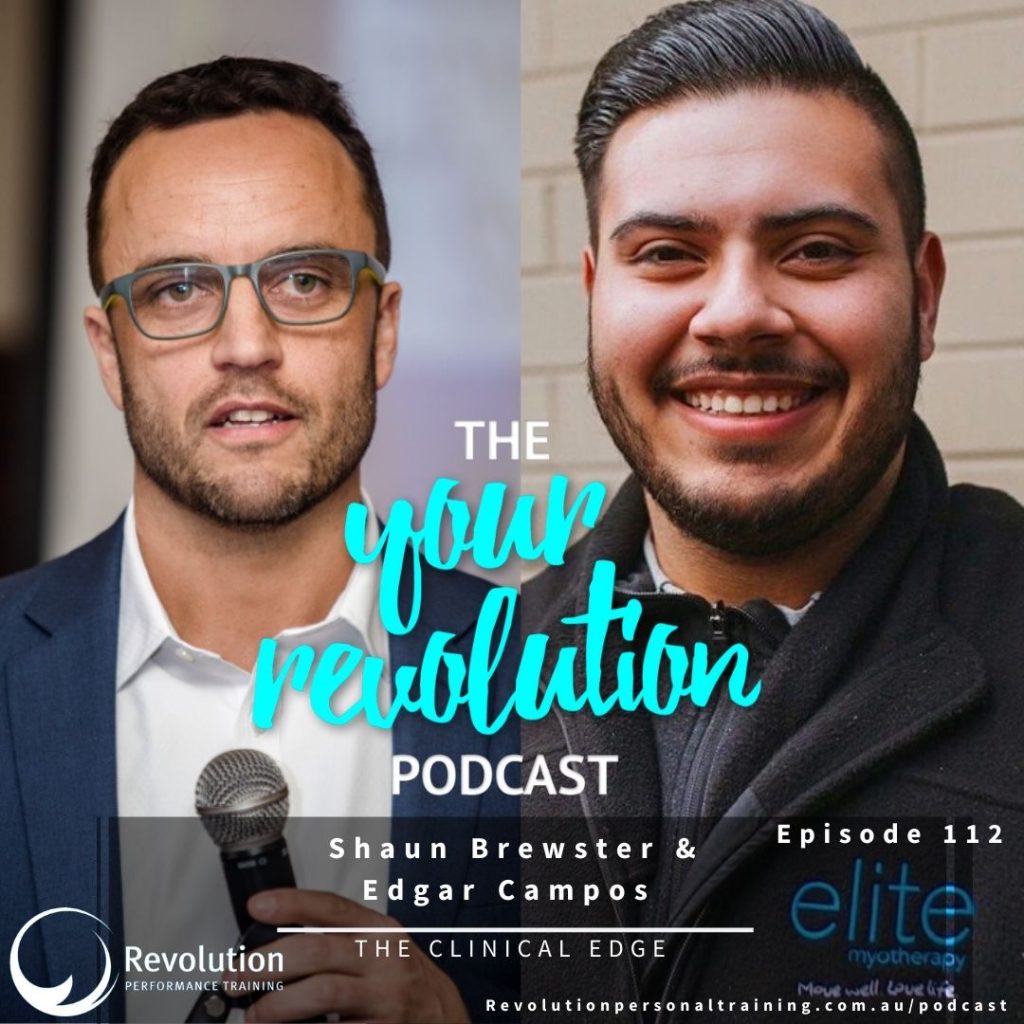
The Your Revolution Podcast is back with Episode 112
With Greg Kourpanidis as your host, join him on this special episode where he sits down with Myotherapist Edgar Campos and Myotherapist and exercise Physiologist Shaun Brewster.
Edgar is an experienced myotherapist and franchise owner of Elite Myotherapy Essendon and Shaun is the founder/director of Advanced clinical education and Brewster sports injury clinic.
You do not want to miss this star-studded line up as they sit down with one of their own Greg to talk all things in the health and wellness industry and drawing from all of their experiences from their own personal journeys and unique backgrounds.
With two guests featuring expect to be filled with knowledge bombs and plenty of banter!
About the guest: Shaun Brewster & Edgar Campos
The team behind The Clinical Edge, bridging rehabilitation and performance.
Episode transcript
Hello and welcome to the Your Revolution podcast. The Your Revolution podcast is a collaboration between Revolution, Personal and Performance Training in Melbourne and the Meeper Project. The purpose of the Your Revolution podcast is to inspire you on your mission of betterment. Each week on the podcast you’ll meet game changes who have created extraordinary lives and you’ll listen to stories and lessons to empower you to make the changes necessary to your life.
The Your Revolution podcast is committed to fitness, health, nutrition, mindset, community, education, empowerment and betterment and we hope that you can take what you learn here and apply 112 of the Your Revolution podcast. Today we’ve got a big episode lined up as I’m going to be joined by two guests today. That’s right. You heard me correctly too.
Both guests come from the manual therapy world like myself who I’ve both known since I started studying as a myotherapist in 2012. So without further ado, let’s welcome Edgar Campos and Sean Brewster. Gentlemen, how’s it going? – Good, thanks for having us. – Thanks for having us. – Absolutely, good to be here. – Yeah, absolutely. Welcome on the podcast.
Super excited to have you both on. I’ll be ready to begin. – Absolutely, born ready. – Born ready, righty. So before we dive in, as we always do, when I kick off the episode, I thought it would be a good opportunity for both of you to firstly give our listeners an introduction into who you are and your journey through health and fitness. Let’s start with you, Edgar.
– Yeah, sure. I suppose it all kind of begins at home for me. I had a dad who was very much like into his fitness, you know, he always kept him good Nick. And then that trickled down to my brothers and I, we grew up in a Latin American family. So football or soccer was the main thing, you know, we loved. And it’s just always been a part of our lives essentially.
So that’s where my kind of initial passion or real interest begun for not sport and health in general. Yep and fantastic and yourself Sean. So my name is Sean, I’m a cancer and I like long walk to the beach. Sorry, wrong meaning. No I can hardly hear anything. No, one-aged Sean Bruce, my therapist, exercise physiologist, this has been my passion, my career for the last 20 plus years.
I knew from very pretty fortunate, I knew from about the right body, I did about 14 that this is the industry that I wanted to work in. Started doing courses at about 15, graduated high school, moved to the city from the country. Started studying, found myself in my therapy, branched out did some other things after that. Been in clinical practice for, I guess, 20 years and found myself in a teaching role a couple of years after graduating and that became my second passion.
So now I split my time between clinical work and teaching training therapists around the country through my other business. Okay. Yeah. Fantastic. Now I guess a question I can follow up for both of you. Can you sort of further elaborate on just your own personal health journey and I suppose how you both got from where you are now? I guess let’s talk about, yeah, the beginning.
Yeah, so for me when I was in high school, you know, you got to answer that. Hey, John question, you know, what do I want to do for the rest of my life or what do I want to do now? So for me, I outlined that yeah, absolutely. I’d love to do something in health It had to be social, you know, I love being around people. So that was a bit of banter. It’s a bit of banter.
Never heard anyone. And you know, if it could be flexible, even better and above all, you know, how can I contribute? How can I help? So I went to an open day at ACSD, Australian College of Sports Therapy. And I sat in a chat, I absolutely loved what I heard and I thought to myself if I can align this, well my therapy with the possibility of working with elite athletes, I’m onto something here.
So I think we’ve all been through that little snippet in our my therapy or health professional life where you’re like, yeah, I wouldn’t work with elite athletes. As I started to delve deeper into my studies, I found that I’d definitely like to be more on a private practice side of things. So yeah, I went through the entire course. After that, took a little bit of time off just to essentially enjoy myself a little bit.
Up until that point all done is study. So yeah, I’m going to be straight, bummed around for about six months. Yeah, just like I said, enjoy myself. And then from there I’ve begun my journey. I began as a therapist at LA Myotherapy. I worked as a subcontractor for two and a half years or so. And with Elite, they offered the possibility of franchising and having your own kind of clinical setup.
And for me, I reached a point where I needed a new challenge. And we have since opened up that location in Essendon. And we a slight bit over a year so year and a quarter and they’re very much loving what I’m doing at the moment. Okay fantastic. Now we should also point out is that’s actually where we all met at the Toronto College of Sports there so Ed, you and I are actually colleagues together and I believe one of our first subjects was if you story.
– That’s after. – Yeah. – But here we are, about seven, nine years later, eight years later. – Shit. – All in different paths and doing different things and basically owning your career, so it’s good. It’s good to see you guys where you’ve come from and where you are now. – As a student, I think coming out of high school, maturity is still ground level, of course.
– level. I was just chasing a good time, meeting new people and everything. But I was one of those students that I could just switch it on as I needed. Like nine times out of ten, I was just enjoying myself. I actually remember the first time we actually caught up. It was the very first class. I think it was one Michael Jeffery, you might have been to it.
I remember you walked in because you were all in Manchester United and I was like, who is this guy? Like Oliver Kit head the toe? Yeah, exactly. Very much a football soccer, a huge passion in my life. So I’m not continuing to do this thing. No, absolutely. Nothing wrong with that. Now, as for yourself, I’m sure you did touch on that you also started from all life from a clinical side, practicing into teaching as well.
Can you kind of further elaborate on that and transition I suppose? Is the teaching side of things started for me pretty early on? I got into martial arts when I was 11 or 12. Yep. And that pretty much consumed my life outside of school and family stuff. For the next probably a couple of decades, I started teaching martial arts when I was about 15 or 16 and I’m taking over the school that I was training at at that point at about that age as well.
So teaching is something I found myself in and found pretty comfortable with early on and then moved to Melbourne to study and then continued teaching martial arts and my understanding of what my interest in learning more about human body probably came from that. So that’s what I said about age 14, 15, I knew what I wanted to do. It probably came from my fascination with the human body and how it broke and then how you could fix it when it’s broken.
And anatomy and physiology had a couple of good mentors along the way. And so that’s where that branched out from. I eventually did martial arts as a part-time career for a long time, teaching that. And then just due to proximity and location and moving around different places, I had to give that away. But then got into running and got into running in a big way and running really, really far trail running.
So ultra marathon trail running. So again, the new passion then was understanding the human body and how it moved over long distances. And that formed a big foundation of what I did clinically for a long time. I had a business around running and get coaching. So again, teaching was sort of part of the natural order of things for me. And I still do a bit of running coaching now for trail runners and ultra distance runners.
So understanding the human body and how it breaks when you’re running can be a big thing. So I guess I specialized in lower limb and endurance sports type patients that were coming through the clinic and I still see a fair bit of that. So yeah, I guess my passions are outside of my career in a big way informed what I ended up doing inside my career.
Yeah. So where I tried like Edgar, tried to combine the things I was really interested in passionate about into my career so that I can make that passion kind of overflowing down the parts of my life. Yeah. Yeah. No, absolutely. Well, great answer. Now, it’s all one question for you both get asked a lot is what is my therapy? In your own words, you’d say that we would differ from a physio, a chiro and whatnot.
That’s a good question. I’m hungry. Look, for starters for me, we all have our place. I don’t bash any other professions. We all have a role to play. So we’re at some osteo, physio, chiro, etc. We all have a role to play. So the way I break it down, you know, as my therapist, my translating to muscle, so muscle therapist, we specialize in treating the muscular’s good system and conditions and pains that come with it.
You know, every other profession has their own little niche. We all have things that we excel in. So like I said, there’s a place for all of us and really we should all be looking to collaborate and just get the best possible result for the client patient depending on how you look at it. What I guess do you say is like a common misconception with a minor?
The number one thing is you know I’m coming in for a massage. And no disrespect to any massage therapist out there but you know just in regards to our qualification it just that next level up. It’s just that I suppose more of a clinical eye if you will. Yeah, just having a bit of a deeper understanding regards to any issues that may be arising in the body.
And I think that that’s all true and I’m probably able to say that you can go and see five different myotherapists and have five completely different treatments. And so while I treat a lot like an osteo sometimes and then sometimes it’s a lot like a physio and then sometimes. But again, if you see five different physios or osteos, they’re going to be different too.
So when it comes down to the differences between my therapy and other things, it really does come down to the therapist preferences and the way they treat. All of us manual therapists in health in health profession get a similar kind of foundational training. Yeah. And then there’s those special niches that we, you know, branch out into and, you know, chiropractor or an osteopath are going to adjust and do manipulation of the joints.
Yeah. More than a physio, but they can also do that. And they’re also trained to do that. Whereas my therapists are less about manipulating more about mobilizing and working with soft tissues, but really it does come down to the individual. So it’s a hard one to put a sentence on and say this is what a biotherapist is, but my therapist uses a range of different tools like any other therapist does with a focus more on soft tissues and probably on average the consultation time with the my therapist is usually longer than you’d see with a physio-Austiara chiro.
And the other thing I’ll add onto that is from the perspective if you’ve never seen an osteo-navic chiro you don’t quite understand. Ask the question or even better yet get tired. That’s something that I tried to do, you know, like quite young in my career, first couple of years I had no idea what they were doing. So I booked in and tried to understand they work a little bit better.
And yeah, you know, you get a good base knowledge of what everyone does. – And a healthy respect for everybody too. – Yeah, that’s a great point. I mean, I first started, I was very lucky. I worked at a place called Stable Health and worked with like multiple practitioners and it wasn’t just, even though like the component that Umbrella is a stable massage, it’s best being able to work with other like austere paths, naturopaths, half these therapists when I started didn’t even know what they were and yeah like you said, I actually went up and see them and then actually could you know, I guess comment or give an actual opinion if someone asked me what they were so no, no, excellent point.
Now I guess further building on you know, for some listeners, as we’re kind of talking, if you’ve never really seen a myotherapist, can you, I guess, both touch on what a typical appointment would look like for both you and I suppose the certainness as modalities or techniques that you would use. Yeah. So, uh, for me and Edgar, I think we probably treat fairly similar to be honest, but I’ll let him answer as well.
For me, a session can be anywhere between 30 and 60 minutes on average. Someone comes in, typically I see a lot of sports injuries just by the demographic of my clinic. They’ll come in with an ache or a pain or a problem. There’s an assessment component of that. So we do a physical assessment, neurological assessment, functional assessment, depending on what’s relevant.
And then sort of spell out a treatment plan for them, what we hope to achieve. And then I’ll use a number of different modalities. Sometimes it’s massage or soft tissue work. Sometimes it’s cupping, dry needling, joint mobilization, taping, electro therapies, a whole bunch of different things. And every treatment could be completely different from the last, based on what they need.
There’s a reassessment, some home advice on what they can do to support what I’ve done, and if I’ve done my job well, I’ll never see them again. We should do a good job. – Yeah, come back again. – The less I see them, the better I’m doing. – Yeah, okay. – We’re working down. – Yeah, so from a treatment standpoint, I pretty much put my hand up and say that’s very similar to what I get.
It’s you got a cater in regards to what they need. So yeah, I mean what a session generally looks like for me is first and foremost I’m trying to understand what’s going on as best as possible. So you sit there and you listen to what this person has to stay at the end of. And then from there I’m really trying to understand what they’re trying to get at.
You know, is that I want to get in and out of here as quickly as I can. I’m trying to run a marathon or I’d love to be able to play tennis. Just understanding what this person wants as an outcome and then understanding why they are motivated by that. So why do you want to play tennis? So I can one day tap back into that. And then yeah, like Sean kind of alluded to, you know, you have your Typical kind of assessments that you want to look at wherever you function or screen the posture Whatever else and then yeah, you know, I like to think of myself as a fairly hands-on therapist.
Yep That’s how I like to treat personally, but like I said, it’s all depending on What kind of course of action will pretty much bring you the best results that dictate the treatment. No, absolutely. And I said, would you both agree just how crucial is that first sort of initial appointment is in terms of getting the, is the right sort of subjective information?
Make or break it. Yeah. Yeah. And not only that, the biggest part of being effective therapists that we are, I think we undersell is building rapport with the person. So it is, I know a big advocate for this is quite good at it. Sitting down with that person and getting their trust so that no matter what you do in that session, they’re on board. And then they’re going to listen to you and take your advice.
And that happens in the first three minutes. And then you just build on it from there. – And so nothing to touch on is, you guys mentioned about the only treatment plan. They wanted the biggest mistake I made as a therapist is when I first started treating as I had this idea that I could fix someone the moment they walked in. – That’s wrong with that.
– Well, none of this is wrong with that, but it was this idea of not having to expose me until the client, okay, well, – This might take a while. – This might take a while. – Yeah, you know, I’m joking. I think I’m very talented, but I feel like I can do it all the way. But being able to suppose that some clients, they come in, they think they can just get fixed in one session.
– Which they can sometimes. – They can, yeah. – But our job is to identify when that’s a possibility and when it’s not. – Yeah, yeah. – And spell that out to people. Yeah. – Okay. Not very good. All right. Now, slightly as we’re switching gears here, suppose can you guys touch on areas, is that you sort of specialise a bit more and I suppose other ways, I suppose that you diagnose sort of health issues, there’s sort of certain tests or assessments to do or do you refer?
Yeah. weight training and then my reputation has been in the endurance sport world. So runners triathletes for the lot of long distance runners specifically. And so that’s kind of where I’ve gotten most of my client’s help and where the kind of people that typically come and see me. So when it comes to assessment and things that I focus on with that, there’s a lot of functional assessments.
So rather than just orthopedic assessment, testing one structure or one tissue, I’ll look at the body and how they move. So if it’s a runner, I’ll actually take them out of the road and have them run up and down the road and watch their form because they’re not what I’m looking for. Yeah. That’s right. But it’s not always specific, not always appropriate every person.
So other times they’ll say, I’m having trouble with my back squat or something. So let’s get in stairs, get in the gym and let’s put a bar in you and see a move. So we try to tailor the assessment to the person’s individual presentation as much as possible and try to make it as functional as possible because people coming with a complaint they either have pain or they have problems doing something.
And so if it’s not a pain thing, we go show me the thing that you’re doing and I’ll try to look for clues within that to see. – Do that’s a bit of like a point of difference here compared to other therapists. You’re able to suppose to practically apply as well as your assessment or technique. – It’s something that’s, I think it’s something that new therapists really struggle to do because they don’t learn functional assessment is really a process of your, your detective.
So you’re looking for clues in a story and the story is their movement. It’s really hard to teach that because it relies completely on your understanding of anatomy, physiology and biomechanics and you learn all that stuff but putting the clues together that give you the solution to that mystery is something that takes practice. So I mean, I was rubbish at in the beginning and I’ve gotten better at over time.
So I don’t know if it’s a point of difference, but I think any therapist that’s been in the game for a long time gets better at it. – But you have an exercise physiology background, so it’s been true. – I do. – That qualification came sort of halfway through my career. It wasn’t always there. But I’ve always been fascinated by human body and how it moves.
So my interest in trying to solve those riddles has been there. The exercise physiology background, I don’t know whether that impacted my ability to do it greatly. But I think that being the changed or improved my ability the most was just starting to pay attention to movement and then looking for clues in the movement and seeing how that related back to the person’s presentation.
And it’s just a time thing. I couldn’t actually sit you down and teach you how to do it. I don’t think it’d be. Here’s some key things I look for now. Can you solve that problem with that information? Yeah, yeah, okay. Yeah, so I understood the question now. So yeah, I mean it’s trying to keep it as relevant as possible to what they are complaining with.
So for example, you know, it hurts when I am swinging the tennis racket. You you know you kind of want to break down that movement and think about what’s happening there. And another thing that I really like to look at is actually understanding people so the emotional and mental state can hugely impact your pain and what’s being perceived and there’s a bunch of other factors that come into a person.
You know we’re looking at their sleep, we’re talking about their diet, any kind of stomach issues they might have, general stress, how’s work going, just encompassing what an entire human is about essentially. Aside from just the physical that we look at. – Okay, good answer. – I think that there’s a big shift, and I don’t know, you might this question later, but there’s a big shift in in the manual therapy health profession away from the physical body and towards this the psychosomatic emotional kind of side of things and that’s a good thing because it’s been lacking.
Yeah, but it’s also a dangerous thing if we go too far in the direction. So I think that a lot of the health professional world is getting very very much deeply entrenched in this bio-psycho-social model where we have to just understand the person’s emotions the way they’re thinking and perceiving their pain and then reverse-engineer their pain by talking to them.
That’s true to a degree but then there’s also a lot we can do physically with that body to help move that process along. So I think that it’s a fine balance. Yeah, absolutely. And so I think going down a rabbit hole too far in any one direction can be a problem. But the understanding the psychological component to it, the mental and emotional component to it is something that’s been lacking for a long time.
Born the recognised. Yeah, so it’s definitely important to recognise without seeing it as the only answer. Yeah. Okay. Good answer. Now I thought it’d be a good idea to debunk a few things about my therapy and our treatment techniques. Probably one of the first ones would be dry needling or some people would think it would be acupuncture. How do I suppose do you break that down the cell because that’s probably one of the big things most will come in if you talk about dry needling or is it like acupuncture?
What would you say is the biggest difference? about – You’re right, has been perceived as being similar to or somewhat like acupuncture for a long time. And I know in my own business, if I ever post anything on social media about the differences between or the similarities of acupuncture and dry kneeling, I can sit back with a box of popcorn and watch the comments and I can let’s flow for the next 72 hours.
There’s a lot of protection going on, some protection going on from world around dry niggling because a good acupuncturist is also trained in niggling of type, you know, responsive or irritated soft tissues. So they do something called arshi point niggling where they need all points that are tender in tissue. And that looks very similar to dry niggling.
Okay, but it is still based on some Chinese medicine principles which are a world apart from what we do in the Western medical world. When we’re looking at dry knee lean, we’re looking at specifically tight spots in muscles, how they refer pain in the body, my facial pain, and then eliminating those points using needles or at least reducing the symptoms of them.
And so one is based on a very esoteric traditional Chinese medicine and the idea of energy flowing through the body, dry needlings based on tension, held in connective tissues and muscles that produces physical pain. They both look the same because we use the same kind of needles. The outcome should theoretically be the same, but the science and the principles they’re based on couldn’t be further apart.
Yeah, that’s absolutely. Yeah, absolutely. And add to that, it’s your easy. Absolutely. I have your passion. You’re welcome. I have to contribute. No, very good. Well, boy, the second one, it seems to follow ears cupping. They often see, you know, a client or anyone really walking around with these massive marks on their back. I know initially when a lot of people probably maybe I’d say about five, 10 years ago, it used to be sort of very like sort of frowned upon.
But now it seems like a more of a, so as a common practice, do you both sort of use cupping a lot in your, I suppose, practice and yeah. – Yes, I mean, suppose, I suppose it’s go through a few things. moving a little bit better. Sean has got an incredible little thing that he’s got going on with functional release cupping. I highly recommend you guys at least look at it if not taking his course.
But actually I’ll handle those. I think segway isn’t it? Again they’re both the fun, they’re the facial cupping and traditional cupping again come from the east and the west. So traditional Chinese medicine was kind of one of the first places that cupping was used it goes back a couple thousand years And so again two different sciences two different approaches and different I guess understandings of how it’s working But the way we do use it in my therapy is very much the western facial style of cupping Yeah creates a decompression in the tissue, lifts the tissues, creates separation.
You’ll get some bruising in some cases. And that’s literally just the superficial, vascular child, the small blood vessels under the skin that are literally being broken by the tension created by the cup. Which creates a tiny bruise, doesn’t feel like a bruise is not sore, but does leave a bit of a mark for a few days till a week. There’s no real demonstrated negative impact of that bruise.
It’s kind of like just an unfortunate side effect. People will say that the cupping helps remove toxins from the tissue and waste products. We’ve completely disproven that. That is not what happens at all. In fact, if anything, it slows down the movement of those toxins. If you’ve actually got any toxin in your body, truth is we’ve all got toxins. They’re meant to be there.
Can’t move them out unless we cut a hole in our body and push them out through the hole. And so it’s claiming that we can do it with cupping or massage is a bit of a joke. But as far as what it does to the connective tissue and the muscle, we definitely can see results with that and measurable results too. Immediately as well. – Okay, very good. Now, I brought the last one now.
I actually, the person is very like an underrated technologist. Sean again will be able to answer this. Is joint mobilizations. May as a great technic, I’ve always liked to use, no in terms of actually this trading, but also actually assessing joint movement, joint play. Yeah, I suppose can you both sort of layer it on that and it’s place and you use it or whatnot?
– I guess the biggest thing to understand is that there’s a difference between joint mobilization and joint manipulation. You go to a osteophyseo, chorose, my therapist would do that high velocity little crack. With the spine or the shoulder, the elbow, whatever in a certain direction, you get this little pop. – Yeah, I’m not a fan personally. – You’re a fan of that?
– I love it. – You love it. – Yeah. – I think I’ve got a frustrated chiropractor inside me too. – Yeah. – But really that’s a manipulation and it’s harder to control requires a lot more skill. The outcome can be similar to mobilization, but the difference with mobilization is it’s slow, it’s rhythmic, it’s controlled, if at any time you have pain with it the patient can kind of tense up to protect against it and stop the movement.
You’re just basically taking the ends of two bones, gliding them against one another to increase mobility, increase, snove your fluid circulation and the joint and health of the joint. And so it’s within the joints range and it’s right. It’s always comfortable. Yes. You should never be any pain with mobilization. They shouldn’t be pain with manipulation either.
Yeah. But if you do have pain, it’s usually because the therapist has assessed you incorrectly or they’ve done the techniques slightly, you know, perfectly. Yeah. Yeah. For me, I’ve always loved it as a complimentary treatment. So like I said, it’s first and foremost understanding why you’re going to be absolutely actually joint mobilizing. So, you know, is it more of a muscular issue that I’m looking at here or more of a joint specific issue?
And then really tailoring your treatment from there, but it’s just something that fantastically can complement anything you’ve just done from a soft tissue perspective. Absolutely. Brilliant. Now, so as I ask a question for both of you is what is that you’re most passionate about? Yeah, that’s an easy one. So for me, I come back to the original reason that I started my health journey or working within my therapy.
It’s to make a difference. So for me, I’ve always said as a health practitioner, if you do your job properly, you can greatly impact someone’s life. You can make a world of change. I’ve always said pain does funny things to people. You see what they’re like as a broad product when they first come in. They’re a bit more quiet, might be a bit more grouchy.
All of a sudden after the third or fourth session, if things are going well, you start to see, you know, a real person coming through what they really like. So, for me, just being able to impact people on a positive level is my passion. – Yeah. – Essentially, just trying to make a positive difference in this world through this modality, essentially.
– Yeah, I think I’m along the same lines. I remember when I was in probably primary school people said, “What do you want to be when you grow up?” And I went through all these different waves of decisions like, “Oh, I’m going to be this person or that person.” And everything when I look back was an occupation that had an impact somehow in society. Like it was not going to be someone who sat behind a desk and nobody saw.
They just completed tasks that were important, but not necessarily impacting anyone dramatically. And I always felt like I was a person who was a person who was a person who was a person who was a person who was a person who was a person who was a person who was a person who was a person who was a person who was a person who was a person who was a person who was a person who was a person who was a person who was a person who was a person who was a person who was a person who was a person who was a person who was a person who was a person who was a person who was a person who was a person who was a person who was a person who was a person who was a person who was a person who was a person who was a person who was a person who was a person who was a person who was a person who was a person who was a person who was a person who was a person who was a person who was a person who was a person who was a person who was a person who was a person who was a person who was a person who was a person who was a person who was a person who was a person who was a person who was a person who was a person who was a person who was a person who was a person who was a person who was a person who was a person who was a person who was a person who was a person who was a person who was a person who was a person who was a person who was a person who was a person who was a person who was a person who was a person who was a person who was a person who was a person who was a person who was a person who was someone who sat behind a desk and nobody saw.
They just completed tasks that were important but not necessarily impacting anyone dramatically. I always felt like I needed to do something that would matter. So as a therapist, I’ve told this story a million times and I still think about it. One of my first ever lectures that I went to at university teachers sat in front of me and said, “You guys have got the most amazing opportunity here because you get to improve the quality of people’s lives and reduce their pain every day.”
And that is cool. And it just stuck with me forever. So that’s just exactly like it. You’re the same thing you were impacting people’s lives. And now in a teaching role with my advanced clinical education business, I get to do that for therapists so that they can do that for more people. So I get to train people, increase their skill and skill level and understanding of knowledge so that they can help more people even better.
So it’s like a dropping a stone and a pond in the ripple spread. Yeah, that’s kind of how I see the teaching side of things for me. Perfect, good answer. So it’s just further expanding a little bit on the earlier question is where I guess do you both see some of the challenges that we face that industry? I mean for me personally one of them is as far as the not having I suppose one sort of recognized body and I suppose as all the citizens I do these multiple courses and you know offering my therapy and you know different names and sort of this whole I don’t know so it’s like competition and whatnot so Sean you, you’ve experienced being an endeavor and…
– Yep, taught us ecologists. – So ecologists as well. – That would be involved with different situations. – Yep, but I’m sure obviously I’d give Kelsey answers as well. Yeah, who would… – I think I’m just gonna address the elephant straight away. From a financial point of view, there’s a bit of a misconception that with my therapy, can’t have the life that you want okay From an income point of view yeah, absolutely.
Yeah, it’s one of the most common things that is bought up So I mean look without beating around for sure the start isn’t glamorous at all you do have to Put your graft in you have to become a good therapist and then from a financial point of view that’s what comes after, that’s the result. So I’d argue that maybe it’s just not done well enough at the moment.
From a business point of view, we’re not, we’re taught very limited. We’re taught everything else that is encompassed in it, but from a business point of view that’s definitely something that we need to improve on I’d say yeah absolutely it’s a it’s a gaping hole yeah training space as far as you ask probably why we lose a lot of therapists actually you know to be hundred and ten percent honest so do you think people sort of come in I’ll come out of University College and sort of just think yeah they’re gonna kill it they’re gonna kill it make a lot of money or all that well they go let’s get a job and go work for somebody and they earn half, if not less, of what they’re bringing through the door as far as client receipts.
And so they see themselves working 30, 40 hours a week and they’re making what they could make working employed in a restaurant or something, but waiting tables almost in some cases. And so they’ll be disheartening. I did all this training. I’m super qualified. I’m helping people. I’m doing good work, but I’m not really getting paid any more than someone down the road who’s doing something.
Didn’t require that training experience. And so you’re right. It’s frustrating and obviously it’s gone out into having his own franchise within a larger business. And you can see opportunities, but not everyone gets to that understanding. Yeah. As they’ll see a big difference between where they are and where they want to be but not know how to get there.
Okay. And for some people they’re entrepreneurial minded and they’ll figure that out. Yeah. Others aren’t and they’ll need some help and others just don’t figure it out at all and don’t look for the help and then they fall off the perch. You know, they end up doing something else altogether, which is a real shame because there’s, you know, there’s so much wasted talent at there in our profession that just fades away because they couldn’t find or didn’t know where to look for the opportunities they needed.
And so business acumen is a big part of that, but not everyone’s designed to run their own business. And so things like franchises like a magazine now is a great opportunity for someone who doesn’t want all the help of starting from scratch but wants to be able to run their own show. Perfect. And then for those who just want to turn up at work and collect a paycheck, there’s plenty of work for those too.
But I was talking to a guy this morning, he treats his last week. He saw 40 clients. So if you’re charging in at 100 bucks an hour, that’s $4,000. If you can’t live off $4,000 a week, there’s something wrong with you. So you can make a good earning. Wow. Make a good earning. And then grow your business and have multiple therapists and that living goes up again.
So there’s no excuse for not being able to make a living out of this career if you’re good at what you do and you’re passionate about what you done that. And we want to see you guys do well. – There’s so many people out there that have got the experience and are having to share it. If you come across somebody who doesn’t want to give you advice, because they think you’re going to steal their clients or move into their territory, they are not the person to give you advice.
Anyone who’s worth their soul is happy to give away every bit of knowledge in their head. they know they’re good enough not to get taken down by Absolutely. Yep. Did you both so have mentors? Are you self personally? Yeah, I’m sitting next to mine Yeah, you better couple of good mentors. Yeah, so I’m definitely so Sam and Mark who Run elite my therapy there Not only mentors, but you know, I yeah, you know, I’m getting a bit cheesy here But Sam is more or less like a second month for me.
I came to Elite as well as I was a boy. Not only did they develop definitely on the path to becoming the person that I’d like to become in. I have a great deal of that to Mark and Sam and of course, Sean. I’ve had very few formal mentors. Yeah, but a lot of people that I aspire to be like and watch closely. Okay. So early on, I had people that I never said you’re my mentor, but I spent a lot of time with them, watch what they did and kind of mirrored that to a certain degree and went, “Yeah, this is working really well.
I like how they’re doing that.” So I’d take their ideas and they’re happy to give me their suggestions along the way. So less formal mentors, but definitely people that I looked up to and aspire to be like. – Yep. Yeah. Okay. And so what’s following up from that is, would you guys say, just, I could go to talk about how important how important it is supposed to have that sort of a practical experience or hands-on experience, I suppose going through college or university.
– So for me, as soon as I started my first year, I thought to myself, you know what, I kind of want to get as good as this as quickly as possible. And I also kind of recognised that I wanted to work with elite athletes at the time. And I thought to myself specifically, I wanted to end up at Melbourne victory. That’s the team I support to this day. And it was one of the affiliations that the college had as well.
So I straight away got busy, started talking local soccer clubs, and I got hands on straight away. So I’ve been qualified as my own for five years I believe now. Yeah, I’ve been hands-on since I was 19 and 26 now. Yeah, well, you know, I got my hands on really quick. So yeah, getting into it nice and early was such a good health. And can you just talk about your experience at let’s say like a professional club like Northern Victorian?
What supposed to do? So just take away from that. Yeah, it’s just seeing that sort of how they do it and yeah, I mean the first and foremost you get a look into the day-to-day’s which is pretty amazing. Yeah, I mean, yeah all this fangirling to be kidding me. These are the guys that I Cheed on as a kid and now to be treating them and helping them out on the field is absolutely incredible.
So, getting to see the standard of therapist that is required, so you spend some time with the physios and see how they conduct themselves to do the professionalism and also the kind of culture and relations that have built it as well. So you see the good and the bad, obviously, and you take the positive away from it. So, yeah fun memory is absolutely fish.
And you’ve now applied it also because you’ve worked out a lot with some more local clubs as well. Yeah, absolutely. I’m still working with in teams. Yeah. It’s like I said, it’s a passion of mine. It’s something that I hope will be a part of my life going forward as well. So yeah, absolutely just being able to share that experience with the more local people, they’re not Ailey Flayers, but they still definitely love this sport.
– Yeah, absolutely. – And Sean? – I think you can’t put enough value on experience when it comes to being any kind of hands on therapist. We often use the phrase “mom hands.” You know when you hurt yourself and your mom goes, “Come here here and they just pat you on the head or rugby shoulder or whatever Yeah, right. Yeah, right the mum hands are not something anyone is born with nobody is born with mum hands you develop it over time and so as a therapist The only way you’re gonna get mum hands is spend a lot of time with hands or bodies Tell me I’m wrong though.
Tell Tell me how much I feel better with just how to get on the outro. And so, you know, I spent the first couple of years of my career as a massage therapist in a place where I was paid absolute rubbish and it was a factory. I just pumped out treatments all day long and almost destroyed my body doing it. But I got my hands on thousands of people. And so that set me up for when I went into my own practice I was confident people would lay on the table and you can feel it when a therapist knows what they’re doing even if they don’t do a super technical treatment if they’ve got those good mum hands you can feel instantly you feel okay this person knows what they’re doing and that’s actually again some year can’t learn you’ve just got to develop over time.
So hands on bodies, you’ve got to pay your dues. – Yeah, get busy. – And find yourself if you’re not busy straight away, do a bit of part-time work in someone else’s clinic. There’s nothing about that. – Yeah. – No, no, no. How, most of you can touch this as well, is just how importantly, as far as to look after yourself when you’re early training,.
You do hear commonly a lot of people burn themselves out, you’ve got to get thumbs or not use incorrect techniques or yeah, so what are some of the strategies that you use suppose for your longevity in the industry? I was talking to someone about this the other day actually. I think a lot of people spend, a lot of us spend a lot of time on self care, foam know, foam rolling and stretching and you know eating well and sleeping well and meditating all this up.
Perfect. Keep doing all that. It’s a great idea. Yeah, but I think the thing we forget is the thing that got us so inspired and passionate about our work. You can go and do a super hard physical job in any field, but if you love it, you’ll come home going, ah, feel good. Yeah, you know, it doesn’t matter what the job is. You could be a brook player, which is a tough job, but if you love it, you’ll come home going, ah, feel good.
Yeah, you know, it doesn’t matter what the job is. You could be a brook player, which is a tough job, but if you love it, you’ll come home going, “Ah, feel good.” It doesn’t matter what the job is. You could be a bricklayer, which is a tough job, but if you love lame bricks, you’re going to come home and feel good, even if you’ve done a big day or a big week.
Our job is no different, so you’ve got to stay in spite, so it’s keeping your brain active as well as managing that body overload. So learn new things, read new things, talk to people, network, so that every time you step into the room with a client you feel excited to be there Yeah, and it gives you any if you’d like exercise. Yeah, exercise should make us tired It takes effort to make energy but if we exercise regularly and maintain that we feel better for it gives us energy Yeah, and so your brain works the same way you gotta try and your brain.
We’re gonna keep. Yeah. Yeah, I agree 110% of that. And another thing that I would say is I’m a huge advocate of is get treated yourself. Yep. Okay. If you’re asking people to look after themselves every two to three, four, six weeks, whatever it might be with your session structure, you’ve got to walk the walk as well. You’ve got to be doing what you’re preaching.
And another thing that Sean just alluded to before is the exercise point of view. As health practitioners, we definitely have to be pushing that message. Again, walking the walk ourselves. – You wouldn’t go to an oncologist, a cancer doctor who smelled like smoke. Or a diabetes doctor who was overweight. Like you look and go, are you what you’re talking about?
So yeah, we as health practitioners need to be able to go look I’m taking my own advice and I’m better for it Yeah, and people give you more respect as a result and they listen to your advice Yeah, yeah, that’s actually really good point I don’t even times myself whether it was actually in fitness or you know, I suppose as a myotherapist obviously just kind of like forget about yourself and whether it’s, you know, exercise.
I mean, probably I was frustrated for me. It’s like when I was not training and like I could be working in a gym and that I’m like not exercising. Like I’m literally in the gym and I’m like, and I’m not doing anything. So now that’s a, um, that’s a very good point. Uh, that’s some, I’ve sort of like closing questions. First of all, if you will start with you, Ed.
Yeah. Is what is one thing you wish you had known when you began your career? Oof. That is a good question. One thing I wish I would have learned. I’m glad they want to do first. Yeah. This gives you a bit of brewing time, I suppose. I knew it all, you know? It’s more of a positive thing because what I would say is I never knew how good this job could make my life.
And what I mean by that is like I have met the most incredible people. Yeah Through his profession. I mean I’m sitting next to you right now. I’m gonna go on boys Yeah, look I and like I said, you know, like Sam has impacted my life greatly some of the people I work with to this day are some of my best friends and not just because of the profession like these guys have moved on yet We remain very close friends.
So yeah, I wish I could have known back then how damn good this is gonna be I don’t have much negativity to say because it’s a process You know, we all find ourselves and do what we have to do And you find out as needed so yeah, I was like under appreciate the time. Oh, yeah Do you think and see where it takes us but man, what a beautiful journey it’s made.
So you feel like a lot of people, I suppose the positive impacts were a lot of people. I never knew what it could do for me and I never knew what it could do for others. I didn’t know it was going to be that good or could be that good. That’s a great answer to that question. Sure. You’ve taken the words out of my eye. It is true though. and I’m so glad I’m hanging there.
Because there’s moments in time I’ve gone through it three or four times in my 20 years. Maybe I could do something else or maybe I shouldn’t be doing this or maybe I’d be better off over here. And you’re hanging there that little bit longer and you get over that hump and you go, you know what, I’m so glad I’m still here.” But if I went back to something really practical, if I was talking to someone who is going through university or college now and studying, the things I would say that I didn’t realize how important they were going to be would be how important it is to understand an out of in physiology and how it’s just a foundation for everything.
I always say it’s in my classes. Everything we learn after you graduate and beyond is an admin physiology as a foundation with principles stacked on top. Everything is just principles stacked on top of your understanding of how the body works so that and then understanding how important the relationships that you build through your career actually end up being.
I can trace back every positive thing that’s happened to me in my career to individual people who have invited me to something, put me in a position, introduced me to somebody, put in the room with somebody, so that they have a particular opportunity that I open a door that turned into something else, and so whenever an island, we always exist as a group, nothing great happens without other people.
And so building and maintaining those relationships. And you never know which relationships are going to work out to be the most valuable. Sure. Great answer. Now, so as I, yeah, you did touch on part of your answer there about, you know, sticking in there. What would you say from each view, your biggest failure and what did you do or how did you learn from it?
So I’ll be shown. throw it to me. Biggest failure. The biggest failure for me… That’s a really hard question to answer because I’m like Edgar, I’m pretty optimistic kind of guy. Yeah. And I don’t see as anything as like it, that shouldn’t have happened. Yeah. letting some of those connections go. So people that I was connected with at different times, that I really valued either friendship or professional relationship behavior that person.
So you lose connections, you lose opportunities through those connections, but you just lose friends over time. And that’s just been the natural course of things. I haven’t intentionally done that. It’s just been you move away or they move away and you lose touch. From a professional career point of view, I don’t really regret anything. I think that everything that I’ve done, whether it’s resulted in a really positive thing or a less positive thing, you see that I can’t even say negative, it’s just less positive, has put me where I am now and I’m so happy in what I’m doing.
There was reason. I wouldn’t change anything. So that’s a really sitting on the fence answer I know. – Yep. – But it’s the best one you’re gonna get, sorry. – Okay, no, fair enough. – Yeah, like Sean said before, you pay your dues, you know what I mean? So for me, yeah, everything very much happened for a reason. I had to, you know, I worked across multiple clinics for a little bit.
And, you know, some of it didn’t work out for whatever reason, but at the same time, you know, I met someone from here or I learned this from there. So I, yeah, I’m not saying I’m perfect yet, but I wouldn’t, I don’t look at these things as failures. I think you’re perfect. Thank you. But yeah, look at them as them as lessons. I don’t look at it as a failure.
Well, I’m always being so negative on that question. But that are good answers for both of you. Now, let’s say for any sort of like new student or someone that’s just wanting to study, what advice would you give to someone who wants to pursue a career or a similar path to each of you? Make sure you actually want to help people first and foremost. If you want to work with elite athletes, and that’s the reason you want to get into this field, get a job as a sports trainer at a football club or whichever sport you want to work in and strap some ankles and tape some shoulders, you’ll get to meet them that way.
If you want to do it just to make money, you think, “Oh, I can earn that four grand a week doing 40 hours as opposed to 800 over here doing this other 40 hour job.” That’s the wrong reason. If you were in it for the people, helping people and feeling good as a result of that, you’ve got to start there. Otherwise, those other things go away. You’ll get bored with the other things.
The money’s never enough. And it doesn’t matter how much you make, you’ll find yourself wanting more in one way or another. And those, you know, the fandom that you get working with, the athletes or whatever it is that you want to be around that’ll wear off too. Yeah, for me, it’s kind of what we have spoken about at least. Understanding your why, you know, why do you get up every morning?
Why do you do what you do? So first and foremost, understanding what you want to do and why you are doing it. And then from there, understanding that this is a grind to start off with, you know, it’s not easy by any means, but it gets better and better and yeah, life only goes up from there really. – Yeah, no, fantastic. Now, I’ll make you can I have a hand to this, but so what are the best resources that you have used or what has helped you along the way?
Ed, go. – Best resource, people. – People? – Absolutely. Like I said to you before, I’ve constantly quizzed and asked questions about any and varying matters. So just like I said, you’re not going back to your mentors asking, what would you do in this situation? Or can I get your feedback on this? So people first and foremost, and then obviously, you know, you get education when you call it, that’s a massive resource.
And then after that, it’s, you know, it’s your professional development. And once again, that comes from people as well. So those are my big resources. Yeah. I don’t know if you agree. Knowing the right Seeking out the right people, put them around you, so gather the right people around you. If the wrong people are around you and they’re leading you somewhere else, you know, flick them, you don’t need them in your life.
So culling is fine if you’ve got too much of the wrong sort of flavour around you. But then probably the most important resource would be outside of people would be curiosity. So that’s not a formal resource, but if you are curious, you can find answers to anything. Either through talking to the right people, doing your own research online, thinking deeply about things, like just be curious.
That you will be amazed how many things you’ve achieved in your life because you’re just interested in it. And you dug a little deeper. little deeper. Yeah. Now, I like that. Now, if you put yourself on both of you, where do you see yourself in the next five years? I want to jump into the view. Five years. You’re 31. Big years. I’d like to think I’d be, I still want to be in this job.
I don’t ever want to see the day where I’m not in this job. I’d love to still be in this. Ideally, I’d like to have opened my second site by that stage. So that’s me from a professional standpoint, I suppose. Yeah. Okay. More of the same. So I’m in clinical practice. I’m traveling a lot teaching. I get to go and meet lots of really interesting people at great conversations.
I just want to do more of that. Yeah. Yeah. I literally want to, I don’t ever try to plan on retiring. The only thing that’ll take me out is if my body lets me out and my brain lets me out, lets me down I should say and other than that I’ll work until I drop because I love it too much. – Mm-hmm, sure. – Not very good. Now one question I like to ask sort of every guest is sort of in regards to work-life balance.
– Yeah. – What would you say are some of the key strategies that you both use in your sort of maybe your own training or treatment, work and life. And yeah, pretty much just walking through a day of yours. So yeah, kind of going back to what I was saying to you before, you know, I, something that was really big for me with my role was the fact that it is quite flexible.
You know, I am now fortunately in a position where I can dictate how much I do or don’t work. And I personally love to work in the evenings because it gives me the best chance to do things that I want to do in the morning. So look, I mean, I’m kind of double-edged here because at the moment I am working six days, but it’s kind of just being organized really.
So, you know, Jim is a huge portion of my life. I love soccer, so I’m finding time to get that. I’m a very social person, so I make my absolute efforts to go and see my friends and spend time with my family. So one of the biggest things I would say is being organized. You know So it’s just figuring out what works for you and run with it. Okay. Yeah, sure.
I actually don’t believe in work-life balance. I don’t think it matters or even exists. Okay. I think it’s about work-life happiness. It’s a good man. And the reason I differentiate it too between balance and happiness is because your life can be completely unbalanced in the eyes of somebody else. Yeah. It can be doing way too much time working and not enough time resting and I’ll have to say, “I need my recovery time.
I need my weekends friend. I need my evenings free.” Whereas I can quite happily, with super excitement and massive amounts of energy, work 18 hours a day for an entire week and be loving life because I’m really inspired or fascinated by what I’m doing or loved what I’m doing. And then the next week I might pull up a bit tired, so I’ll back off a bit.
So I find happiness through variety, spontaneity, creativity. I was working super long hours about a week ago and then I woke up one morning and said, “I’ll part out.” You want to go snorkeling? We’ve never been snorkeling together. And we just snorkeling here on went to the beach, when snorkeling came back and then went back to work. So the ability to decide on any given day what you’re doing based on the needs of that day and what you feel like you want to put into it, that’s my work life happiness.
What’s that saying? Nothing extraordinary, never balanced. Yeah, it’s so true. I love that area. I think that’s a moment in this podcast. That is a pleasure. I just need to snip it. We start with Ed. Yeah, if you were the podcast host, what would you have asked yourself that I don’t know. Sean, is anything coming to you? – Fast ball. – Yeah, I’m gonna give a nice hand.
– Do you want to do it better? – Yeah, I’m gonna sit on this one. – Okay, so what would, I would ask the question, if you could go back to the start of your career, what advice would you give yourself? That’s the question I would ask me. And to answer that a bit of advice, I would say… Take up stripping. No, try that. I would say keep going, it’s going to happen.
Okay. So if you love it hard enough and you put enough into it, you’ll get there no matter what. And leave no doubt, which is my favorite saying, if I ever get a tattoo, That’s the words I’m gonna put on my body Leave no doubt so whatever you do make sure that when you I was the podcast host would be, how did you decide that the Sonic the Hedgehog haircut was for you?
Now, this is an audio podcast. There’s no video. We’re going to attach photos. You’re going to attach photos. It is, I’ve seen it go through a number of different hairstyles. I’ve noticed I’ve noticed this is the most dashing, amazing haircut I’ve seen. It’s Sonic the Hedge and I highly questioned they could do it. Wow. I’ll do 12 games there, one 11 and drew one.
So, full credit to those guys. And I wanted my bet when you’re on it. And then I suppose I’ll just let my hair kind of grow a little bit, cut the sides and sunny the edge over the earth. – Just run with it. – Yeah, absolutely. – Is that works for you? – Yeah, absolutely. – Absolutely. – Absolutely, it does. Oh, very good. Well, yeah, thanks for throwing that one.
– Yeah, I’m on the phone. – Yeah, it’s just curviling. (laughs) No, yeah, good question. We’ll start with you Sean, where can our listeners connect with you online? com is the website, or you can find me on Facebook, Instagram, and now TikTok. – TikTok? This is really guys so I may need to go to the door in a minute because he’s gonna be gonna park like crazy.
TikTok is like Instagram but more video based and you can get super creative with it and it’s a lot of music and dancing and ridiculousness and it’s so much fun so we just started the sounding topic and I’m already getting it because it’s very creative and all of that. Okay you guys can find me on Instagram and I’ll leave my therapist in them then I supply you guys with daily facts.
Absolutely. I’m a necessary viewer. And there we are. Did you call it? Yeah. I don’t know. And it was a website Elite Mytherapy. Yeah, and you can find the larger business. If you you type Elite My Therapy straight into Google, you’ll find us, and not only me, but the other franchise partners and the other therapists that encompass Elite. And yeah, obviously we’ve got our Facebook sites as well.
– Yeah. Okay. – And your clinic, where is your clinic? – I’m located in Essendon. So I’m on 73A Napier Street, and work alongside a few Osteos in the form of lifespan osteopathy and also a naturopath in bio to health. Okay, so you do actually alarm to your fellow therapists. Yeah, so we’re in a multi-modality clinic. Okay. And that kind of goes back to what I was saying.
We all have our place. Yeah. And yeah, we’ll work alongside one of those. back. – So, – So, – So, – So, – So, – I was just talking about that. – No, no, actually, the question is, it’s obviously where can you find it? Is where is your clinic base? So I’m going to find you have a website. – Sure thing. – Yeah, my clinic is in Williamstown, North in Melbourne.
It’s called Brewster Sports Injury Clinic. I don’t have a website because I’ve got a pretty stable clientele and I’m not looking to kind of grow it too much, but I do have some available appointments still. But you can find our Brewster Sports Injury Clinic on Facebook. Best place to find it. – Yeah, very good. Now, as for closing, we always like to finish off with the RoboPT signature 20 questions.
– We got a rapid fire. – Yeah, so rapid fire, so we’ll just work around. It’s usually gonna be short short responses but there may be a few questions we have to give a little bit more and extend response Already yeah, I think we’ll start a words. We’ll start with it and work and then the short okay first of all question one apples oranges Oh, it’s going to be oranges John risky apples Rock or R&B?
A sigh of bowls or all the bowls? Stay. Okay. Do pineapple is blowing pizza day for that. Chocolate or vanilla? Vanilla. Have a look at me. Drive on that again. Drive all day. Either. Don’t care. Okay. Three things he can’t live without. Music, sport and people. People, dogs and my job. Favorite sports team you know Don’t ever know annoying habit favorite movie Yeah, I’m going to go with Sean first.
Now let’s switch it up. There’s all tacos. What three things would you take on a desert island? Food, water and fire. It’s going to keep me alive. Yeah, I’m going, uh, water unlimited food. What’s the best Wi-Fi name you have seen? No, don’t have anything for that one. I don’t really pay attention to different Wi-Fi names. Sprigles box. Sprigles box.
All right. Do you have any superstitions and if yes, what are they superstitions? No, I gotta say no. No, I don’t really know I’ve got one with whatever team I’m working with a bit of array of shoe collections So if we win the game, I am wearing those same shoes as the red next game. – It’s stupid, but it works for me. – I don’t know. We were on your team’s one, the one you lost the bet, you’re from wearing their shoes.
– Yeah, absolutely. – Yeah. All right. – Thank you for that. – All right, okay. If you were not a myotherapist, you would be a… – Teacher, I’m doing that now. – I fell in the mire. I’d still be working within a health somewhere. I I’m not a PT. I’d like to ask you to. Sort of see you as a G-load. Yeah. Or I would just be the funniest, most distracting guy in the audience.
Yeah. I’m a good culture human. I’m a good culture human. I’m a good culture human. I’m a good culture human. I’m a good culture human. I’m a good culture human. I’m a good culture human. I’m a good culture human. I’m a good culture human. I’m a good culture human. I’m a good culture human. I’m a good culture human. I’m a good culture human. I’m a good culture human.
I’m a good culture human. I’m a good culture human. I’m a good culture human. I’m a good culture human. I’m a good culture human. I’m a good culture human. I’m a good culture human. I’m a good culture human. I’m a good culture human. I’m a good culture human. I’m a good culture human. I’m a good culture human. I’m a good culture human. I’m a good culture human.
I’m a good culture human. I’m a good culture human. I’m a good culture human. I’m a good culture human. I’m a good culture human. I’m a good culture human. I’m a good culture human. I’m a good culture human. I’m a good culture human. I’m a good culture human. I’m a good culture human. I’m a good culture human. I’m a good culture human. I’m a good culture human.
I’m a good culture human. I’m a good culture human. I’m a good culture human. I’m a good culture human. I’m a good culture human. I’m a good culture human. I’m a good culture human. I’m a good culture human. I’m a good culture human. I’m a good culture human. I’m a good culture human. I’m a fan of English. Yeah, look it up. You’ll think later. I’ll figure out next All right, if you are if you had two superpowers, what would they be?
I’m going to visibility. Yep flying flying for sure. Oh no no no no get a flying teleportation Okay, so yeah, you’re flying and read your minds. I apologize for trouble and I would just do whatever the opposite of what he’s done for the last few years basically and listen to people and say what they want. Yeah. You’re the wall. Yeah. I’m going to go back.
And to close that with you Sean, what is the most ridiculous facts you know? Most ridiculous fact I know. Yes. You’ve my boys one. and I think it’s actually that’s why yeah, you know this one first thing He’s a little bit more bad. Yeah, I’m just it’s a fact. I am the most loaded my therapist the most ridiculous fact I know It’s really disappointing.
I don’t have an answer for this question. I have I can’t think of a single fact now that you put me on the spot Yeah, I’m actually trying to think back for the fact that I’m ready. Yeah Why don’t you give us a clinical fact? He was a myotherapist. Yeah, I guess Okay, there’s an orthopedic test that is so bizarre, you know All the tests that we learn have got so many names after you know you know Gainesvilleon’s test.
Yeah, no goals test. Tom’s name is Tom’s name. Where’s my name? Dr. Simon. There is a test which name I can’t remember at the moment. It’s named after an individual who invented it for the lower motor neuron where you literally take a glove finger and you poke someone on the perineum which is the spot on your body between your anus and your other bits.
You poke them and you watch the anus to see if it clenches. And if it doesn’t clench, they have a dysfunctional low amount of neuron, and it’s a positive test for them. So somebody came up with that test and then named it after themselves. So the interesting fact is that somebody would actually name the test after themselves. And that’s the interesting thing about the body as well.
I’m going completely left here, but I remember I was having this conversation yesterday with one of the clients like Who would be a good idea to get a needle with someone and say let’s see what happens here. Yeah, and who was the person that was happy to learn? I was very good. I just say well, this is episode 112 is a 1-0. I can assess this one. Well the your revolution podcast Probably the best one you’ve done yet.
Yeah, absolutely. I have to get to of you. Yeah, so I’d like first I’d like to thank Edg you guys and discuss life and the profession a little bit and thank you guys for listening. Yeah, and so great for me to be able to see the journey, particularly of Edgar, I’ve stayed in close contact with him for the last few years to see him evolve and then he touched base again with you, Greg, and to see where you’re up to with things that’s so rewarding from someone in the education sector to be able to watch somebody walk in the door on day one and then to look back almost a decade later and go, “Wow, look what you guys are doing with what you took away.”
So that’s cool. So rewarding for me. – And we remember that business class. – It was a lot of changing. – I was gonna watch it. – How bad did you want it? – I was gonna say, I remember just one of the funniest memories I had in that class. I remember we were all lining up like, shape just to get our result. You know, like 74%, 80%, whatever and then I’m walking up and I’m pretty confident here and then Sean just looked to me dead in the eye and goes, “Bella, next time” and I’m like, “No, I looked at the piece of paper, 100% on the table.”
I remember, I actually do remember that. Oh, come on, man. No, very good. All right, well, thank you very much guys. So stay tuned for the next episode and we will see you next time.
Listen & subscribe
Browse all Your Revolution Podcast episodes, or listen on .
Train with RevoPT
Inspired by this episode? Explore exercise physiology and performance training at our South Melbourne studio.
Listen & subscribe
Catch every episode of the Your Revolution podcast on your favourite platform.
Listen on Spotify More ways to listen