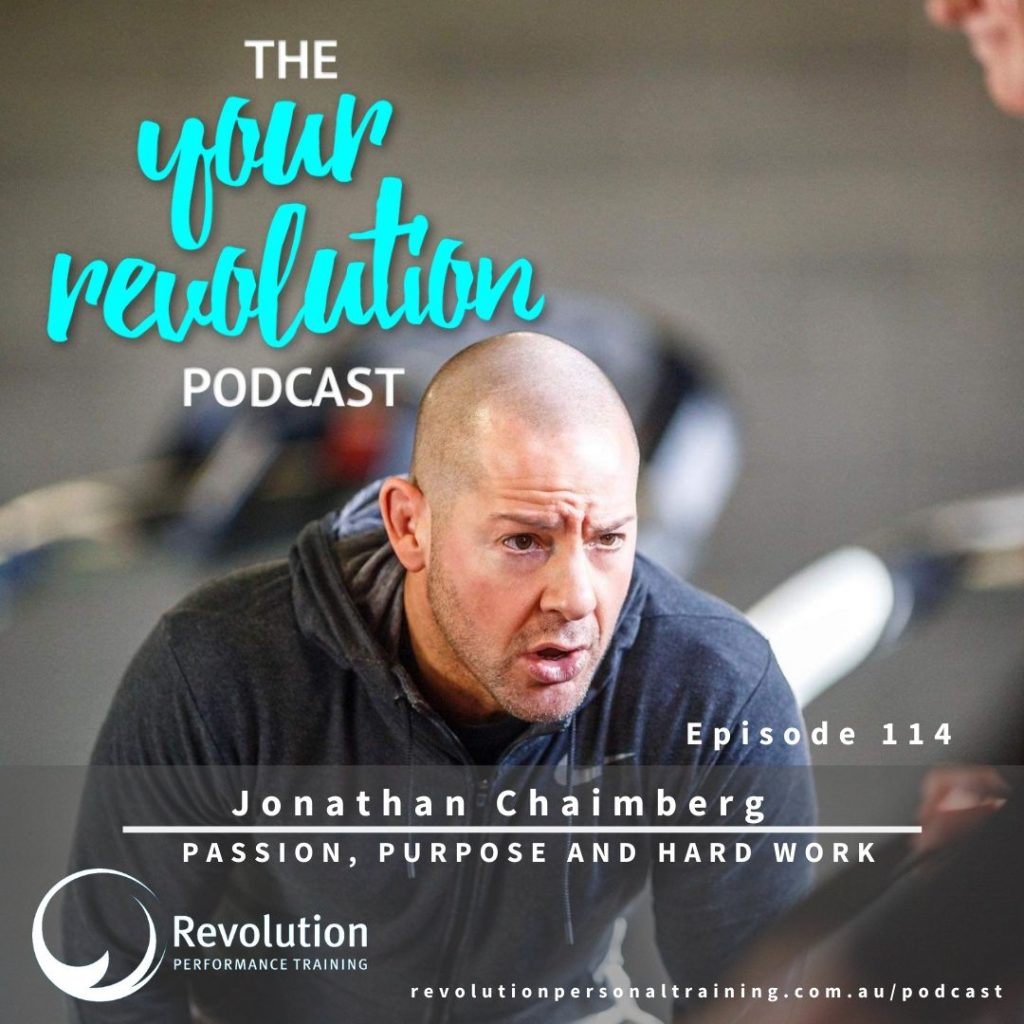
The Your Revolution Podcast is back again for Episode 114!
Join your host @g_alexander21 Greg Kourpanidis on this special episode with internationally renowned Strength and Conditioning Coach and founder of the @apcgym Athletic Performance Centre in Montreal Quebec Canada, @jonchaimberg Jonathan Chaimberg.
With an extensive client base, Mr. Chaimberg has trained elite athletes in the MMA, NHL, MLB, WTA, Professional boxing, and the Canadian National Wrestling team, he has also filmed segments for ESPN.
He is also the strength and conditioning editor of Canada’s number 1 fitness magazine
“Inside Fitness” and his fitness programs have featured on UFC Primetime as well as the Ultimate Fighter on Spike TV.
Tune in as we speak to one of the most respected strength coaches in North America and hear how his passion, purpose, and hard work continue to be his recipe for success.
About the guest: Jon Chaimberg
Elite MMA strength coach (Adrenaline Performance Center) who has trained world champions including Georges St-Pierre.
Episode transcript
Hi guys, my name is Greg Corbinidis and welcome to the Rev. T. Pogmaster, which is brought to you by Revolution Performance Training. I’m an avid trainer and fitness coach, who strives to learn the very best in the world of health and fitness. Join me in this episode and expect a game changers in their chosen fields to share in their story of passion and success.
For all podcast related things, please leave a “Please Subscribe” and check us out on RevoPT/podcast. Enjoy this episode. Welcome to episode 114 of Your Revolution podcast, where I’m joined in the line all the way from Montreal Quebec, Canada, Jonathan Schoenberg. Welcome to your revolution podcast. How you doing? Good to be here. Yeah, no, great to have you.
First of all, we get stuck into this discussion. How is everything going on your side of the world? I’m guessing it’s the same as everywhere. Lock down quarantine. Businesses closed, schools closed. So it’s a big change. Absolutely. Yeah. Very much the same here. I was always athletic my father played professional hockey and I never really saw that I had potential so they invited me you know within months to at that point it was called the well it’s still called the Montreal Wrestling Club which is where all the high level wrestlers from the area and around you know Canada would go plus we had guys like Gia Sory you know we had high level Georgians in Russians that were part of this club.
So it was the highest level of wrestling in Canada. And under Victor Zoberman, I had a huge passion for it right away. And it all just took off for me where I’m a decent athlete and my work level is very, very high. So I was able to pick up a lot in a short period of time just off work ethic alone, but that couldn’t take me to that next level. And I’ll see the combination of the injuries or concussions as well.
to see if I would have seen it through but I’m actually happy with the way my life turned out and took me in this direction and I probably wouldn’t have gotten to this point if I would have seen it wrestling and as far as the rules and how it was always one you know you versus me I mean I like you I think I played a lot of team sports as well was that sort of I guess some of the things that drew you to the sport of wrestling as well?
It’s probably the main thing is that you know in team sports there you could you could always be on you could be off but it doesn’t matter you need other people around you to be successful whereas in wrestling The only person you have to blame or credit is yourself. So you know, whatever you put into it you get out and you know You know you have to put that work in and it’s you there’s no excuses you can’t rely on anybody else There’s there’s even though you’re part of a team.
there’s no real teammates. You’re buying yourself out there. – Yeah, no, no, absolutely. Now, in terms of just talking your transition to being as an athlete to a coach, what would you say was the biggest challenge? – It was my biggest challenge. See, I was lucky as that I got to deal with a very high level of athlete right away is that when I was done wrestling or I took breaks, I was able to train and work with members of the Olympic team right off the bat.
And I think that was my greatest ability to transition was I was one of those athletes at one point. I trained with them. We had a good understanding. I was still young enough where they respected me, but we had some sort of camaraderie. I know what athletes go through. I wouldn’t necessarily give any protocol to an athlete. I wouldn’t have tried myself so they know that I struggled through and helped me a lot was always known as one of the hardest workers in the world.
So I always pushed myself harder than everybody. That’s one of the reasons why I was able to progress, you know, taking up the sport so late and be successful is I had to outwork everybody. I wasn’t going to get there on. There’s just too many guys, you know, Europeans and Russians that were way too far ahead of you technically that you were going to get there on.
There’s just too many guys, Europeans and Russians that were way too far ahead of you technically that you had to work outwork everybody. So I think people respected me in that sense. No, absolutely. It helps to come from, I suppose, an athletic background or to have, I suppose, go to the path that you did to transition to coaching or does that matter?
Do you think it’s a factor or? It all depends on someone’s personality. Obviously, you know, they’re the way they can. You know, the best trait as a coach is you have to be able to make your athlete do what you want them to do. So as weird as that sounds, they have to believe that what you’re telling them is is good for them and beneficial to them and So you need to have some sort of communication skills with them And they have to believe in you and so so the fact that I could demonstrate Whatever technique you know talk about in the gym not not in on the on the mats but technique in the gym exercise I was able to show them I was able to perform with them but but also just that I’d suffer it through it and they believe that this was good for them hmm no great answer and what would you say I suppose the main resources or people you looked up to I suppose in the beginning of your I suppose careers, you know, you’re coming up in fitness so in fitness.
I was lucky is that I Found the is actually a credit to perform better were the first real seminars I went to we’re talking about this is going back probably close 20 years is I chose perform better as I just got lucky enough and that was one of the seminars, the first ones I went to. While I was there, some of the presenters that first week were Mike Boyle, Gary Gray, Stuart McGill.
There was just a lot of high level mark for Stegen. So a lot of high level coaches that were there and I chose to follow them. There were a few other fluffy guys there, but I was lucky enough that I believed that what they were saying made sense. So right off the bat, the Mike Boyle’s the Mark Verstegen’s, the guys who I didn’t even know at the time, but they would help me mold the early part of my career as I was able to build a relationship with Mike and was able to go to Boston a few times to, I don’t know if you want to call it mentor or intern.
It wasn’t really that long a period of time because I was still working with athletes but spent time with him and I would say right off the bat Mike Boyle, Mark Verstig, and when he was with Before Was Exos, he was an athletes performance. So those were some of the two guys that I really looked up to growing up. Okay. Now, did you always work for yourself or did you work like in commercial gyms?
I and what’s what led to you, running your own business? people had a question I would help out, you know that was in my early early 20s and then Like me I guess and I ended up you know even though I was training higher level guys I don’t even know if I was training the high level guys then but I Stepped up into personal trainer there where they rape you for money where you’re training You know a client there for you probably getting an 80/20 split against you.
And I built a clientele there and I decided once I had my clientele it was time to leave. I had bought a house and I put the, I made the basement, my home gym where I trained clients and I did that for a while until Until I bought my first studio and then just progressed to bigger studio to bigger studio to where I am now. Hmm. No, no great and you do you think it’s actually in terms of going back to just training that’s like general population I think that’s very important for someone I suppose it’s starting you know who maybe wants to know because some people I suppose when they get into fitness, they just think, “I want to try and delete athletes.”
Or, “I want to try and do the best.” Do you think it’s very important, I suppose, to start first by training that general population first? I think people have to be their do’s. So nowadays, people just get into the business thinking they’re going to be either internet celebrities, social media stars, or train the highest level athlete right away. And it just doesn’t work like that.
And you can go your whole life never training one high level athlete. So I think people get spoiled nowadays is when you intern or you’re meant to under someone who is credible, they have a lot that you have access to a high level of clients, whether it be professional athletes, amateur athletes, you know, whatever spectrum of clientele that person has, whether it be 62 year old men, to the fittest teens, you have an encyclopedia of knowledge in front of you and as long as you don’t get carried away and think that that’s what you should be doing right off the bat.
That’s why I think that working, putting away ways in turning, mentoring, there should be a process in there where people develop their skills not only socially but obviously intellectually and off of what they read in a book. So there’s no hands-on, there’s no social skills, there’s no changing things on the fly and calling audible based on how your athlete or client feels everything is based on what they read in a book and then and real life does not work like that.
So this is a good little segue into my next part is I suppose fast forwarding a little bit here is can you talk about how APC started? Yes, so again from my home I is I transition to a larger scale. I wanted to bring a public gym that you could train like an athlete, but go to a public gym before what happens is any gym you went to, if you wanted to train like an athlete, being on turf, which no gyms had before, med ball work, power work, pushing sled, agility work, whatever it was, jumping boxes.
You would have to hire a personal trainer and have them run you through a workout so you’d have to deal with only training privately. So I said, how do I bring a safe alternative to let the general public come in and train like athletes or get that athletic training and sort of what we’re exposed now to is you know most gyms have that That they called functional training area I wanted to bring it, you know that as a whole to to the general public.
So that’s how EPC Started okay, and how long has it been open for? This gym here has been open eight years Okay, nice one question there ten years something long. That’s great. Now, I guess describing the, I suppose the day-to-day operations, are you quite hands-on? Like, do you do all the coaching? Do you have staff? How does APC run? I’m the most hands-on coach.
There probably is. 30 in the morning and I’ll be privates all day. And if I’m teaching class, I’m teaching classes, but it’s mostly we have staff that are doing privates and teaching classes. 30 during the day. And we have a great staff that have their private training clients. The entire room is used for private training. When there are bigger classes, we cut that off.
And for the big classes, that gym is basically set aside just for a group training. What sort of numbers are you looking at for the big classes? My classes, I can hold. In the summer, I can hold up to 60 people. Probably more if I wanted to but we because we’ll use outside We have the garage doors we open up so yeah, it’s a good space and We can we can sort of put each station make three or four people per station So you can you can get a good you know you get a good 15 stations with four people and you have a you have 60 people in that you know, normally we like to cut it off around 45 is a good it’s a good it’s a nice that 45 is a nice that nice number for us what would you say makes APC stand out from the rest is the level of training where most of the trainers there have done you know internships mentorships it’s it’s just a different camaraderie.
It’s hard to explain. It’s just a family at APC where the clients all get along. It’s not a huge membership where we’re thousands of people and it’s just a regular gym. You come in and do your work as everybody knows each other. The classes, people suffer together. The private training clients are sort of always around the same time. So they build a relationship with each other.
So you could be doing, let’s say I could be doing a private training session with a few people doing a, you know, my clients and one of my other trainers could have a group of clients that get along with ours. And just halfway through it at end we’ll set up a sledge mill where you know we’re all meshing together doing sites to a sites together we’re doing skier drills together.
It’s a fun atmosphere, it makes training fun. Everybody pushes each other to be better. There’s no real egos and it sort of weeds out you know at most gyms who have bad apples that’ll come in and train and at our gym, being at We Did Out Right Away, so it’s a nice community. People really, really respect each other. Yeah, absolutely. And do you sort of encourage, I mean, you just kind of touch on your answer here, but you kind of encourage even your staff and yourself to kind of, you know, get into those sort of workouts as well and kind of jump in and participate.
I’ll still put them with either the athletes sometimes, I’ll train with them just to feel what it’s like to push themselves advantage. It’s not, they’re always there to encourage some people, some of the classes aren’t for everybody. The conditioning classes are very intense and some people like to lift weights, don’t like to get in there and run out of treadmill or push sled or see at that pace.
But there’s always coaches that sort of stuff, all the stuff you’ve been doing this stuff for a very long time. But I would say long before a lot of other gyms and fitness facilities. What would you sort of, I suppose, credit that? Was that more, I suppose your own experience that kind of exposed you to some of this training? Because you did mention how you wanted to bring all this into a facility without privately doing it.
Yeah. So like, what sort of I suppose, what do you credit that to? Well, like I said, is that I was exposed to a high level of training right away where it came to I immersed myself in those coaches and I would go to back then I would get a seminar every month You know, so I invested myself back then as I enjoyed being around there running some coaches I was able to go to different my mother was Was a staff member at the University of Southern California at one point so I I did some work there with with you know I was able to be exposed to their their football team in the way they trained I went to my place You know he was at that point he was the BU Hockey string coach so I was able to see those those coaches I went to athletes performance in at the point as long beach so I would you know that To be around Mark Kristi again, so I was I was able to be exposed to a lot of different Training principles and what I took from it I mean the same the way in the athlete or the way I wrestled, I took pieces of great wrestlers and tried to build my style to myself.
The same way I would coach is whenever I saw that would work or that fit my style and I tried to build one big style based on all all the good things I tried to steal as much as I can to be honest like I mean that in a good way is I try to steal whatever I saw worked Yeah, and whatever I saw would be beneficial. I just I didn’t get used now for I suppose like any sort of new client or member who would walk through your doors How would you could you describe so what would what would an initial or first session look like?
and just get an idea of what fitness level they’re at. Obviously, their injuries, what their goals are. Every client should have different goals, nobody should have the same exact goals and the same exact path to what they want to do. So you have to sort of build their program design off of what they want and what their limitations are. So training them, getting a good idea from what kind of fitness they’re at at the same point You know just building your relationship with them right away seeing where they want to go and then from there You know your your first session is basically a workout slash assessment and then you know just They’re often running you know if they want to train X amount of times a week, you know I have clients who train five days a week and the other two days They’re doing class of that some clients who train twice a week and do two classes it all depends on You know the volume they want to put in and how many days they want to be the jump now So is that you have a cross of training athletes and also the you know the average normal like general pop population do you train them?
I suppose the same way, you’d be surprised at how many similarities there are in those two divisions, you know, professional athlete and just a regular client is, you know, a lot of the exercise selection is going to be the exact same, you know, they’re going to pull, they’re going to push, hip knee dominant and the conditioning, you know, obviously, from athlete to athlete that the major difference is the conditioning aspect of what their sport demands are.
Obviously a wrestler or a UFC fighter will fight five minutes and get a minute break. And their work rest will be sort of a cyclical means they’ll have a burst of energy and then sort of something, some sort of active recovery whereas I can have a hockey player who has a 45 second shift and it’s not a bench for six minutes. So the major difference in every athlete you’ll train is your work arrest ratio and how you’re gonna train them.
I have the ball players who, they play a six second play and then they get up to 40 seconds to recover. So you have very, very powerful athletes. to recovery, you know, there’s five minute minute round. So the major difference is the conditioning aspect and obviously the power, you know, some 50 year old, 40 year old, 30 year old, you’re not necessarily giving them Olympic lifts based on what their needs are.
You know, if if someone doesn’t need to, I don’t need to clean anymore. I know that if I power clean or I hang clean, I’m gonna hurt my back mean it’s a given with me if I heavy deadlift now my back will go so I know what my limitations are what my triggers are to what I get injured with yeah Most athletes you know what we’ll still need to Olympic lift you know into some capacity and they’re still young enough that their bodies are fine with it The The main thing is mostly the power work and the plyometrics and the jumping you wouldn’t have, you know, I wouldn’t want my average client doesn’t have to do hurdles or high impact plows.
I would keep them away from it and Olympic lifting as well. But you’d be surprised at the similarities of how a regular 60 year old woman and Olympic athlete can train. I mean, if they can chin, if they can, you’d be surprised at the similarities of how a regular 60 year old woman in an Olympic athlete can train him if they can chin, if they can, you know, you would inverted rows, if they can lunge and split squat and there’s a lot of similarities.
Yeah, that’s a great answer. And that actually works one of my next question because observing you from afar, you have always been someone I noticed that didn’t rely on purely the big three lifts such as the bench press squat and the deadlift or Olympic lifts. I’m sure they’re obviously in your programming, but you see a lot of I suppose gyms and I mean even in the gym and I work at what I’ve done in the past is I’ve always kind of relied a lot of my training around these sort of big compound dominant movements.
Yeah, I suppose my question is why I suppose you don’t as well rely on those sort of big lifts, is that stuff? So I was lucky enough to be in a sport where just the workload was so high with the practices and then moving, transitioning to mixed martial arts where I would say you have George or any other athlete. They have so many practices a week where demands are on their training through having a wrestling practice, kickboxing, jitsu.
There’s just so many demands that heavy back squatting was just not in the cards for a lot of the guys, you know, teaching Olympic lifting to an athlete who has never Olympic lifted before was mobility issues. You know, if you’re I I mean, that’s the most important thing is you need to keep that. – Is that more risk than reward? – Exactly. So for guys who already knew how to catch or Olympic lift properly, it’s a great tool, especially if they don’t get any injuries from that.
But to teach a new lift where it’s sort of like putting a square peg into a round hole or whatever that that saying is is you’re trying to force something that doesn’t necessarily need to happen and There’s other ways I can work power I mean if when I first started training George if you if you watch we’re doing one of them snatch primarily as his main Olympic lift back 15, 20 years ago or however long it was, it’s been so long.
But most of my guys, one arm snatch, Bobby Rory was one of the only guys who actually cleaned because his catch was good. And I didn’t have to spend a lot of time teaching the catch. And it wasn’t stressful in his body, he wasn’t getting hurt. Whereas George, his mobility, he couldn’t catch and over the head, if I were to snatch him with a bar, he didn’t have that shoulder mobility so, you know, obviously we worked on getting that mobility and it was a good testing tool but for him to generate power, his snatch was still good, he’s one arm snatch is still good so we would one arm snatch a lot, we do a lot of med ball work so all the power we did was basically primarily through jump squatting plyometrics and one arm snatch so you’ll see that we did Olympic lift back then but that was his Olympic lift.
Some of my hockey players went to a US college, so they have good Olympic lifting form. I have no problems with them, you know, hand-cleaning, but to force an athlete to start learning new movements at an older age, and that might not necessarily fit, there’s other alternatives to those big lifts like Demless. At this stage, an actual bar deadlift.
I know my back can’t handle a certain amount of weight and then once I hit that weight, my back will go. So if you want to actually stress the system and get results, you need to start going heavier, whereas trap bar deadlifts for most athletes will work. So, so I know I can go trap bar instead of bar back squatting for me I’ve always you know the same idea when I load my back certain amount the only way to cheat is forward and I can all I put my lower back at risk whereas front squatting I can sort of get away with that single leg squatting Split squatting rear foot elevated split spots.
I know I can stress and of those lifts where I’m happy I’m looking at your big muscle groups, your back and your lower body. So obviously, chins and rows would be, you know, like, whether it be one arm row, inverted row weighted, weighted chins, and then you’re looking at lower body exercises. So, single leg deadlifts, walking lunges, rear foot elevated foot squats, those are sort of my go-to when it comes to lower body and pressing.
You we, we, I’m okay with dumbbell pressing or any variations of those kind of those presses. Now, how would you describe this as your training systems at APC? My training systems. Hmm. I suppose the way, I suppose you train the club, the clientele, the members, how would you describe is it more? I could dispose is there do you have sort of like string foot power?
metabolic work suppose yes, there’s certain sort of Protocol or something yeah if a client is gonna do power it’s always at the beginning of their workout So anything that’s nervous system related so any kind of you know, they’ll come in The clients will roll out the athletes will roll out. They’ll do their soft tissue by themselves. Yeah, we usually have a protocol where we have a You know warm up where they can do by themselves where you know they come in and each person has sort of their own band drills their own Whether it be the tux cradles.
Whatever a client has is they’re comfortable. Even my athletes will have their comfortable warm up, you know, their comfortable activation. And then once we get into lifting and, you know, the workout always power first. So, a plyometric will always be first, whether it be box jumping, bounding, any kind of jumping will always be first. The med ball drills.
So the power drills are the med balls. So they usually, let’s say, let’s say a simple quad set would be a box jump, a shot put or a side ball toss, some kind of carry. So either a suitcase carry or a farmer walk, maybe one cordial and then something that we call prehab, which is let’s say either shoulder mobility, hip mobility, something to calm the system down to be able to generate power again in the first two lifts, without really taking any time off.
So the bodybuilding principle would be to go to a set, you take water, you go to a set, take water. We just want to roll through. Exactly. Because we want to get in the most bang for our bucket, our workouts. We don’t like taking too many breaks. It’s not a circuit, but we’re not doing anything where we’re competing with another muscle group, but we still want to go from exercise to exercise, where you’re fresh enough to get the most out of that lift.
And once we hit that first quad set or whatever you want to call it, whether there is Olympic lifting or weight or strength training, the next set will do all our strength training next. So all year we will, depending on how the sequence is, it could a vertical pull, a horizontal push, and let’s say a hand, a dumb, and then a core, we’ll put that together in another quad set, and then we’ll do our conditioning all the, most of the time at the end, for people who want to burn a bit more fat and your general public, for them what we we’ll do is we’ll put conditioning, sort of intertwined in the workout where they’ll do some intervals while they’re doing their strength work.
So that’s another place where the client would be a lot different from the actual athlete. Most of the time, almost always my athletes will do their conditioning at the end of their training. and they’ll only sprint by all the good jelly work that day. – That makes sense. Now to actually also going more into that sort of training, why is it that you prefer more full body training as opposed to doing body splits?
– I just never found, I never really found success in the whole upper body, lower body. I’m a big fan more of the vertical pulls, the horizontal pulls, hip knee dominant. I still find that you can get benefit in training more joined by joint approach and not just, you know, we’re going to train upper body today. We’re going to train lower body today.
Yeah. Yeah. So it’s worked for me. I like the whole full body approach. Yeah. But, um, you know, I know a lot of people who, who still swear by upper body lower body days, especially in the world of hockey, but I’ve sort of found success in this way of training. Absolutely. Now in terms of, I suppose, uh I suppose, recovery. How important you say that is in terms of getting results and also as managing potential plateaus that a client could experience in the training?
– It’s huge. I mean, that’s the biggest thing in my career is I’ve worked out many times, is that I tried to catch up to everybody who’s more advanced than me when I came to technique. I just worked too hard and I worked out or I got injured. I’ve adapted my philosophy as I’m growing older. I’m putting in more active recovery days where we’ll do two hard days in a row, what’s in Monday and Tuesday, when they’ll be an active recovery day where they can choose whether they want to go do any kind of mobility work, whether if they, some, some athletes like yoga, I’m not, I’m not sold on yoga, but if they like yoga, they can go to yoga.
We can do, I’m big into that pool, pool for regeneration. So we’ll do the sort of like an easy work out in the pool You know so so I like to split up two hard days regeneration day two hard days regeneration day and they can have sort of like a day off during the week so Definitely I’ve adapted more towards regen work and pre-hab work as I’m getting older.
We’re on the yoga subject I think would have been a fair few years ago. I saw you worked with Tristratus I know she’s going to a yoga I got to say you’re out. You’re out to do some of those crow poses pretty well. So for someone that’s not a yoga person That’s the first time I’ve ever been around any kind of yoga is they brought us together where you would do one of my workouts and I would do one of her work I showed her to show the yoga studio at that point so I went in and we were both good sports devoted and I tried it out and my body for some reason does not react to all the yoga I’m so stiff that I just have a tough time with it to be honest.
Now I suppose it’s two people you credit a lot of your success to and influence. I suppose what I found is really interesting is that there were probably two aspects, different aspects of your life. And there was one as an athlete and another as a coach. The first you brought up his name earlier on, and that was Victor Ziberman. Can you suppose you talk a little bit about him, first of all?
And so also touch on his work and wrestling, I suppose, and what, I suppose it taught you on and off the mat? – Victor was great, is that when I got exposed to that much medicine club, my parents were divorced, so I’m not sure if my mother had moved to California yet, but I lived with my father, but I sort of needed that father figure at the time and I was so enamored with wrestling that I find passion and I give 110% too.
So Victor was the coach there. He was a lot of tough love and I think as I took to it right away and he saw the potential and how hard I were as the coach even nowadays I don’t know if it’s his effect or just Just me is that I take to athletes who love to work hard and love to be there and and take criticism well and you know Victor had a lot of tough love it was you know he’d yell at you he criticized you he put you down but but you knew deep down that he cared about you and deep down he did care about you and you knew what he was doing was pushing your buttons to be a better athlete so he knew how to to push my buttons and what stirred me.
He pushed me is that everything I had to give I gave to him. So whether it be on the wrestling match or we used to, you know, we had our conditioning through sports or through, you know, I would give everything and I was probably the most athletic guy on that team when it came to the sports replay. So we got along well. I pushed everybody when it came to the actual physical aspect of that.
And he was just there. You’re talking about a guy that when you’re growing up and you’re doing three practice a day sometimes, we’d go to. He was a teacher in a school. so our first practice, wake up in the morning, go to his class. Whatever class he had, whether it be a wrestling sounds like he really sort of shaped your, I suppose mindset and work ethic.
And as you said, he was probably able to get that sort of reaction, that response was to kind of, you know, push you to be better. So, no, that’s really interesting. Does Victor still coach? Is he still kind of involved? And I imagine you probably still keep in touch with him as well. Yeah, he’s still a coach. He’s still there a lot. What’s great now is that so his son is sort of like taking in a split up.
His son is a teacher. His son’s a young man. and he’d come up and play basketball with us and you know he was the kid who hated to be there but the kid you know he pushed through it and he worked hard and he became one of the highest level wrestlers in Canada and now he’s a great coach. So it’s interesting to see Victor is still there. If you go check out a practice sitting and watching everybody it’s pretty amazing.
– Yeah, absolutely. Now another influence Which I guess this name is very synonymous around the world is GSP George St Pierre I’m so I can you know one of the greatest mixed martial arts that we’ve ever seen or had Couldn’t expose you talk about the early days of working with George and how actually you first met him. I don’t know if you had beaten Matt Hughes, but he was still winning and you know I would always invite him to train with the wrestlers at my old facility and He was always friendly and always said no, and not always said nobody it was never the right time and then after he lost to to Matt Sarah He approached me regarding handling his his strength and conditioning work and We sort of hit it off right away from there, as he gave me full reigns on handling that aspect of planning his week regarding strength conditioning and use an unbelievable athlete.
Yeah, well, I suppose I’m touching on here, Zaflais, what sort of made George stand out from the rest? they’re not so fine tuned. They might not be that fast, which either. So, you know, maybe they’re jumping mechanics aren’t great. They’re not great lifters. But George had a good athletic base and was very explosive for a mixed martial artist. And, you know, so jumping, that ball work, like he took to a lot of the exercises right away.
So if you showed him something, he would get it. And if he didn’t get it, he’d work his ass off to get it by the next time you saw him. So he was a perfectionist. He didn’t get something. He’d either stick around until he got that exercise right or even to this day. Even if I show him something like when it comes to a skater squat or something, the guy will I I suppose a little bit of my research, but look, obviously there’s been a lot of highlights in George St.
Pierre’s career, but the one I wanted to go to first was UFC 83. So he was taking on Matt Sarah in a rematch. And I suppose at the time was a pretty significant event being, I believe it was the first official UFC event in Canada. That was the Bell Centre. I suppose, can you talk about the overall experience and build up and why it was such a fight he fought Josh Kong check in at Madalabia pretty sure that’s the first fight I work with George for on that fight and then I heard his back I think and Matt Sarah was supposed to fight I believe Nagin Matt Hughes, but George filled in for the interim title, he fought Matt Hughes, he beat Matt Hughes, in Vegas again, and then this fight, the rematch came up for third fight working together as in Montreal.
So, George is a French Canadian kid, Canadian icon. M. and Grand. Those arenas in Vegas and most of those arenas fell, you know, let’s say 12,000, 13,000. And for any fight night around, I’m guessing if they had them, usually you do a half dome where they cut the arena sort of in half or cut the top seats off. And this one was standing only, it was a real turning point.
I don’t know if you tell you that his fight camp for the Matt Seraphite wasn’t the greatest, but I’m pretty sure it wasn’t. – Yeah. – To where he took everything, you know, as a business where, you know, he’s gonna make sure that you never walk to the, you never wanna walk to the Octon thinking that you didn’t put in the work. So he’ll tell you on any given night and he fight your killing.
It doesn’t matter who you’re fighting. It’s not necessarily the best fighter that I win, it’s the fighter that fights the best on that given night. – Correct. I You know that you’ve prepared yourself the best in that you don’t have any you know second second doubts questions that you’re not prepared so that’s the most important thing is being Mentally prepared knowing that you’ve done all the work leading up to that event.
Yeah, absolutely There are any sort of other personal highlights of George that sort of stand out in his career? was sort of a comedian, but you know, they were still dislike, but they ended up being respectful at the end, which was great. But BJ was the first one where they sort of, you know, there was dislike, there was trash talk to another level, they had a prime time, you know, the prom.
– Absolutely, yeah. – Came up also, I think. It was something that had never been done before, and just leading up to it, I know that the be a highlight UFC 100 against the tag. or another sort of super fight or he doesn’t want to defend that. He just wants stuff that’s going to excite him at this point. He doesn’t need it. He doesn’t need the money.
He’s successful. He’s he’s he’s content in his life. I think the Khabib was the only fight out there that that made sense to him sense to him and if that’s not gonna happen there’s no use in him. There’s no use in him coming back in and it takes so much now that for for someone to get up for a fight. There’s so many young guns out there they’re they’re living in dorms there you know George’s is set for life I mean he doesn’t need to fight Yeah, his legacy is set.
He doesn’t need to fight anymore. Yeah, absolutely It’s a set in stone for sure. All right, so going back on the present I suppose how I suppose if you being as was managing the challenge that sort of like we’re currently in at the moment with your I suppose your members and your and I guess yourself personally. I’m doing it on my clients that I can see but it’s a lot more demanding doing it on BFO.
It’s a lot tougher challenge when it comes to giving privates to certain screens. What advice would you give to someone? I suppose it’s sort of struggling with motivation to those train or even, you know, I guess follow a diet or a bit more, you know, a discipline to suppose that they’re diet or anything during their, I guess, this period. You know, it’s a tough time, obviously, and it’s depressing, but but for myself I find there’s no excuse for you especially during this time not to be in shape or be following some side.
The diets are a bit tougher because if you’re at home a lot and you want a snack for myself I’m planning it very easy to follow. I don’t need till 12 at least I just I’m not even trying to intermid fast. I just I work all morning and that I But I’m finished doing my my live class or my morning sessions and I’ll go get my food so I eat you know pretty big meal for lunch and then I want me to get until until dinner I’m eating a lot of calories like I’m not really snacking.
I don’t have the urge to snack with the training. I have access to a gym so I’m spoiled. But again, nowadays there’s a million free workouts you can do online. You can do some body weights. It’s tough. I could say everybody has a way to stay in shape. When you use the training in a big gym like this, every sort of equipment or any need and then you’re in a house and you’re not really able to do anything.
It’s tough. It’s a lot tougher now. – Yeah. I’m just going a little bit on back to yourself. So obviously it sounds like you’re very back to back. Is that more, so I guess from a time point of view that you don’t really, are I able to suppose to have, I suppose like breakfast or like I suppose a meal or, yeah. Or is that just sort of like just how it sort of ends up working out?
For me it might make my profitable like I’m very profitable in the morning So if I can see four or five people at six o’clock in the morning and you know and seven and eight and nine and people Sometimes coming on the half hour or so they’re always streaming in we’re training everybody a bit differently I can manage that very easily at my gym and I don’t feel the need to, you know, I have a coffee in the morning, let’s say first thing and, you know, my day is pretty easy.
I wake up max five o’clock in the morning, I pray and then I start my day till at least 12 or one straight. I don’t take any breaks. Take a break. 30 to when I rest finish. – It sounds like you’re, I suppose you’re very sort of like regimented. It kind of goes into like a really good, well my next question kind of goes into that as well is, I suppose one thing that I suppose a lot of people sort of struggle with is that sort of, I guess work-life balance.
Probably a little bit different than the circumstances we’re in at the moment, but what would you say, I suppose, the key things that you’re able to expose, these make things work. Because I know you’re a family man, you have kids, you have a business, obviously I suppose have your own personal time or downtime. How I suppose are you able to balance all that?
What’s your day of yours? So I’ll never be able to eat breakfast with my kids and that’s one thing I’ve had to give up. But on days when it can work, if I can go pick them up from school, do an activity with them, spend time with them at night, do some homework with them. Those are the important part, it’s not the weekends. Once I’m finished, I only really work from, I’d say, seven in the morning, six in the morning on the weekends till, I’d say, lunchtime.
I have the rest of the day to spend with them or do activities. I have to give up the breakfast every day, but other than that, you just try and fit everything in and see what’s important. I’d rather, I wouldn, I wouldn’t have done it before because I’m a workaholic, but now it’s important to pick your kids up from school sometimes, even if you can find someone else to do it, it’s good to do it sometimes, go to all their school events and it’s very important to their shaping.
– Would you say that kids have kind of changed your life in that sort of aspect? Because you sound like a very work. 100% that the kids like really, like I used to work nonstop. I never took a vacation, never, never took a day off. Now, you know, like I’ve taken them to the Disney world. We’re able to spend time together. I’d rather see them than jam an extra hour of working to my day.
So definitely, it’s still over alcoholic, but they’ve definitely put some, they’ve calmed me down a lot when it comes to that kind of stuff. – Fantastic. Now, I suppose looking into the future, I suppose, in regards to APC and your self-persons, anything is working on at the moment or planning training, it’s going to start taking up because people are going to be nervous to put a gym.
So we’re going to have to develop, you know, being able to luckily, you know, out of no objective of our own, we were just wanting to give free classes to the people and it just took off. So now we have such a big following with people who want to, you know, keep training with us from afar, where they can’t get to the gym, that we’ll have that ability to train virtually.
You want to listen all over and then probably unlucky is that I make more money from doing, let’s say, my personal training, my private system is a good shock of my living. So, each in classes and large scale things aren’t aren’t huge on my for the gym will struggle But I can still make a living but the gym probably won’t be able to do as many people in a room as possible when it comes to you know I do a class for 45 people easily and I don’t I don’t know that to allow that Okay, I’m far enough now.
It’s what’s going to some closing questions. questions. First one the first ones is what’s one thing you wish you had learned as I was early on in your career? I think I think the regeneration aspect of training were the rest and the recovery. You know, even in my career, I didn’t I burnt out many times when it came to actual training because I would just I did too much Async thing with you know my athletes is is we always been really hard, but we didn’t really have any regeneration days And now it’s definitely in all our program design so I’d say regeneration and recovery is definitely the most important thing in my career that that changed I wish I would have learned it earlier.
Okay, that’s a good answer. In terms of advice, for someone I suppose you wanted to pursue a career similar to yours, what advice would you give them? Find as many mentors and do as many internships as possible. There’s only so much you can. a little bit of a curveball question. I kind of throw this out to every person, but say you were the podcast host.
What question would you ask yourself that I haven’t already asked you? And you have to answer it of course. What question? Who is the… That’s actually a very good question. I to be objective Who would you say is or what is the greatest? I don’t be answered at the other greatest sporting event you’ve ever been to who is the Tricky question Actually, it’s not even a good question.
You know, that’s that’s such a tricky question. I don’t even know what I would ask myself. Here’s a good question. If you could pick any sport or any achievement that I would even know, I don’t even know that is a… It’s a little bit of a bad thing. Maybe it means I’ve done my job well. If you could go back and change any path in your life or career, what would you have changed?
Okay. And I wish I would have tried maybe a bit harder, maybe a couple more years to see if I could succeed on the world level when it came to athletics, other world championships, a but some of the guys that I beat on the way up either stayed with it or and they wanted to go to the World Championships, they were national champions many times over they went to similar game so it’s I would like to see if I would have actually stuck with Victor and the Montreal that.
I would have turned out. Yeah, just a little on that because you know, I know you started wrestling at a later age. Do you think if you had started it a little bit younger that could have had, I guess, a 100% 100% I picked it up very quickly. Luckily, I have good athletic jeans from my parents and whatever. No, I did going up and that was the sport that I really could have excelled in at a very high level like I took it far for someone who started so late So I would have liked to see you know Even at 15 16 if I would have taken it up It would have been a whole different story because I had good training partners.
I had good mentors. I had good people around me that I could have gone for. Now where can people, I suppose, find out more about you? Do you have, as opposed to like a social media, like a website, your own personal page or the gym itself? Where can people connect with you? On the Instagram,? My Instagram John and Schimberg I think it’s John Schimberg I think it’s John Schimberg I think it’s John Schimberg I think it’s John Schimberg I think it’s John Schimberg John Schimberg I’m not really active on Facebook I’m sort of not really good at social media so I have people on that I concentrate on and Instagram John X.
We’ll be working. We’re actually gonna work on our website now because you know, General and Perfume Center has its own website, but I’m you know now that we’re having this little break in society I’ll have some time to work on building my own website. I never really worked on it, but I think it’s a good time to launch it Sounds like a pretty common thing for most trainers It’s kind of like working on those things especially the that back end or admin or the stuff that we of don’t like to do.
Because we always like to manly be on the floor. Yeah. Exactly not. I never worked on anything related to social media. So now finally I’m starting to push a bit. You know, I’m doing these live workouts and I’m posting a bit more about its stuff. It’s challenging. And the gym itself, where is it located exactly? It’s in Montreal, Quebec, Canada. If you know Montreal, it’s probably like in TMR, so town of Montreal.
But yeah, it’s centralised in Montreal. OK, fantastic. All right, so before we sign off, we have our signature Revo PT questions. So just going to ask you a series of questions, short responses, quick rabbit fire, ready to go. Let’s do it. Alright, alright. Squat or deadlift? Trap or deadlift? No. No. Roh-ski. Uh, uh, ski. Assault block or sled? Good question, sled.
Dumbbells or kettlebells? Dumbbells. Skated squats or pistol squats? Needers. Drive or navigate? Head drive. Nice. Baseball or hockey? Uh, well, I was I was actually a really good baseball player growing up at a hockey Okay, he’s positive important to watch yeah Best Wi-Fi name you have seen that’s sorry. What best Wi-Fi name you have seen I Don’t know I don’t even I’m so bad with with computers and I’m telling you, I’m not even honest.
I’m not even honest. I’m not even honest. I’m not even honest. I’m not even honest. I’m not honest. I’m not honest. I’m not honest. I’m not honest. I’m not honest. I’m not honest. I’m not honest. I’m not honest. I’m not honest. I’m not honest. I’m not honest. I’m not honest. I’m not honest. I’m not honest. I’m not honest. I’m not honest. I’m not honest.
I’m not honest. I’m not honest. I’m not honest. I’m not honest. I’m not honest. I’m not honest. I’m not honest. I’m not honest. I’m not honest. I’m not honest. I’m not honest. I’m not honest. I’m not honest. I’m not honest. I’m not honest. I’m honest. I’m honest. I’m honest. I’m honest. I’m honest. I’m honest. I’m honest. I’m honest. I’m honest. I’m honest.
I’m honest. I’m honest. I’m honest. I’m honest. I’m honest. I’m honest. I’m honest. I’m honest. I’m honest. I’m honest. I’m honest. I’m honest. I’m honest. I’m honest. I’m honest. I’m honest. I’m honest. I’m honest. I’m honest. I’m honest. I’m honest. I’m honest. I’m honest. I’m honest. I’m honest. I’m honest. I’m honest. I’m honest. I’m honest. I’m honest.
I’m honest. I’m honest. I’m honest. I’m honest. I’m honest. I’m honest. I’m honest. I’m honest. I’m honest. I’m honest. I’m honest. I’m honest. I’m honest. Two movies everyone should watch. Good Will Hunting and show Bill. Okay. No, good movies. Most annoying habit. I bite my nails badly down until they bleed. Me too. That’s a, yeah. Okay. I feel you there.
Favorite cuisine. Fleezing? Mm-hmm. I like, I like a good, a good steak. Good steaks. Sushi and steak. Sushi and steak. All very good. Well, I’m guessing this could be the next one. Uh, favorite cheat meal. Uh, I don’t cheat that much, but if I, if I’m going to cheat, sweet potato fries. Okay. Uh, burgers or tacos? Burgers, I don’t, I don’t need either, but I’m going to need anything.
It’s going to be a burger. Fair enough. Three things that you can’t live about. My kids and my wife and my gym. That’s a sum to offer. Three things that you would take on a desert island. My phone, surprisingly, a chin up bar and I sent for a ball that I could throw around with someone. If I was a woman, I don’t know a gumerengue. Alright, if you if you weren’t a fitness trainer you would be a professional athlete Very good.
Alright. Well, thank you so much for joining me on the your evolution podcast episode 114 I’ll give you the final word anything you’d like to finish with. Vancouver a few times but yes I do come to Canada I will have to come check you guys out. Absolutely. Definitely open invitation. Thank you. Thanks for tuning into this episode of the Your Revolution podcast.
If you enjoyed this episode, please be sure to subscribe to a notified when a new episode is posted. Like all episodes, I hope you are leaving with some great things that can help you in your life and journey through health and fitness. Get after it and as always, train with purpose.
Listen & subscribe
Browse all Your Revolution Podcast episodes, or listen on .
Train with RevoPT
Inspired by this episode? Explore performance training and personal training at our South Melbourne studio.
Listen & subscribe
Catch every episode of the Your Revolution podcast on your favourite platform.
Listen on Spotify More ways to listen