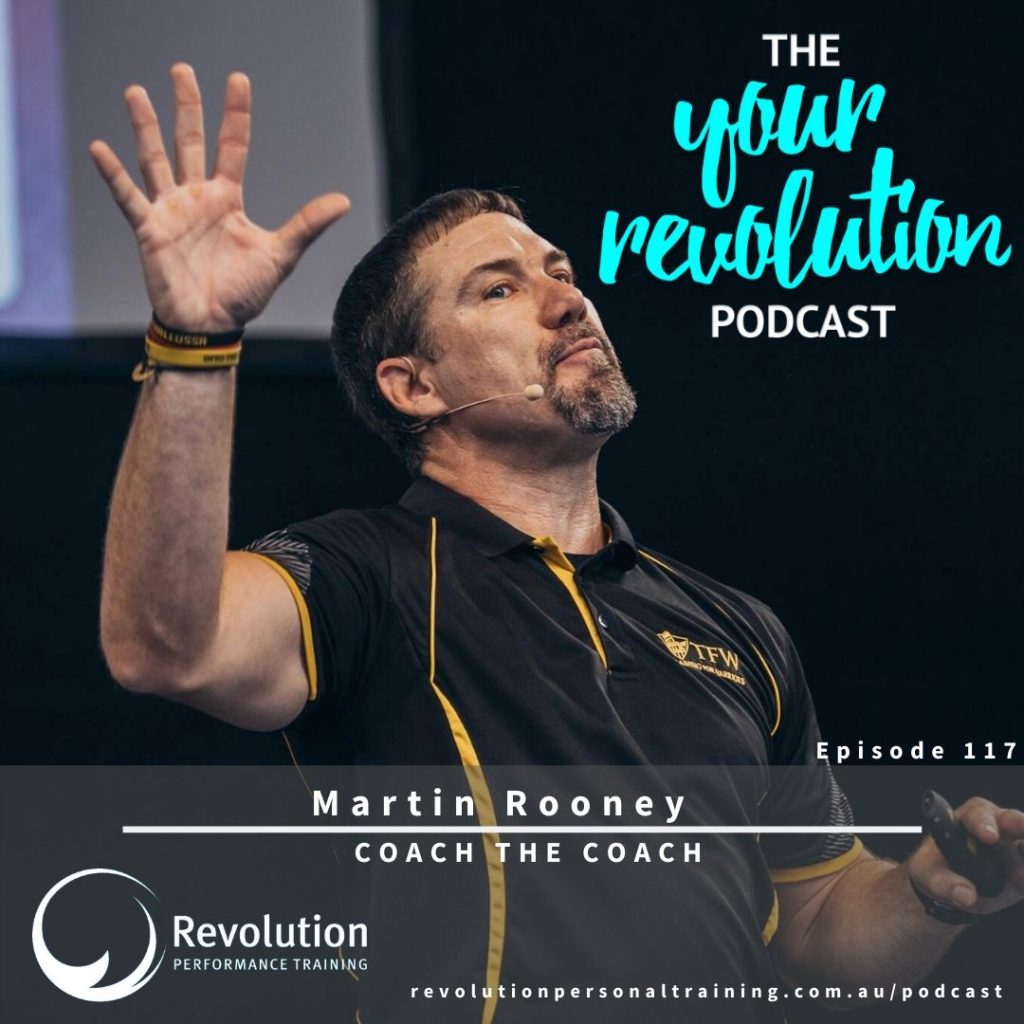
The Your Revolution Podcast is back with Episode 117. With Greg Kourpanidis as your host, Join him as he hosts Martin Rooney. Martin Rooney is the founder of Training for Warriors, internationally recognized trainer, speaker, and author of the bestseller “Coach to Coach”.
Martin has consulted for people from all walks of life including the NFL, MMA, Special Forces, and even high school kids. He doesn’t just talk the talk, he also walks the walks and is on a current mission to make better coaches!
Tune into This special episode where we dive in Martins Coaching Philosophies, how A coach can increase performance by focusing on the positive, and how to be a great leader!
About the guest: Martin Rooney
Founder of Training for Warriors and author of Coach to Coach; works with the NFL, MMA and Special Forces.
Episode transcript
Hi guys, my name is Greg Corbinidis and welcome to the Rev. T. Pogmaster, which is brought to you by Revolution Performance Training. I’m an avid trainer and fitness coach, who strives to learn the very best in the world of health and fitness. Join me in this episode and expect a game changers in their chosen fields to share in their story of passion and success. For all podcast related things, please leave aplease subscribe” and check us out on Revo PT/podcast. Enjoy this episode. So welcome to episode 117 of the Your Revolution podcast.
We are joined by Martin Rooney. How’s it going? It’s going good, Greg. And hey, for everybody listening right now, Greg is a trooper. It is midnight his time, depending on when you are listening to this, we’ve been trying to put this together for a while because we’re in two different hemispheres. So me, it’s Monday morning. He’s got midnight, I guess on, is it Monday night or is it Tuesday? – We had to choose that. I mean, the Tuesday. – Yeah, these two, it’s crazy. So, but hey, really glad to do this and hope for everybody that is listening right now, the goal today, we wanna keep it positive, have some great stuff for you and give you something that can help you through this difficult time that we’re all experiencing together.
Yeah, absolutely. Well, as Martin touched on, yeah, we’ve been obviously keeping in touch at least for, say about a month, nearly. Yeah. Well, while we’re going a lot back and forth, as you said, kind of dealing with, you know, two different time zones and, yeah, look, obviously, right off the bat, look, I was super excited to talk to you. And the obviously, the main thing we’re going to obviously talk about or love, Shady, is your new book, Coach the Coach, which got the hunt. Yep. Copy your right. That’s pretty cool to see it in two hemispheres at one time.
Exactly. So look, before we get into the book, I think it’s really important that our audience gets to know who I suppose Martin Rooney is and I suppose your background to sports and coaching, which is quite comprehensive because I think it’s really important to us as people to know that you’re not just someone I suppose that talks to talk, but you also walk the walk as well. So can you, I guess, give us a little bit of an insight into, yes. Yeah, who is Martin Rooney? Yeah, well, I’ll try to do it really quick. And, uh, and hey, it’s going to be comprehensive.
So for everyone listening, everything I’m about to say is real, but it doesn’t mean that it’s so great. It just means I’m getting old and I’ve been doing this for a long time. So, uh, I grew up outside of New York City, uh, in New Jersey. I was a track and field athlete. My mom was a phys ed teacher and coach. I don’t always talk about that. And I think that’s a very important thing to say that I was always raised with an attention to health and fitness and sleep habits and sport. And I was a track and field athlete.
I was a scholarship athlete, division one for track and field in college. And I went to that college particularly because they were one of the only schools in the late 1980s and 90s, which should date, early 90s, which should date myself that had an exercise and health and fitness program that you could major in. Most schools just, it didn’t even exist. So I majored in health and exercise science. I worked in the laboratories through school. And when that was over, I applied to the medical university of South Carolina because another industry that was really budding then that everybody said I should be a part of was physical therapy.
So I got my degree in physical therapy and then my master’s degree in health sciences at the same time. So at that point, I’ve got three degrees and in a weird twist of fate, I make the US Bob sled team. So I make the US team because I had always been staying fit. They were looking for X track and field guys. And then for the next few years, I was chasing an Olympic dream around the world as a part of the US bobsled team. And when that was over, now we’re getting into the mid 1990s. When that was over, I returned home.
I didn’t really have a home base. I went home and became a therapist. You know, that’s what you do, right? I had these degrees and now I’m a physio. And what’s interesting is I realized pretty quickly that really, I don’t know, people are going to see that I have high energy. I want to impact a lot of people. And although I love therapy and the people that I was working with and the education, I was essentially put into a one room place seeing four people an hour, just getting crushed. And I knew there was something else for me.
I didn’t know what it was. And anytime I talked about it, everybody told me, I was just like, I’m just like, I’m just like started on the weekends with the money that I was making. I was just going to courses on fitness, courses on sport. But there really was no sports performance industry yet. This was still fledgling. It didn’t happen. And on one of those trips, I was on a plane sitting next to a guy that was going to the course, who I had met years earlier, and he told me he was starting a business in this field.
And I came home, quit my job, moved into a basement apartment of some guy I knew, and we launched what I consider the sports performance industry in a big way in the United States which then went on to spread all over the world. That was called the Parisi Speed School. It got up to a hundred locations around the world and it gave me this opportunity to work with you know, not only kids and really build our sports performance philosophy but also learn about business and work with the highest end athletes in the world.
And during that process, I was working with tons of fighters as well and wrote a number of books and that led to traveling around the world, which led to my adult fitness program company called Training for Warriors, which is now all over the world helping thousands a day. And now currently that is what I do as well as I’m a high school track coach in town. And, you know, or was, you know, now, you know, we’ll see where that goes, but now my time has spent supporting our businesses that are really helping the adult bring out the warrior within.
And I just summarized about 30 years. So there’s a lot of incredible stories that all have happened within there, but hopefully that gives everybody a view where I was in sports performance and many parts of fitness at the beginning. And I’ve been very lucky through my career that when things went big, if anybody’s ever read the book outliers by Malcolm Gladwell, I just seemed to be in the right place at the right time for a bunch of different launches of whether it was the UFC NFL Combine, sports performance in general, adult fitness.
I was always at the crest of the wave and was able to pioneer some of those things which has been which has made my career so exciting. And finally, I have four daughters. So I, you know, I’m a dad. Yeah, I got four daughters and my wife. We all are here and have been inside for 13 weeks, which I guess everybody can imagine. That’s been one of the toughest things for me because most of my days were always spent around male athletes and these tough guys. And now I’m in a house of estrogen right now. Well said. Now, I suppose now, can we first off to start off as I was talking about your transition from, I I suppose an athlete to a coach?
What would you say? What was I suppose like the main challenges or if there was any or what was probably I suppose the process, you know, go through the process? Well, you know, it’s funny and I think we’ll go deep into this, Greg, that I think everybody is always making the transition from athlete to coach. Like in some way, I’m still making it a little, but not enough anymore to influence my coaching. And what I mean by that is, let’s use the word, this is an important word and the word is identity, right? And right now more than ever, as we were pushed into our homes, many things were revealed to us.
And one of those was, I guess, our identity, right? Like, imagine you were, if you were a professional sport athlete right now in the NBA and the NBA shut down, like you see yourself, your identity is an NBA athlete and now that’s been stripped away. Well, then who am I, right? And the same thing for me, when I was stripped from being able to leave my home, I realized I’m a coach. Like that’s what I am. I’m not a athlete. I’m not a professional athlete anymore. But where I make my impact is as a coach. And that’s what I missed the most.
But I wasn’t, I didn’t always think like that. So when I was in college, I saw myself as an athlete. When I, even when I was a therapist and I had left the bobsled team and started training in mixed martial arts, I still saw myself as an athlete. Even when I started in sports performance, I was still trying to master all these things and set powerlifting records. And I was still training and competing in so many things. I still saw myself as an athlete. But then I think in my late 20s and early 30s and when I did have children, I started to see that, man, my bigger impact is not going to be about being selfish about myself, which by the way, to be a high-level athlete or world-class athlete, you got to be a selfish person, right?
And that’s not a bad thing. You want to be an Olympic medalist. You got to be the most selfish person on earth. And that means you’re not worried about anybody else. You’re worried about what you’re doing. And that’s okay. And actually it’s mandatory. So if anybody says, Hey, that’s not fair. And Olympian can be a good I’m not saying it can’t be a good person. But if you’re focused on everyone else’s performance, you are not going to be the best on planet earth. And and hey, I’ve tried to aspire to be one and I’ve worked with so many, that’s the truth.
But then after their gold medals, they can use that for incredible good to coach the world into great stuff. So it’s a transition. And as I made that transition, I realized I had to be much less concerned about me and my performance and much more concerned about everybody else. And that has been, I would say it’s like, imagine it was, here was athlete and here was coach. For the last 30 years, I’ve kind of been going like this to where now, to be honest, I work out now just to stay healthy and for longevity so that I have a great life with my children.
I’m no longer trying to break records or on next with people in fight. But what I would say is now any opportunity I get to coach just like what this is right now, man, I relish it and I want to share as much as I can to help somebody else and pay it forward. And that’s when I guess now I understand my identity as that coach. And what’s interesting about it is, hey, so for everybody listening, your identity will change, right? Like I can remember when my identity was high school student and athlete, then it was college student and athlete, then it was med school student and athlete, but then it switched to kind of athlete and coach, then it was athlete dad and coach, then it was kind of dad and coach.
And right now that’s where I’m at is dad and coach versus actually, you know, we’re way too like writer. I identify like as a writer and a speaker and different things where it, your identity will change according to the, to the things that you pursue over time, right? It doesn’t happen one day to the next, but it’s an evolution. And so for the listener, and what does that mean? I would challenge you to say, who do you identify as? Like, what are you and what do you do? And when someone asks you, what do you do? What do you answer?
And then how much of that percentage scale are you really putting into that? And because if you say I’m a coach and I’m an athlete, but you spend most of your time watching Netflix and, you know, and really not a lot of time spending coaching or trying to help people, then that’s a good thing to say. But you’re not really, you’re not really like you had said before walking the talk, right? And, uh, and right now it’s a easy time to discover who you are or who you want to be and where you want to go. But I think, uh, but know that it’s going to evolve and there’s no rush.
But if you are going to, you know, but that identity will help determine who you are and how you act. And I think we’re seeing that more than ever. – No, no, yeah, absolutely. That’s, I really like how you sort of scaled that bar ’cause I’ve had something we’re gonna talk about a bit later on and it’s suppose that, like you said, that transition of, you know, suppose when you’ve been the coach and focusing on yourself to that going the other way more focusing on, you know, who you’re coaching and that. So that’s a really good point.
But going more I suppose into coaching, what do I find really fascinating about you is I suppose the, I guess the art and the science behind, I think a lot of people seem to, when they are supposed to think of coaching, they think of numbers, statistics, the stats, like they, I suppose they don’t realize that there’s more to coaching than just you know the the science obviously it’s important to have that knowledge and I think there was a I listen to a podcast you don’t and you called it I think you almost call it like a mandatory or compulsory learning like I think of course you should know this stuff like but but I suppose, can you tell me when was the point?
I suppose that you, I guess, thought of the, or knew it was like there was more of an art behind coaching and it’s pretty funny to say that because I used to deliver a speech. I started delivering a speech over a decade ago and it was called the art and science of coaching. And what I always, I believed and, you know, through, remember through experience. So at that time, there wasn’t as much research as there is now or at least I didn’t have as much access to it. But what I found was, you know, already I’ve talked about, oh, I had three degrees and, hey, my books on my shelves are my, they’re my trophy case now and I love to learn.
But what I realized was was no matter how much I knew that didn’t ultimately affect my results with the people I was working with. And when I started to see that as I made that transition from athlete to coach and whether you want to use the word cared more or spent more time on them or even better when I connected and I engaged and I had a better not just level of technical intelligence, but also emotional intelligence. I started to see that, wow, this was where the real results were really happening. Like at the beginning of my career, I was again, I had to be selfish to remember a coach has to be a little selfish in the beginning to gain that knowledge and to learn everything and really have the information that’s necessary to deliver.
But then at that point, once you have that science, I believe there is an art in its delivery that’ll help you get the result that you want. And remember, that’s the job of a coach, right? Like why someone hires you is to get some type of result. They want something, right? Or to improve in some way. And that’s where when I started to really spend all my time there, and remember, because there was pressure on me, I had to produce results. When you’re working with the NFL Combine guys, or UFC guys, or all these professional athletes, man, you’re only measured in results, right?
Like I wasn’t measured in, hey, am I a nice guy or not? It was kind of, did this person run for three in the 40 yard dash or not? And if he didn’t, you’re never gonna do that again. And, but I needed the science, but where those results really happened was how I applied it. And that was what I considered, I guess the art. And, uh, so you said something important and, and I want everybody to understand. I, I like to call it the yin and the yang. I’m not saying, so I don’t want anybody to leave this podcast and say, Oh, Martin Rudy said, you don’t need to know much.
Just, uh, you just need to be a good guy and really care about him and not think of yourself as an athlete and you’re just a coach now and you’ll do great. No, I’m not saying that because if you, if you don’t have the goods and you have nothing to deliver today, you know, hey, you’re, you’re a grocer down the street could be a good, uh, a great person too, but that doesn’t mean they’re going to make run faster, right? So it’s this combination. And what I’m saying is it’s both. You have to have the knowledge and information.
So if you’re in the fitness industry or the sports performance industry that were to use before, I call it compulsory now. You have to have all the information. If you don’t know everything you need to know about either nutrition or fitness or health or physiology or pathophysiology or movement. I mean, it’s endless what you need to understand and that pursuit, I love it and I’m still chasing it. I’ll never know enough, but all of that information, if you’ve got 10 PhDs, but you’re a bad person and no one likes you, that’s not going to work either.
So it’s a combination. And that’s why, you know, why I wrote the book is I guess the here’s a great one is one of the big, I guess, discoveries is that I believe coaching is not only the most important job in the world, but one of the greatest because not only did you get an opportunity to impact people with that title, but, and there’s such an authority and responsibility that goes with it, but in order to be a great one, you have to be great first, right? Like, you know, we’re seeing it more than ever. Bad people make bad people, right?
Like, so that’s just how it works. And it’s kind of like, so you can’t be this horrible person and then produce great people or a better person. And so you have to be on this life of self discovery and an improvement that then you use that as your expertise to teach to other people. And I don’t know. And that’s why I identify now as a coach, know, see, you could be a therapist, I guess, and not be a good person. Give out protocols, make sure they did their range of motion, not saying that therapists aren’t bad people.
But what I mean is, but if the therapist is now also this incredible person and has that compulsory knowledge, I believe the results will be even better. And, uh, and it’s an area we spend no time. I’m up. Yeah, so here would be a good thing Greg and I’m having a breakthrough I Said I had three degrees and you were like whoa and you know what I don’t think degrees You know hey, they’re great But if you just sit in that chair and put in the work and stay long enough you’ll get a right? But those degrees don’t say who you are as a person.
And during all those degrees, I never had one course, not even one class on coaching. There wasn’t one course, one class on it. And so just because you’re a physio, it doesn’t mean you’re a great coach or just because you’ve got a PhD and something doesn’t mean you can coach it because they are two separate entities and that is what I’ve tried to explore and why I believe the book is helping so many people and why they love it because they have some really great breakthroughs too. Yeah, no, no, wow, that was a great answer.
Yeah, I suppose going further into this, I suppose this evolution and some of the lessons I suppose, what would you say, I suppose, were your biggest challenges in terms of your evolution and more looking into that learning, I suppose, that sort of art of coaching? Because one of the things that you touch in your book in the whole story is both that you do touch on that look, this idea look it wasn’t your fault because you know you weren’t taught this and as you said you never took I never took I’ve done plenty of studies and six years of study I never learned one thing about how to be a good coach there was never a subject there was never a book or a rule book it wasn’t like there wasn’t like like God.
Me. It was something I had to just learn on the. Yeah, suppose can you, suppose talk about, suppose that, that, suppose that fervor talk about that evolution story. Yeah. Well, I would say this. One of the challenges is, is just being aware of what we just said that the first challenge was, I thought, how you become a great coach as you read all the books about the thing you’re studying, right? Like that was like, so I was like, wow, if I want to be a speed coach, then I should read anything I can read about speed.
I should go to any weekend course about speed and now I’m a speed coach. So like I wrote about in the book, which was hinting to that is I was completely even unaware of that other side of the yin and the yang. So I was only spending my time on the compulsory thinking the more that I knew, that would make me better. And it was over time that I began to discover, man, I’ve got more knowledge than I can deliver and I’m not doing a good job delivering it. And because I’m not delivering it, that’s why I’m not getting the results.
And that kind of led me to these small mini breakthroughs that were like, oh my gosh, yeah, I’m not a great coach. I just know a lot of stuff. Or just because I was an athlete doesn’t mean I can coach it. And that’s an interesting thing too, is oftentimes when you see people who are considered the best coaches in the world, which unfortunately is often the pros or the high level coaches in sport or Olympic coaches, hey, I want everybody to know right now the most important coaches in the world are the youth coaches and parents because those pros never get anybody to work with if they didn’t do their job first.
What would the coaches never heard about? Yeah, but what I mean is, those people were never great. You don’t have to be a great athlete to be a great coach. And actually, sometimes maybe it could be a hindrance, right? Like, Hey, everybody was talks about Michael Jordan, Michael Jordan. Well, imagine Michael Jordan says, Hey, Greg, just run to the foul line and jump in the air and dunk it. That’s all you got to do. Just go do that. Right? Like, so it doesn’t mean that he could be the same coach just because he’s able to do it or perform it.
And so the first I think obstacle was I didn’t even know, right? Like that’s what I had to do. And then the next obstacle was as I found out about it, I was, I guess for lack of a better word, addicted to learning and addicted to reading. And it’s actually much easier to stay where you’re comfortable than get uncomfortable. And I was comfortable just reading more books and going to more courses. And you know those types of people? I’ll meet some trainer guy or fitness guy and he’s got 5,000 letters or acronyms behind his name on his business card, but he’s never trained a person.
And why? ‘Cause he loves studying. Like what I call that person is an information gatherer, right? It’s like, I’m just gonna go to the next course. And hey, I know all this stuff, but, and that same guy will say, look at this guy down the street, he doesn’t know anything, but his business is good and mine isn’t, the life’s not fair. And again, I can remember kind of being there too that it was like I’m collecting all this information, but I was still missing the concept of, hey, you got to go apply it like, you know, you know, where the rubber meets the road.
And then because that’s more uncomfortable, it’s easy to sit in a course. It’s hard to now go apply that stuff when you’re not good at it and and really take the time to master your craft. But again, I just kept going and going and then hey, then the next obstacle is when you make mistakes. Like then I would make mistakes and things didn’t go well and it would have been easier to be like, man, let me get up on this. Like I’m just gonna, I’m just gonna keep doing what I was doing. , right? But then through that process of mastery, if you will, which began with enlightenment, right?
First, you have to be enlightened that coaching is a real thing. Then you realize, wow, I’m not doing that at all. Now I have to pursue that. Then I’ve got to make the mistakes in that. And then over time now, and what I’m saying in time, it could be a decade, you know, and then you get there. So those were definitely the obstacles for me. And I’m being, I guess, vulnerable and honest. So everybody’s listening. Hey, the only reason I was able to write this book on coaching was by making more mistakes than the person that’s gonna read it, right?
And I’ve made tremendous mistakes. And for every great athlete, I’ll tell you, oh, this guy won a gold medal or this guy won the UFC belt or, oh, this team won the Super Bowl. For every one of those things, I can say, I could also tell you about somebody that got injured or somebody that didn’t probably reach their dreams or somebody that maybe when I was much younger as a coach, holds me responsible for being a jerk, you know, or, you know, somebody that like, uninspired them. And those are the regrets I have that I wish I would have known what to do sooner.
And that’s a big reason why I wrote the book. ‘Cause, hey, you know, you read it. Once you read this book, you will never think about coaching the same way again. And there are just some great tips and action items that will skyrocket you as a coach to skip the decade of mistakes I made trying to figure it out. I think that’s something, I know definitely for me growing up and also studying is that I think for our generation, the information is just so easily accessible now that now you can access things. And I think like you said, that sort of applying of that sort of practical knowledge often goes missing because we’re just able, we’re kind of obsessed over, you know, so much information.
I mean, I even remember, you know, being a trainer when I started is that I was always trying to find, you know, the perfect, the perfect training session. The perfect, the perfect work out. I used to have books. Yeah. Back then to eat all of it. Yeah. And I think we all go there. Right. So anyone listening, if you are a trainer, coach, physio, whatever you call yourself, we all got to, again, you got to fall in love with the compulsory first. So if I when I look back on a lot of my early work, you know, I would, I was chasing around the world.
How many pushups could I find? How many types of body squat? How many different exercises? If you look at all my original YouTube videos, it’s, it’s all just exercise, exercise. And what’s funny is all I see is it being repeated. Now 20 years later, it’s still, you go on Instagram and people are showing up, you know, I guess here’s a word that I use that’s a power word, right? And here on my desk, I only have a few things. One of them is my black belt. So I’m up, I didn’t say before I’m a black belt in Judo. It took over a decade to pursue was and and like I always think in my head I’m not done right and So one lesson is when they give you the black belt There’s an old saying from Japan they say this isn’t the end This is just the beginning of your learning right?
Which I think everybody’s always trying to find the end find the end Oh, if I just find 10 more push-ups that now now I got it and now I’m a master trainer. And then once I’m a master trainer, I never have to do anything again. That doesn’t exist. But this word, and this is an even important lesson. I was trained by a number of Olympians and I got to work with really high level people. And I remember when I was young and starting out, I was like, man, I want to do anything for that black belt. I wish I could have that black belt.
And I remember as I was maybe halfway into my learning and I started to, the black belt was becoming less important and it was becoming about who I was becoming, right? Listen to that, it was becoming about who I was becoming. I like that. And I remember this guy that was my biggest mentor and he was just such an inspiration. And you know, he was in his 50s, late 50s already. He had been an Olympian and he’d still come in and he was still unstoppable and just so incredible. And but he walked in and he didn’t, he forgot his belt.
You know, so he just grabbed a white belt and he put on a white belt. And I remember saying to him, you know, sensei, you’re putting a white belt on? Are you kidding me? And, and I’ll never forget. He was like, man, it’s, it’s not about the belt. I don’t care what I wear around my waist. It’s like, it’s what’s in here. It’s who I know who I am. I don’t need a, I don’t need a belt to show anybody that, you know, and I guess the word that I was gonna say, the power word is transcend. He had transcended the belt. The belt was unimportant, he knew who he was, and that’s all that mattered.
And I guess what I’m saying to everybody today is it’s not about another acronym after your name or, you know, hey, what you read or what course you or, but, you know, meaning you have to have it, but someday you’ll transcend that to like, who are you as a coach and how do you really measure yourself, you know, and how I measure myself now is the people that I’m helping and the results that I’ve been able to produce. So when I, you know, for instance, on this podcast, I’m not writing 50 letters after my name anymore.
You know, actually the real goal is to get so great in your industry. They just call you by your first name, right? Like, you know, like, you know, imagine if any of the unearth said Martin and they knew they were talking about me. I want to make it shorter, not bigger, you know? And, uh, and I guess, you know, it, it’s this idea and I’m giving people this vision, which it’s hard, but DC, where we started with was, oh man, I’m measuring myself by how many pushups I know. Man, if I really looked at how many pushups I can use with the people that I try to help or how many versions of the chin up I can really use with anybody, it’s not much.
Most people can’t even do a chin up. And now I’m worried about, hey, can I do the one handed clapping chin up where I jump over the bar? Wow, look at me. That, I don’t know, I’ve lost sight of that. And now where I’m at in my life and everybody listening, depending on what age you are, you’re gonna get there. And maybe to be clear, ’cause people might think, wow, this guy has great energy, he must be so young. so young. I’m like very close to 50, which scares me to even say that, right? So I’m in the third quarter of my life.
And I’m thinking more now about my legacy. And I don’t think people are spending enough time on that. What’s the world gonna be, or how will I be remembered? What will I have done to made everything better? And I’ll tell you what, that was the inspiration behind the book. I kept saying like, yeah, I’ve done all these great things. Hey, I’ll get on a podcast with Greg. He’ll say, he did this, he did that. Wow, listen to this, man. I’ve transcended that now, like NFL Combine, like who cares how many fastest guys I had?
Like, hey, it’s great. I would never trade it. And the lessons I learned are incredible and make me who I am but now hey can I make somebody a better parent can I make somebody put down the bottle can I can I make somebody healthier so that they live 30 or 40 more years with their family and then and then go on to have more hey can I create a generation of coaches that people really understand what it means to be that and we change the world and that that word whether it’s legacy That is I’m thinking with a lens on that now again making the joke versus Like a diamond diamond sideways one arm one leg push-up, right?
Like you know like yeah, so and, I’m not saying that is an important. I don’t want anybody right now, depending on where you are in your journey to say, Oh, Martin said pushups aren’t important. So I’m going to go think about my legacy and you’re like 19. Hey, it doesn’t mean that it’s a bad thing to do that, but you still got to learn it all. So I don’t want to discount it. It’s easy for me to discount all the things I’ve done, but every one of those was a piece to where I am. I’m just trying to make everybody aware that it is like we’ve said today, it’s going to evolve your identity will evolve your idea of what you want as your legacy will evolve your idea of what you will consider important will involve will evolve.
And Greg and I talked about this before we started this. Hey, this quarantine experience, COVID-19 experience, whatever you want to call it, it has it has revealed to us what is more important, right? Whether it’s your family, whether it’s your own discipline, whether it was your own career choice. We are faced with the like talking inside the six inches in between our ears more than ever. And I’m hoping that if you do have a glimpse of some of these things of what really is important or man, how am I spending my time?
I hope you’re going to see it’s not Netflix. And you know, can you binge watch another series or Hey, you know, again, can I learn, you know, or am I going to say nasty things or rip people on the internet because they put up a abdominal flexion exercise like right now, like all this silly stuff is not important to the major things that are happening around the world. Yeah, right. So absolutely. No, great answer. I love it. I’m just trying to do that. Say some deep stuffs of Greg goes, whoa. No, he’s no hit the nail on the head on that one.
Now, I suppose it turns, I guess, talking about similarities because you’ve trained a vast variety of people from, I suppose, the very elites to, you know, even like the high school, middle school, as well. Six year olds, man. We started at six or seven, so. – There you go. – I like to pride myself on there isn’t a really a demographic I have not worked with, which also maybe makes me unique. – Well, I find it really unique because you’ve trained, I suppose, is a vast variety. What would you say, I suppose, the common things you find that all of these groups are after and a great coach.
What would you say that would be? – Well, here’s one right off the bat. Greg is, what’s the biggest common thing of all those people? Ready? And this one’s gonna hit home, it’s great. They all need a coach. Like every one of them, when you’re six, you need a coach. When you’re 10, you need a coach. When you’re in high school, you need a coach coach when you’re in college you need a coach an Olympian. Hey an Olympian does he go to does he go to the Olympics by himself? No, he does not. Where does he go? You guys are the coach.
Yeah, I see people need a coach military leaders need a coach world leaders have coaches and advisors everybody needs a coach that’s the biggest similarity and Most people when I ask them hey, do you have some good coaches in your life? People be like, you know, I had a couple people. Hey, do you have some bad coaches? Every hand goes up and they’ll be like, oh my gosh, how much time do you got? Right? And I don’t know. It’s so the biggest first off similarities, we all have coaches, but we didn’t all have great coaches.
And when I really dug into, well, why is that? Well, cause we don’t even know what a coach is and we don’t even spend any time worried about that. I guarantee every one of those kids had the coach knew about the sport and you know, they know what the sport is. But because maybe they didn’t coach them with passion or energy or fire, that kid never went on to pursue it or actually ran away from it because of the wrong things you can do in coaching. So that would be the first one. Once we’ve identified that everybody needs a coach, here’s the next thing.
You know what everybody needs? What is that? It’s the simplest stuff and it’s in the book about what people need enthusiasm, right? Like, so that’s in the book. Like people need a coach that’s going to be on fire and on fire, not just about the sport or whatever else, but about them and their progress, right? And then once they’re on fire about them, the other big piece they need, if we’re going to sum up coaching in a really interesting way, is they need somebody that recognizes when they’re doing good things and let’s know about it.
So watch. So now imagine you’ve got this kid, they have a coach. The coach is knowledgeable, but also really cares about being a coach and cares about that kid. And then it’s so on fire that the kid falls in love with the sport, right? And then when the kid makes progress, he’s recognized for that, which according to psychology, then the kid wants to repeat those things more and more and more. And then 30 years later, the kid wins a gold medal and then goes on and changes the world, right? Boom, right? Or you could have a coach that doesn’t really want to be there, tries to think that he knows better and sees nothing in this kid, which how could he know that at six or seven years old and ignores the kid or treats the kid bad or worse, punishes the kid with the same exercises he’s trying to get him to fall in love with.
Like, oh, you’re late. Five minutes late, Johnny, because your mom was in traffic. Now you’re going to do 50 pushups or 100 burpees. How about that? And then the kid’s going to run and you’re going to say something else. And then the kid goes home and says, “Mom, I don’t wanna play to that sport anymore. ” You know, I burned out. And now, and then the kid goes on to a life of not enjoying fitness sport or health. And look at that, like a tale of two coaches. How amazing. Just a little bit of how we do it could change the world.
– Yeah, that’s really great touch tonight. because part of my next question was going to talk about how I think everyone seems to put coaches or the idea of a coach based on the one way it could be a lot of different things. But I think this coach has to be this, you know, negative, this real tough person or even like, let’s say a coach or a train like a boot camp train, I think, you know, got a, like you said, you were like, for the hundred bopies, you know, 50 pushups. Um, yeah, I suppose, can you, yeah, I suppose further talk about that and how why it’s in post so it’s so important for a coach to be more sort of constructive and not, I don’t know, destructive.
You could say. Well, here’s the interesting part. You just said it, whether it’s media, well, I would even say it’s not even media, which we do. I call it romanticize. We romanticize that coach that says these negative things and somehow that motivates the kid to be better. That’s a very rare person and not the way we should go. Also, remember, we repeat our stories or our programs. So most of us, hey, if we had like my coaches, when I grew we a remember, I grew up in the 90s and 80s. It was a d got away with more crazier st when it’s my turn to be a co they did to me and that’s t right?
And that’s what we what w history With all different topics, not just coaching. So something has to be revolutionary to then start a new evolution. That’s what I was hoping the book will be is it’s just this fresh breath of air that, hey, wow, a coach doesn’t have to be this tyrant, right? Or, you know, again, words I use a lot is you’re not there to torture, you’re to nurture right but like hey unless you get that education you learn that you won’t know that right it’s easier to make kids run laps and beat them up but that is not the job but what I would say is I think we’re repeating the programs of our own parents we’re repeating the programs of our the coaches that we had but that doesn doesn’t make it right.
And so ultimately, hey, it’s doing stuff like this, like I’ve been ceaseless, yelling it from the rooftops where now on this podcast, somebody is going to listen. Not everybody will do what we say, but somebody’s going to listen and say, whoa, I never thought of it like that. Like, yeah, coach is more than just the exercises or the actual sport. A coach is a leader, a coach is a mentor, a coach is somebody that could really influence somebody’s life and wait a minute, there’s better ways to do it than I need to find that out.
And this is how change is spread. And I don’t know, I’ve been ceaseless for a long time talking about it. My hope is that I’m planting trees that I’ll never see. You know, like so for instance, somebody you may work with, you’re going to have a different mindset or skill set because of our conversation. Help that person. That person’s going to help either their child or spouse or someone and they’re going to go on to do something great. I’ll never know it, but it will have been by, you know, you know, preaching it, you know, if you will, about what I, you know, the thing I think is important.
But yeah, back to the original thing where a lot of the, the bad coaching or craziness may come from is either the romantic idea that I’m going to use negative reinforcement to get this great performance out of somebody, which again is very rare and destructive. But at the same time too, we are the products of our programs and it’s our parents and our coaches that put those into our heads. And then we just operate those systems. So I like to say, this is like some new software, right? That you wanna insert into the back of your head into head into the hardware Which is your brain and hey, that’s how a computer works, right?
You put in some new software and it operates differently I’m hoping that this is and funny that it’s the soft versus hard like this is the software some people might say it’s the soft skill Boat and to be clear too because you said something before don’t get me wrong. When I coach, I’m tough, right? Like when I’m coaching a UFC guy or NFL guy, I’m tough as nails, but I’m also fun and I care and they know that. So I am not saying to everybody, oh, we’re just going to go now sit a downward dog with our people and hum and not train or not go hard or whatever else.
Like I’m tough as nails and I know how to discipline and I don’t know, like I think a coach still has to have that. But the generation of people that we’re working with now is very different and you have to understand how to best do that and get the results of holding someone accountable. And it’s not by screaming at them or calling them names or punishing them with exercise. But I think once the person knows you care, there’s a bond bill and they’re gonna trust you, which is trust is the cornerstone of your coaching.
And then the great stuff, the magic can happen, but it’s the art again of how do you build that? And there is some science behind it too, which is slowly coming out or it’s coming from different fields that can be applied. But again, I don’t know, I think it’s just an interesting conversation we’re having, ’cause this isn’t one that a lot of people have and we have to, I don’t know, we have to embrace that. Like coaches have a tremendous responsibility yet. Maybe a lot of people that call themselves coaches haven’t even ever thought about the stuff we’re talking about today.
– Mm, absolutely. And I’m gonna talk about, this is something especially you also touched in your book. I know it’s something for sure. You preach yourself. Is that why how it’s so important and why you should be coaching was what’s in front of you and not I suppose I guess what you wish you were coaching. Yeah, well, hey, that weren’t that line right there, right? Like coach coach that kid in front of you coach that athlete in front of you. I’ve made that mistake, right? And even in particular with my own children, right?
Like, ’cause you have this vision, right, of, oh, my kid’s gonna be a college star, my kid’s gonna be a pro or something. And you’re training your kid like he’s a pro when he’s seven, right? And now you violated that rule. You’re no longer coaching the person in front of you. You think you’re coaching an NFL star. The kid is seven. And where I have been lucky is, uh, when you do have children, man, you become very conservative and cautious, right? Like, so I, having kids changed me in a lot of ways in particular in my coaching where I started to realize, man, well, there were things I was doing with other people’s kids that I wouldn’t do with mine, then maybe that’s not a good thing.
And I’ve been so careful and cognizant of trying to coach the kid in front of me, you know, when it was my own kid, that I’ve definitely applied that, you know, and again, that comes with maturity too. Like we’ve talked about, like I’ve made the mistakes. I wish I could say I did it all perfect and I know all this stuff and I always knew it. I didn’t. And even with my own children, I made mistakes. And being a dad and a coach is very stressful in a relationship. There’s no doubt ’cause it’s hard to know when to wear either hat, but I feel like I’ve navigated that pretty well.
My oldest daughter is a really successful athlete here in the States and it was very devastating for us to have no season this year. This was the big year where the colleges find out who you are and everything and it didn’t happen. And we’ve been navigating that as well, but our relationship has grown stronger because now we’re spending more time than ever together training in the house and just trying to educate. And it’s, but yeah, you got a coach who’s in front of you and here’s another thing. Why I think I’ve been successful with my children is I followed another thing.
One is coach the people in front of you. But if you look at the most successful people in the world, whether it’s fitness, athletics, finance, business, and all the studies show it, they always had a long term view. They always had a long term view. See, I didn’t really, you know, of course, did I care if my kid was successful when she was seven? Sure. But that was, that’s not the big thing. Like, and actually, I don’t know when the big thing ever happens. It’s like coaching for any of them and you want them to be successful, but it’s kind of like I never, I always thought the long term.
I wanted my kids to have to be healthy. I wanted my kids to eat right. I wanted my kids to be confident and I always coached for those things those things, thinking long term. And now 17 years later, because I started coaching my kids, you know, the day they could, they were born actually, but the day they could walk. So hey, 17 years later, it’s working where I was never trying to achieve everything when they were 10, if that makes sense. And you see a lot of that too, where I don’t know, I don’t know if everybody’s thinking long-term development versus short-term development.
And that’s important, at least when we’re talking about coaching kids. Now, if I have NFL Combine guys and they have to be ready in six weeks, that short-term, you know, you don’t get to think long-term, right? It’s different. But with your own children or youths, youth athletics, man, there’s a big picture and you better make sure you do it right. And how do I say they, you should be measured. You should be measured if the kids come back year after year, right? Like what I take great pride in is I got my daughter involved in track and feel pretty early and every year she keeps coming back because she loves it.
Whereas that would have been a tragedy if I would have done things so wrong that she hated it and never wanted to be around it. Because we would have never gotten to have all these great memories together. And I could have jeopardized that. And for anybody that’s listening, that’s apparent. Hey, you’re a coach too. And you’re a coach to your kids and your spouse. And you should be thinking long term, right? I a relationships marriages people don’t think long term that’s why this stuff fails right and yeah and and you know it’s all in there so this book for anybody listening if you’re still with us this is a story it’s not a textbook it’s not a workbook it’s a parable and because I believe coaches tell stories and that’s why it’s the title.
Everything is passed down from coach to coach. Right now I’m trying to give my wisdom to Greg. I’m passing it down coach to coach. He’s going to tell it to somebody else, pass it down coach to coach. Someday somebody’s going to use something I said to pass down to their kid, coach to coach. Someday their kid is going to be a coach, if somebody else, they’re a kid, coach to coach. And it’s how the world works. Right? That we pass something down. If it’s of the right stuff, man, you know, we got to hope that the world to be better place, you know, c you’ve been in it.
And, uh, yeah. So it’s pretty deep, but it’s a story. So it’s, this is not an intimidating book. This is something you read in a couple of sitings, Max. And the greatest compliments I’ve had is people keep writing over over around the world. I couldn’t put it down. I couldn’t put it down. And they say, and then I read it for the story. And then they say, I haven’t read a book in forever. And I just read it again. And now I’m pulling out the other stuff. So it’s really, it’s really cool. Because I knew, I don’t know, I knew I had something the minute I finished it, but it’s so neat to see people enjoying it.
Like again, like you picking it up, you’re picking up the book in Australia and I have it in my hand in America. That’s pretty neat. – Yeah. No, I was like so ecstatic to actually contact you and even just connect with you is that I feel like this idea is everyone has had a coach in their life and it’s something that I think everyone can really relate to because we’ve all had good coaches and all had bad coaches. I mean, that’s like this topic of, you know, talking about a coach is, you know, it’s really exciting and, you know, I’ve seen, you can see how passionate it is.
But can you, I suppose, talk to or explain why you, I mean, you kind of have a rainbow. I want to hear more more of it is that why do you believe being a coach is the best job on on earth? Well again I think the first part is and what I say is that I love it as the best job but here’s what here’s a little piece of advice I’ll give anybody. Whatever your job is right now pretend it’s the best job. So that is what I also always did so maybe maybe to get a little more of my history, I told the cool stuff. Hey, I worked construction.
I worked as a waiter. I worked as data entry. You know, again, I worked in labs, you know, like I was always working odd jobs, different things to make money. And what I always treated each one of those jobs, like it was the best job. And what I mean by that is because I treated it like it was the best job, I did my best at that job. And by always doing the best, like guys, the world is a ladder and people will find the best people at the top of a ladder and then you get on another ladder. And hey, when I was a student, I was trying to be the best student.
When I was an athlete, I was trying to be the best athlete. When I was a therapist, I was still trying to be the best, even though I wanted to do something else. But then, man, when it was sports performance, I wanted to be the best. And when it was adult fitness, I wanted to be the best. Or combine or fighting. And the world takes notice. And then eventually, you do the best long enough. Your job is the best job in the world. And now I have the best job in the world. I travel around, well, I did travel around the world before this.
And I would get to present, I get to write, I get to just help people. But that all started because when I was about 14 or 15, I still always worked hard with discipline and treated every job like it was the best. But this is the job I find myself in now, right? And then, but why do I believe it’s the best? And I always say, and I said it earlier, the word coach, when someone calls you a coach, there’s something magical that happens with that title. ” You know, maybe if it’s tax season yet, you ask for a piece of advice, but it’s not life changing.
And you’re really not going to probably listen to much of what that person says. But when you call somebody your coach, immediately something has happened and like anything they say gets like etched in the steel of your mind and you take that as the truth and you operate according to that, right? Like you give them the reins in some capacity to some area of your life. And there’s an authority that comes with that title. And again, what I’ve talked about today is if you now understand that, then there’s also a responsibility that comes with that title.
And you should be trying to always pursue being a better coach, a more impactful coach, a more caring coach or a coach that, I don’t know, helps that person get that goal or reach that thing that they desire, and that’s our job. And I don’t know, I’ve had a lot of other jobs, no other job had that, right? And with that, I’ve tried to take that responsibility to the best I can do and always try to deliver for people, you know, and that’s what we’re doing today again. So I can say, but I’ll also say not just the best job, but the most important because if it comes with such responsibility and authority, then man, the world needs better coaches and more than ever right now, like more like it’s almost crazy.
Like the book, this book released the day after we went into quarantine. And why it was releasing in the US on that day was because that was when spring sports were all beginning in the US. And I thought all these coaches are going to read it. It’s going to help all these coaches. And when sport ended and the book came out, I was terrified because I said, man, now, now what’s its purpose? And now I realized the messages inside, it was even more important to have released it during this time. And it’s only helped more people to see their role, whether they’re a coach in their own home or in their community.
And yeah, so it’s almost this has been a reminder more than ever, especially all the things that are happening in the United States right now. I just hope, I don’t know how many more reminders we can stack on top of each other here like, man, I’m even looking forward to hopefully seeing some more light at the end of the tunnel but ultimately this book I know it’s gonna help a lot of people and but like we talked about it I couldn’t be happier in my role and And just but I hope everybody listening to this today You’ve seen you’ve put yourself on a continuum of where I am as a coach.
You have questioned yourself about how am I coaching? Where am I spending my time? Am I just gathering information or am I really applying it? Even if I have to make mistakes, am I doing it? Maybe today, hopefully they’ve asked, what is my legacy going to be? Is it going to be through my children, through the people I coach? How will I do it? And wow, wow, do I identify with that term? Is this who I am? And if it is, then how can I be better? Cause the world needs me more now than ever. And, uh, man, that was a big summary of all the stuff we just went through today.
That absolutely happened. Certainly was. Now, uh, what, um, what advice would you suppose give to someone who wants to pursue us? It was like a similar career path to yours. – Well, here’s what I would say. And this is interesting. Now I gave you the career path in the last like 25, 30 years. – Yes. – Not by have now, did not exist when I started, right? Like just like you right now, like there was no podcasting a handful of years ago. Man, when I got started, we didn’t even have cell phones. There was no internet.
You know, so, so I guess what I’m saying is I would throw it back to the listener and say, you need to decide what you want to be. Don’t let me tell you that. Don’t say I want to be like, I want to be what Martin Rooney does. No, you got to be the best version of you and you got to decide for yourself what it is you want to pursue and know that that thing is going to evolve and change. So I told my kids all the time, I’m not worried. You know, a lot of people ask them all the time lately, oh, what do you want to be when you grow up?
What do you want to be? And I always tell them what you’re going to be isn’t doesn’t isn’t even a job yet. It’s not even real, you know, like so technology is going to change. The world is going to change. So let’s find what you’re super interested in and continue to pursue that and that career path will come. But that being said, I would say again, hey, you want to follow how I did it? You got to be ceaseless in your pursuit. You got to be super disciplined. And I guess the word that I would use that is my secret or two of them.
I have stayed super super focused. I believe I have an ability to focus better than most people. And I have stayed very, very consistent for a really long time. So man, you listen to a podcast from a year ago, five years ago, you read a book of mine or writings of mine from a year ago, five years ago, I have stayed very consistent. I’ve tried to do things at a high level. I’ve always tried to help. I’ve tried to, I don’t know, I think that’s the things that people lack right now is discipline, focus, and just consistency.
I mean, I’m the same body weight I was 30 years ago. Why? I’ve stayed very consistent in my training and my diet. I don’t know. I have the relationship I have with my kids because I’ve stayed very consistent in our communication, even when they became teenagers and maybe didn’t want that as much, you know? You know, again, my sleep habits, super consistent. Also this, go find a bat, go find somebody that’s going to say, Mark Rooney, I went one time and he gave a lousy speech or a lousy talk or it was just he had no energy.
No, you have to be consistent. And, and I think and not only that, but those are easy to do. Those are free. It’s free to stay focused. It’s free to be consistent. And that’s the piece that if you do that long enough, again, thinking long term, I promise really good things are going to happen. And look at our look at the health and fitness industry. I’m having a breakthrough. Why? Why do we have to help so many people? Greg? Because they couldn’t stay consistent. They couldn’t eat right. They didn’t stay focused. They lack discipline.
And those are like three areas. We got to help everybody with the most. And and maybe this being said, if you’re going to be in fitness, yeah, here’s advice I’ll give. If you’re going to be in fitness or call yourself a coach, then you have to have those three things or how can you teach anybody else how to have it. You have to, right, that’s part of your job. You have to get enough sleep before you ask anybody else to do it. And I don’t know, I don’t see everybody doing that. And that maybe means that their passion for the industry isn’t as strong.
And if it isn’t, this is a great time to also ask yourself, what are you passionate about? And you should go chase that. Because if you’re doing something like I talked about today, therapy was cool, but it wasn’t my ultimate passion. And I would have never, I would have never been who I am now and have the energy I have if I would have stayed with it. So that can be another great piece of career advice. – No, for sure. I think that’s a credit to your longevity. It’s something even in Australia, I think they talk about the average of in terms of a coach or a trainer or something about one or two years.
So it’s amazing just the amount of the cycle of turning over of trainers and coaches. And it’s, you know, it’s a testament to you. It’s so important why, you know, we need, you know, a guide and we need these for lessons. We’re just suppose goes into the next point. Our next transition is talking about your book. – Which we already, I think we hit pretty good today. – We hit it very well, but I want to really, I guess the first thing I want to go into, I suppose, suppose you have actually talked about be a kid’s supposed to give me more of a guess of an overview of the book and Yeah, when did you decide to write it?
Yeah, well the book is a story as we already said and as a quick summary it’s a story of a young coach who is Has now aspired to a position, but now realizes he’s not prepared for this position. And although he had an athletic background, although he’s got the knowledge, he has just now been exposed that he is not that good of a coach. And now his job is in jeopardy, his family is in jeopardy, his relationship at home and his relationship with his athletes and other coaches, everything is kind of self destructing around him.
And like the classic stories, right? The hero’s journey. First there is this difficulty and then it’s met with opportunity. There’s this guy. He kind of, you know, appears from the ether and he’s got the answers this kid seeks, you know, and we call him the old coach. And then the book is about this guy teaching this kid some lessons and really this kid having to get uncomfortable to really learn these things. But then he does go on this hero’s journey of trying to apply them in his house, on the field. And then there are some successes at the end.
But through that whole story, I’m teaching the greatest lessons that I’ve learned about coaching, the lessons that I present all over the world in my course called coaching greatness. And the inspiration to answer it behind the book was one, you know, maybe what would I tell myself now 25 years ago? I think that was a big part of the inspiration. Like we’ve done today. Today, guys, I’ve been very vulnerable admitting I made a lot of mistakes. I didn’t do it right. But now I know these lessons. What would I tell myself?
What would I tell that 24 year old kid when he was getting started? Right. And it’s like, wow, I would I go back and slap him in the face with a lot of things. And then what I did was I just wrote the book on it. But so many people, when they would finish the course, they would always say, you got to write a book on this. You got to write a book on this. And I don’t know, a textbook just never felt right. Like that’s not how coaching works. Remember how we said today, there is science, but there’s also art. And how do you write a, how do you write an art book?
Right? So, but I said, well, man, how do you write it? You write it as a story. People love my stories. And that made it hard because now I had to write a fictional story with stories within the story. But I’ll tell you what, it was a labor of love. The minute I was done, I knew I had something like I knew it. Like sometimes I guess you just know. And I sent it into one of the biggest publishing houses in America and I was expecting all my rejections but in a day they wrote back and said it was one of the best ones they’ve read they fast tracked it so they said we are not gonna we want it and we’re not gonna Have this come out in a year and a half.
We’re gonna have this thing come out like in three months and then you know they did and the challenges it launched you know the day after we went into quarantine. Yeah yeah absolutely. Fantastic. Now I suppose going into the book I just want to let you know it’s here is that one part was really resonated with me and I think yeah as a coach for me was even, it was like the light bulb moment and it was the chapter on the real definition. It’s just, you know, the chapter has the old coach who sits down at Brian and, you know, he gives in the blank book and defines the word coach and what does it mean?
And there’s a passage where it says, we’ve touched a little bit on this today as well, is that, so nothing up to this point is your fault. You’ve just been trying to find your way and probably just emulating other coaches you’ve had in the past. If ever goes on to say that the good news now is that you know what it means to be a coach and the bad news is if you mess it up, there’s all your faults. And then you have the knowledge just be better. Can I suppose you talk about why you wrote this in the book and I suppose further expand on this?
Yeah, well, I think we already hit that one today that most of us are just operating on programs that have been given to us. And I mentioned it earlier, remember, like, I thought, how do you be a good coach? You played the sport and you got to read a lot about strategy and physiology and movement and now you should be great. And so what I’ll say is it wasn’t my fault. ” And you’re just not even aware of it. If you’re not even aware, then don’t beat yourself up over it. ” you you can’t go back to being the same. And what I always like to say in my seminars is, once you’ve seen something, you can’t unsee it.
You know what I mean? Like once you’ve learned something, you can’t unlearn it. And then if somebody’s choice to just stay the same, then they’re just lazy, right? Like then they’re afraid and they’re just lazy. And that was put in there to make sure that that didn’t happen. A little chat. – No, I loved it. I was one of the, really good part. ” – Yeah. – Yeah, I suppose what are the ways, I suppose, that you approach that? – Well, obviously in the book, you see it that maybe one of the characters in their markets could have been seen as uncoachable, right?
Like you could have seen is incoragible. But one of the advice I will give is you’re there as the coach and you can never forget that it’s your job to make them better. Well, not just better. It’s your job to help them get whatever it is they want. You know, why are they there? Why did they hire you as a coach? Is it for sports and they want to win or they want to be better at sport? Is it for fitness and they want to lose body fat or they want to gain strength or they want to perform in some of it? And why I say that is if you noticed, one of the earliest parts of the book, the coach realizes he doesn’t even know what that person wants.
He doesn’t know anything about him and he doesn’t know what that guy’s goal is. So it’s almost like they’re speaking a different language, if you will. And one tactic or technique, and I outlined it in the book, I used, you know, so again, everything in the book is real too, like just so you know, like they’re all, it’s all based on real experience. It’s not like I made this stuff up. And that was a big technique of mine is I would sit people down, really identify what is it that they want and then show them I’m gonna do everything I can to help them get there.
And I’ll tell you what, when you have that kind of connection with somebody, uncoachable, kind of goes away, right? And I’ve done it with people that we couldn’t have been more different or, you know, in so many ways, but yet when we’re both on that same path and they know you’re the person that’s trying to help them get there, how can they not trust you, you know, and ultimately that would be some advice I would give that, hey, if you’re training a seven-year kid, like their goal isn’t to like maybe go to, you know, Manchester United, like they don’t care, right?
Like they want to have fun and you’re trying to get them to do that and now you’re yelling at them for that. You speak in two different languages, right? And that goes all the way through. So definitely, yeah, that would be it is it’s you got to identify what it is they want and never forget your job. That’s your job is to like help them get that. And I never lost sight of that. Like I was always really results oriented, but the results that the people wanted. And I think that was a that that major lesson is in there.
And then you see that it happens once they finally figure that stuff out. – Yeah. Well, that kind of goes another part into the book. I think it’s one of the best, I also want to give too much away, but that is the chapter of the old rule of coaching. This was a really powerful chapter for me. I suppose, can you further delve into this section of the book as I believe that this is kind of what really, I believe sets you apart from everyone else and kind of really defines who you are. Yeah, well, what Greg is describing is it was a major breakthrough that I had in my coaching and actually all the book is it was all these great lessons and then I would distill them out.
And remember, I taught courses on coaching for a decade around, you know, 35 countries around the world, always bringing out the greatest parts. But what I really discovered, you know, the first discovery and we already mentioned it today is that you’ve got to be enthusiastic. Like you got to have enthusiasm, right? I really believe that. I don’t think a coach should be out there angry and that’s it. I don’t think a coach can just stand there and have no energy and really, you know, get someone else fired up. And, but then I started to really realize like we talked about today as the transition from coach to athlete or from athlete to coach.
I really then said, okay, well, where is my enthusiasm? Like I was always an enthusiastic guy, but where was that enthusiasm? And when I was a young coach, I started to realize the times I would get into trouble or the times that I wouldn’t get really good results is because I was directing all that enthusiasm towards myself. Like I was much more worried about my own performance than theirs. When I was with them, I’d be talking about my goals or what I wanted or what I was gonna be doing instead of them. And so therefore I didn I didn’t really, not because I didn’t understand the job, but I was still identifying as an athlete trying to be an athlete with them instead of trying to be their coach.
And when I really understood that, that’s where I learned it’s the direction of enthusiasm that one of the secrets is your enthusiasm should be directed towards them about them. And that’s what I refer to as that in the chapter that like holy cow, like, and we know it instinctively like with our own children, where no one’s more enthusiastic about their own kid than the parent, right? And when that exists, there’s a great relationship there, but what happens then like the kid gets older and now we’re the most negative person or we’re the one always yelling at them or we’re always finding something bad they did or something wrong.
And this happens a lot. And yet what’s happened is we’ve lost our enthusiasm either for that person or hey, even in our marriages and stuff in our own relationships. It is one of the greatest secrets of like where are you directing that enthusiasm and I don’t know this generation I see people get more enthusiastic about a new Netflix series Then they are about the people that are closest to them and then they wonder why their relationships aren’t good So in that chapter when people read it and they get the rule and if you can apply it, I’m telling you, you won’t fail.
Like, hey, who am I enthusiastic about right now? I’m not enthusiastic about me. I got a big day of work ahead. I got all this other stuff to do, but I’m enthusiastic about you, Greg, and then the listener, whoever you are, the listener, I’m enthusiastic about you that you’re going to learn some of this stuff and take some of the things we did today and go with it. ” And it all goes with how that, you know, which way you’re directing that, which is pretty cool. – For sure, for sure. Now, I’m going into some sort of further points and concepts.
One kind of like to talk about is I suppose that coaching males and females and I suppose what are some of the I suppose the similarities and differences and Why why is it both further touch on some of this why is it so important? I suppose to make sure you’re speaking that same language whether it’s tone or you know language and whatnot. So are you saying some different males and females? Yeah, yeah, yeah, and which is funny because as I’ve already mentioned, right? I’ve got I’ve got four daughters, right? So hey, I’ve had a masterclass on the I guess the differences and I will say this prefacing it in my career.
career, I would definitely say I’ve probably trained more male athletes than female athletes or at least that’s where I’ve spent more of my time, meaning at least at the way highest level. So obviously NFL, there are no female athletes. When I was really predominant in UFC, there really weren’t any female athletes yet. And even a lot th and fire and like, man, w and it was also the coul and how they demanded it. But then when I had children in particular daughters and then when I became a track coach, so I’ve been a track coach for the last six years, middle school track, which is sixth grade, seventh grade, eighth grade, and then the last three years high school track.
And there are more girls on the team than boys. And I really, these last handful of years is where it’s really shown me that there are differences. And I’ve tried to read up on them where it’s pretty interesting that male athletes, man, you can motivate them and fire them up and kind of give them, this is it kind of, that talks be to people respond, right? Whereas when I was starting to experience is when I would give that to my girl teams or relay teams or whatever else, that would disrupt, right? Like they would be nervous or getting upset and a man.
So I had to really read up on how to present myself. I had to, you know, it was almost that you had to remind a lot of the female athletes that, hey, no matter what happens here, I still care about yet and it’s going to be okay and you’re going to be great. Whereas like the boy athletes, it was, you gotta do this or it’s all over or something like that. And also what was interesting is the male and female athletes of how they are with a group where the males really group together and they thrive on the entire group and the camaraderie but also the rivalry.
They like being rivals. You can pit him against each other. We’re in the stuff that I’ve really read about training female athletes like you don’t want to do that like because now you’ve created like the rivalry doesn’t work as good. They want to know that they care about each other. They don’t want to seem almost adversarial or like short term enemies. And so I’ve had to really, you know, man, yeah, again, there is some real science and psychology behind the training. And I hate to even short knit or paraphrase it or not do it justice, but without a doubt training.
But here’s what I would say, training male and female athletes, there are differences. But every person you train, there are differences because every person is unique. And that’s what makes coaching great. So you still have to understand that. So I don’t want anybody to take what I said and say, oh, I’m training this female athlete. Now I’m going to be very nice and quiet and everything else. Maybe that’s not how that person thrives. And what’s the best advice I can give you? Here’s a little trick that I used that was always working for me.
When I realized I wasn’t doing it right, I said, how would you like me to coach you? Hey, what do you respond best to? What do you like? And they might be afraid at first, but if they really tell you what works for them, then when you do it, you’ve built a bond and you use that together. And I’ve had to even in particular, my daughter, like my daughter, I’m too amped up. Like I get too amped up and especially with my daughter and she that that’s not what she likes. And it’s been tough to, I gotta figure out how to control that.
Cause I almost in my head think she should be getting more fired up. She should be amped up. But that’s not how she does it. She is internally creating that storm and goes and doesn’t need me. Yeah, I’m sure. Even more and hurt and performance. So, so yeah, it’s it’s a case by case basis, but there are some generalizations. But if nothing else, everybody’s got to be continuing to study it down to, hey, where I’m spending a lot of time and my friend Nick Winkelman, he just produced some great stuff on queuing and even the words you choose and how you say them and what you do can also influence the results.
So we’re talking, you know, big globally, it’s like, hey, people are people and they’re different. Then generally it’s like, hey, males have females even down to that are different, but then even after that, what’s their learning style or what do they respond to most and how can you use your words correctly to get the result and the long-term learning you want? I mean, so again, I don’t want to sugarcoat it, but guys, coaching is this art of enthusiasm, but there’s a deep science to how you deliver it. And this is where I’ve spent my time because nothing’s more important than me to me than producing that result the person wants.
And I want to explore the ways to do it. And hopefully this today has inspired all the listeners to think that way too. – For sure. Now, so I was going more into coaching. So there’s one term always, who is here is the fear of failure. We often hear about it and also the fear of unknown and how it manifests and what so. Can I suppose you talk about how someone can I suppose unlearn this and sort of get this sort of cycle, break the cycle out of their mind of failure failure. Yeah, well that one, hey, I think it’s tough.
I think it’s innate. I think it’s, you know, it’s, it’s, and it’s also placed upon somebody by their own, their own selves, you know, in their own minds. But, you know, that one, I don’t know if I have the answer to, but what I would say is it’s again, having conversations, exploring and embracing that fear with the person, you know, to really say, what are you afraid of? What are the biggest fears? And once you’ve embraced it, then you can create solutions and options of how they can cope with that fear. And no, I mean, I’ve experienced it.
I mean, I know my daughter, there were times she would say, I don’t wanna, you know, I’m terrified to do this ’cause I don’t wanna let me down or, you know, she doesn’t want to let somebody else down. And we had to talk about that and say, Hey, like that, you know, it’s hard though, because you don’t want to say, Hey, no one at the end of the day is going to care five or 10 years from now. So I think it’s just again, case by case basis, you’ve got to explore, you got to embrace whatever that fear is they’re having and really bring it to light.
And then you’ve got to go through strategies to try to overcome that. But again, do you see how hey, that’s a deep question where do you see how the coach also plays point time psychologist? And if you haven’t even studied that at all, it could be disastrous, you know, for somebody’s career. But I think that’s something we all made it, you know, in nature experience at some point, like, oh, I don’t want to do bad or I’m afraid to do it. But definitely, I think the science has always shown that if you’re fighting not to lose versus going out and doing your best to compete, that fear will always hold back great performance, you know, and get in the way of that kind of Zen or zone state that we aspire to.
– No, absolutely. Now another concept, one of the run with you, I suppose in, I think it’s really a big thing today, as soon as we are in this whole creative quarantine is the, the term that I call it the comparative trap and it’s supposed to comparing yourself to others. And, you obviously being that you know and you’re in this digital age of social media, you know, every it’s in health and fitness is you have I suppose individuals and people always trying to compare themselves to other people and you know saying, oh well, I don’t know, I haven’t got a six pack like this person or you know, oh, you know, I don’t have this over this, you So, what, I suppose what advice would you be supposed to someone to get out of this sort of mindset and I suppose focusing on the most important thing and that’s being, I suppose, you, the individual.
– Well, definitely a line I use a lot for this and we’re at an incredible day and age of comparison, but comparison is the thief of joy, right? Like everything today is a edited filtered fake sometimes photo of a life that isn’t real. And yet we compare ourselves to that at all times. And it’s again, I think that’s part of human nature. I guess what I would say is the first thing would be, hey, you got to really be cognizant of how much time you’re spending on social media. What are you really following? What are you, I don’t know, what are you concerning yourself with?
But again, looking internal and just asking what’s important to you and who are you and who do you want to become? And then go chase that because I see the trap too. It’s so easy. Every time you actually it’s every time you’re on social media, you’re forming comparisons and a lot of social media when you when someone leaves it, they don’t feel better. They feel worse. And when you look at a lot of the devastating, whether it’s depression or suicide or all these things and how it’s coincided with the advent of social media.
Hey, some of that has to be held responsible. So my biggest advice would be get off social media and spend some time discovering who you are and what you want and then go to work on it versus spending your life watching somebody else. And I know that’s easier said than done because it’s where everybody’s spending their time. But I do think that would be the solution. And it’s, you know, because it’s easy to just say, I don’t compare yourself to that person or, oh, that’s okay, but I don’t, I, you know, I think we’re just always forming those, but I think, again, it’s who do you wanna be and why don’t you go to work on that?
Like, I don’t have enough time to spend worried about everybody else’s life. I got a lot going on in my own one and I’m trying to make the best one possible. So I think people just have to be very selective on where they’re spending their time and where they’re focused. Like we talked about before, focus is one of those big things. And if you’re focused on everybody else’s life, you’re going to be an unhappy person. If you’re focused on your dreams and what can make you better, then you’ll be more disciplined. So that I guess would be my answer there.
– No, absolutely. Good answer. Now, I saw some little closing questions. One thing in the podcast we always like to talk about is this post work-life balance. As you touched on, you gave us a very good summary. You’re a very busy man. You have a lot of things in your life going on and you’re a family man as well. You have forward orders. I suppose can you talk about how firstly your secrets and how you’re able to do it. And I suppose give there a list of vivid insight into a day of yours. – Well, here’s what I would say.
Well, a day of mine now is probably similar to a day. A lot of people’s I get up and I stay in my house. So my life has radically changed from I used to be traveling 150 days a year. I’d be on the road a lot presenting. I’d be coaching, you know, spending a lot of time in the gym where all of that has been removed in some capacity. And now I’m spending a lot of time with my family and, you know, focusing on them and my organization. But when you talk about balance, the answer that I always give, because people ask me, how do you stay so balanced?
How do you stay so balanced? Ready? I don’t. Like, I wish I could say like I’m balanced, but I’m not. But here, but look at the word. And this is how I describe it. The word balance, if I were to keep my balance on a type rope or even just balance walking, I’m always teetering between balance and off balance. So walking is actually controlled off balancing. You’re leaning forward, you’re off balance, which makes you take another step and another step. And what I say about that is I am always off balance, but I’m always teetering back towards the center.
So what I mean is right now on this podcast, I’m balanced right here. I’m not worried about my family or anything else. I’m focused right here right now. But as soon as it’s over, then I’m gonna have to focus on my business. And as soon as that’s over, then I’ll focus on my family. But never is it balanced because if right now I was worried about my family, then I wouldn’t deliver a good podcast. And then when I’m with my family, I would have probably been saying, man, now I’m not, I blew that podcast ’cause of them, what am I doing?
And now I’m completely off balance. So the way, again, it goes back to that word focus and it’s just, what are you giving your focus in that moment, but make sure that you have the ability to refocus on what’s important in that next moment. And that’s kind of the best way that I describe it. But for everybody listening, see, we’ve hit some mate big stuff today, like, hey, the comparison thing, like, guys, it’s natural for you to do that. You’ve got to figure out how to control that balance. I don’t think anybody has it.
Nobody has it. What does that even mean? A balanced life, like, oh, 50% family, 50% worker. I don’t know. Well, how do you fit in your own life or anything else? So really I would say, instead of balanced, it’s a juggling act and you want to make sure you keep all the balls in the air and when you got that ball in your hand that you are focused on that one for the period that you haven’t. And that I’ve been able to at least do, because again, it goes back to those three that we talked about before, one of them being focused.
And so, hey, when I’m with my kids, I’m with my kids. When I’m on a podcast, I’m on the podcast, and I’m giving everything I got. And you know what? You gotta hope that it’s gonna be enough. But if there are times that you realize you’ve given your family no attention and things are not going well, then maybe that needs a little more focus and you need to really dive in a little more. That’s a sign telling you you’re not juggling the balls, right? And definitely I’ve had a lot of those in my life too, ’cause you can’t do what I do and not drop some sometimes.
And then you gotta restart again and get going. But I’m taking the heat off everybody, ’cause again, if you say, Oh, Mark Rudy, he’s super balanced. And now I’m comparing myself to him. And that’s not fair. And now I don’t feel good. Now you’re wrong. Cause I think we’re all running around with chickens, like chickens with our heads cut off a lot of our lives. And we’re all doing our best. Just make sure at the end of the day, when you put your head on the pillow, you did give your best and you’ll be okay with that.
No, it’s a real credit too. And it’s one thing I really like to suppose your, it’s really showing us a vulnerability in terms of knowing everything you’ve done, like you’ve learned, learning from your mistakes. And I think a while listeners will, I really hope they really hear that like, it’s not all like, you didn’t get to where you were, like it’s all like you obviously had had to face, face challenges and you’ve had to learn from mistakes and you didn’t, you weren’t no one’s this perfect coach. Like you’re always the perfect person.
It takes time and whatnot. So that’s a, yeah, that does a really good answer. Now I’m going to throw a bit of a curveball question to you. Now I’m a little bit worried to ask it just because you are a podcast to yourself. And anyway, I’ll fire it away. If you were, if you were in my shoes and you were the podcaster, what question would you have asked yourself, although I haven’t already asked you? Hey, you know, it’s funny. A lot of times and these have come up a lot lately. ” Who was your favorite athlete that you ever trained?
And how I guess I answer it now because I’ve been getting asked that a lot lately. I don’t know why now that we’ve gone into quarantine, I guess everybody’s thinking about their favorites. But what I’ve found is I’m just not good at picking a favorite anything. Like I’ve got thousands of books on my shelves, each one has contributed to my life. I have four daughters, I can’t say one of them is my favorite. Like, you know, you just, you know, it’s, you know, it’s, it’s impossible. Or even like a favorite exercise. Like I love fitness.
Like, so there’s no, I don’t know. Like I don’t like I’m not good at that. I don’t know if some people are maybe just better at it than others. But that’s one that I think a lot of people like to always hear in particular. It’s usually exercise or books. Like they want to hear what is your big favorite thing? And I’ve never been great at answering that, but that would have been one that, but I still like to hear what people say. So I probably wouldn’t ask that one. – No, no, fair enough, fair enough. Well, it’s funny you say that because, you know, towards the end of this podcast, we like to do what’s called the, which we’ll do shortly, the Revo PT signature question.
So I feel like we’re going to touch on some of this already. So we’ll actually get to find out what your favorite things are. But before we get into that, where can I suppose our listeners, if it was connected to you online or if they want to find out more about you, how can they find you? Yeah. Well, hey, hopefully if everybody’s listened, because we’ve just gone an hour and a half. Yeah. And I got a run because I haven’t done it. I got another thing. But but guys, you can find me anywhere on social media. I’m the Martin Rooney on Instagram, Martin Rooney on Facebook.
com. au, hey, I’m really hoping you pick up the book because this should start your adventure with the things that you’ve learned about me today. But and I have a podcast called Into the Roar as well. That’s really motivational. And if everybody has enjoyed listening to me today, I’ve got about 150 hours more waiting for you if you didn’t have it or hear it before. But just hope everybody really enjoyed this and stay safe at this time but that you continue to better yourself and I really believe that this is one easy to read way to do it and and I’m looking forward to what people think when they finish it.
Yeah perfect all right well let’s fly through this 20 questions here ’cause I don’t want any much longer. This rapid fire short response first and second line ready. – Yeah. – All right. Squats or deadlifts? – Deadlifts. – Bench press or military press? – Bench press. (laughs) – Lead push or sled pull? – Sled push. – Judo or Jiu Jitsu? – I can’t win with that one because then I’ll be offending a lot of my greatest friends in the world. So I’m gonna have to say both. – All right, good. 100 meter or 400 meter? – 100.
– Arm bars or leg locks? – Arm bar. – Childhood hero? – My father. – Favorite sport growing up? – Baseball. – Two movies everybody should watch. – This is where it gets bad. Like man, I’m just not good at this. Gladiator and Braveheart. – I don’t know. – Drive Navigate? Navigate. Favorite cheat meal? Chicken and broccoli, but with a full quart of white rice. Most annoying habit. I think we’d have to ask somebody else for that one, but I think, yeah, like, how do I annoy people, I guess? I don’t know, being high energy all the time.
– Right. What’s the best Wi-Fi name you’ve seen? – Oh my God. I don’t even know. What do you mean? What’s a Wi-Fi name? Yeah, like the internet when you sign into a user, you know, the Wi-Fi pass. These are– Yeah, I don’t even– yeah, I guess I don’t– I never even pay attention to that. See, that’s a good answer. I do not focus on like what the Wi-Fi name is all. Because that means nothing. Good thing. What led to describe you? Ferocious. Three. Three things that you can’t live without. My kids working out and water.
Go to song when you’re at the gym. Thunderstruck, AC/DC. Nice. Shout to the Ozzy, here we go. If you had two superpowers, what would they be? Super speed and flight. Nice. Favorite pastime? Reading. Do pineapples belong on pizza? I enjoy them but I would say no. And final question, what is an amazing fact you know? An amazing fact I know. Man these are, yeah these I don’t know like an amazing fact I know. I just read a book and there’s a river in Brazil named Rio Teodoro and it’s named after Theodor Roosevelt who went and explored it and I had never known that and almost died on that river so that’s a cool fact.
Wow, alright awesome I didn’t even know I’ve been in Brazil a few times myself so that’s an awesome way to close. Alright well thank you very much for joining me on episode 117. As always do I will give you the final word. Okay well hey I hope again everybody enjoyed that and I hope you listened because this might be the longest podcast I ever did great. You know, Greg’s we’re around the world. So we nailed it. But hey, so much information in there. Tell somebody about it. And if you really did enjoy it, right Greg and let them know because every podcaster they’re putting this stuff out there.
We’re taking our time to help everybody. But unless you hear about it that it’s making a difference, it’s hard to know what to do. So I hope everybody in us stays safe. I can’t wait to get back there. And again, I really hope if you if you want to thank me the best way, pick up the book. It’s a great use to your time. And I really hope it helps you out. If it does, hey, write me about it too. Mm. Well, fantastic. Well, thank you very much, Martin, for your time, stay safe. – And you gotta go to sleep, man. It’s like, you’re in the morning.
Holy cow. All right, hey. – Thank you. – My pleasure. Can’t wait to hear from everybody. Cheers. – All right, sunny out. Thanks so much Martin. Really appreciate it. that can help you in your life and journey through health and fitness. Get after it and as always, train with purpose.
Listen & subscribe
Browse all Your Revolution Podcast episodes, or listen on .
Train with RevoPT
Inspired by this episode? Explore performance training and personal training at our South Melbourne studio.
Listen & subscribe
Catch every episode of the Your Revolution podcast on your favourite platform.
Listen on Spotify More ways to listen