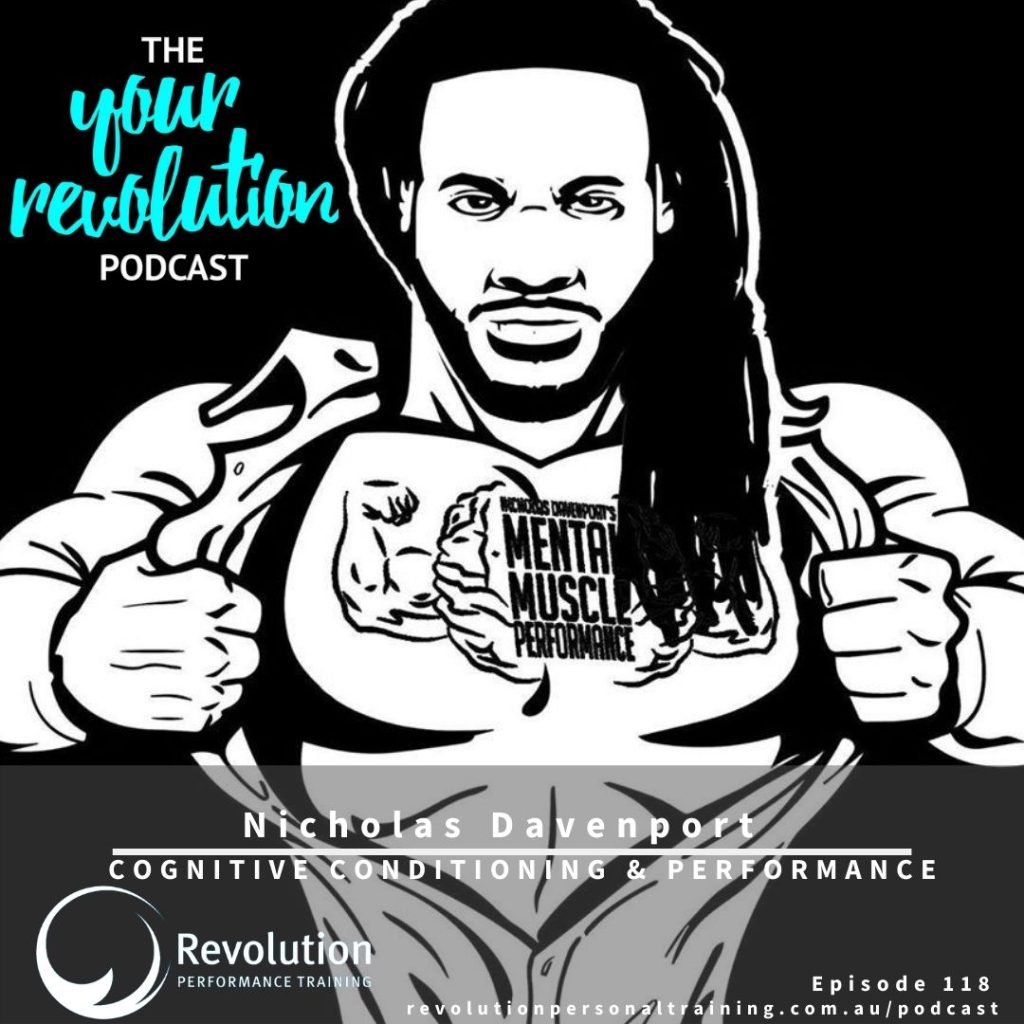
The Your Revolution Podcast is back with episode 118. With Greg Kourpanidis as your host, Join him as he hosts professor, S&C coach and cognitive conditioning expert Nicholas Davenport AKA Mr. Mental Muscle. Mr. Davenport is the founder of Mind.Body1 and a lead advocate for all things training the brain.
Nicholas has consulted for people from all works of life including the NFL, basketball, Law enforcement, and college kids. He is on a current mission to helping those take their mental performance to the next level!
Tune in as we delve into the art of Cognitive training, the science behind his methods, his entrepreneur journey overcoming his own failures to achieve success, and the mantra behind Mr. Mental Muscle!
About the guest: Nicholas Davenport
Coach specialising in cognitive conditioning and performance under pressure.
Episode transcript
Hi guys, my name is Greg Corbinidis and welcome to the All Revolution Podcast, which is brought to you by Revolution Personal Training. I’m an avid trainer and fitness coach who strives to learn from the very best in the world of health and fitness. Join me in this episode and besmeter game changes in their chosen field, sharing their story of passion and success.
For all podcast-related things, please subscribe and check us out on Revolution Personal Training the world. This is not bad. You just try to get back into swinging things, you know, with the world shutting down. I know a lot of businesses in general took a hit. So me and my partner, Phil, who have been working diligently to get our businesses consistently, you know, back on our feet, because being in the human performance industry is like, this is not an necessity.
So it’s just a matter of getting things in a way that can make sense for us to keep us going, you know. Yeah, absolutely. Well, we definitely talk about, uh, yeah, Phil Deroux. Like I said, as I was touched before, you know, a lot of people I’ve been following, a lot of your recent work through social media and I guess through Phil’s channel, but not only your own, but for those who I suppose don’t know who you are, can I suppose you give a little bit of an introduction, I suppose, who you are and also your background, what it is is that you do.
So yeah, I kind of do a little bit of a lot of things but the main premise to anything that involves brain training would it be mental skills, mental health, performance, anything that requires thinking, I kind of dictate. So that could be something as simple as reaction time. So every sport in sport will need to be able to react quickly to different stimulus because if the quicker you act, the quicker you can get the job done.
That’s just probably the tip of the iceberg. My background actually is in psychology and I do have degrees in psychology. So I really deal with the mental side of things and all aspects, but now I’m going to kind of put it more in the performance role than like the clinical role. Yes. Yeah. Okay. And in terms of like, did you start off clinically or did you, what sort of got us, but how did you get into sports psychology?
And I suppose it had to be version to kind of like what you’re it now. numerous times. So I had a teacher named Dr. Ian Payton, who was a British fellow who taught at my school. And he got me hooked on psychology. I had to take one class in psychology. But when I took that one class, I was like, “No, what? This needs to be my major.” I switched it right then that day.
So the fast forward that to my higher level, my graduate work, I was doing mental health, so more clinical stuff. And I had a classmate, so I was doing my master’s and I had a classmate who said you would probably like sports psychology and I’m like what’s that in mind? You I’m like 2012 so I’m like 24 at the time and I’m like I’ve never heard sports I come being an athlete you think I got interested in the brain psychology would have heard of sports like I did so she told me like yeah I got my master’s in that and I’m doing mental health with which I was doing with her and I was like I think which of that she said I wouldn’t advise that because it’s not very lucrative and me being the idiot I am I didn’t care I heard sports psychology and digital performance the mental side physical that’s Mr.
Mental muscle was born that day like literally that that was like a I would say December or October 2012 so that’s right time Mr. Mistle was born literally I made an Instagram I think the following month and I made it Mr. Mistle Mistle and it’s been at name since 2012 and I never looked back like I got in this course I called you after that and why she said it wasn’t okay it isn’t I said I’m gonna find a make it work for my wild, whether it be financially or just the good feeling of knowing I’m doing something that I love to do.
And I have a look back. Yeah, that’s very important. Obviously, you know, for anyone who obviously follow up their passion and out, as I’m really just fascinated, no, in your interest is with some of it also from your, you as an athlete, you mentioned you were a high look, you were your D1 athlete. In terms of looking at the mental side and that whole sort of the psychology aspect, did you draw, was it from like your own experiences as well that sort of led to you being sort of fascinating to kind of pursuing it further or, yeah, what else?
Were there any other factors I should say? – Oh yeah, most definitely like I’m big on like all my methods whether it be the Fitlight stuff or the more mental psychological stuff all that is drawn from my course working what I’ve learned from my science But a big part of it too is from what I’ve seen or done through my own life and think in my own eyes So I could say a lot of it comes from either my experience of overcoming adversity and sport adversity in life as an athlete as a man in the world.
And also seeing teammates or other people around me go through things and saying, okay, I can take what he went through even though I didn’t experience it, but I can draw from that. And I use some of those people like I’ve learned from like their experience. I use them as an analogy with my mental school letters to this day because it’s about putting into context because anyone can review science.
I can tell you about neurons and how the brain adapts to X, Y, and Z. But most people don’t care about that. Or they just don’t know about that. So it’s good to bring in context to make people know, oh, I can relate to that. I’ve never heard of the word Neurodegenerative disease, but I know what it feels like to have a bad day and know that ruminating thoughts can lead me down the rabbit hole of depression like people understand that I told a story about that versus be breaking down the neurochemicals and And talking about serotonin and dopamine, right?
So it’s about making the context from my real life experiences or external experiences that I could bring into it. – Yeah, no, for sure. Now going a little bit back onto the study as well. Now, something I listened to in a previous podcast you’re on is that you actually went on the same to get, went back to college, literally to get more credits in psychology.
Like you did like this additional study. He needed to talk about this, I find this really fascinating. Yeah. – Okay, you did your research, huh? So yeah, that’s something that most people don’t know about me that I’ve got my master in 2015, but I still went back and took our core level classes because I felt like I can’t be the, I would say we’re a leader because I’m not a world leader, but I like to say I’ve done a lot of due diligence to get where I’m at.
So I felt like I couldn’t get in my own heart without knowing what I’m talking about. Because not knocking anyone’s trying to promote this field. I’m all for that But at the same time I feel me personally I can’t see everyone but I first put a certain levels you have to cross because when I set in those classes I paid out of my own pocket or took out loans or and No one is funny because the teachers would be like Nicholas Davenport You’re not in need on any of my three lists because you know about 12 programs You have to be admitted and then you have like an advisor So I’m in this class with all these other students who are in the program and I’m not so I had to get approval as a non-degree seeking student So it’s like who the hell is this guy?
And I’m in the class raising my hand. Hey, big knee. Um, can I say this so it was good because I learned a lot but Missed us in the self. It was hard because it was easy stuff Like people say oh you take these classes cool. I know this is rigorous course room I’ve wrote numerous numerous 20 plus page papers on topics that I either was kind of familiar with or not familiar with at all So I had to earn those grades like what I got to see in one of them.
But I got eight of these as well. But I took about, I think, eight classes outside of my masters and I told all the courses. And I passed, I think, I think four with A’s, maybe one or two with B’s, I think I got one C. And that was my class that I got C because I had something going on in my life that made me fall behind. But basically, I was really working.
Like, it’s not I could just go through that and be like, hey, I’m taking these cool doctoral classes, which were cool. But there was the other side of a lot of papers, a lot of discussion, a lot of presentations. So it helped me become better at talking about this subject as well. No, no, absolutely. Now, your business obviously is involved in, quote, over a period of time.”
You know, we often hear sports psychologists and, and, and, suppose the role they play in that fleet. But, you know, brain training is probably something that, you know, I haven’t really, I wouldn’t say I’ve done too much. I’m sure many people listening might not be familiar with. I suppose can you talk about what a cognitive training is and I suppose what also led you looking at a past physical training?
So I imagine initially you did more sort of strength conditioning as well before you moved into this series. I grew up. Yes, sir. So the stroke conditioning room more so because out of height or out of college. So this is around the same time I was doing that master’s degree in mental health right before I switched more psych in 2012. So it was like, it was money to be made in that because I don’t have to explain to a person what a squat is.
Like you said, a lot of people are familiar with brain training. So it’s kind of like, I did strength and conditioning. I got first enough to live in South Florida where a lot of top athletes, football, basketball, baseball, train at. So I got to do some internships with some type of guys. And then I started my own thing and made a little money there, but it wasn’t like super crazy money, but it’s more lucrative to say it’s like a brain training business.
So I kind of segued into that because the name Mr. Minto most of was a friend at first, but it slowly became my way of life because I knew for a fact just from experience and you probably can agree with this, everything starts from here. So no matter how fast and how physically gifted I am, if this is not firing off how it should be cognitively meaning processing-wise or psychologically meaning mindset of oceans, you’re not going to do your best with that school, sport, business or magic relationships.
So I always knew there was some connection there, but I didn’t fully understand the science. And that’s where it came in, me learning more, taking classes, reading books. So it’s like, my business shifting to the capitalism was more so, like, now let me make a construct that puts this into actual applied situations because you see my drills, you see like Dustin Poirier or Junior Dos Santos or one of my NFL players, like Rashard Matthews.
And it’s like, they’re doing things that emulate, not necessarily the movement patterns. I try to stay away with the movement patterns per se, but more so the limited amounts of time or the stress states that they will face in a match or in a game. And that kind of my mentality, can I stimulate the mood states, the processes cognitively, because it may not look like that at face value You see some lights or numbers or colors, but we think about if I give them point four seconds to take in some external information like an equation and then the style what that equation tells them to do and get to that point and do it But if they do it point three seconds guess what I can measure that and that’s kind of what a premise of my body went and kind of ran with at this point and I had to create a lot of different factors with that Yeah, no, and that’s actually been drilled into my next questions in terms of the athletes now I’m sure from the average eye a lot of people would think that you know cognitive training is like playing games You know and, you know, the lights and the flashy things are, I suppose, initially, there would have been maybe some pushback or maybe some of the athletes or people that you train who probably didn’t understand, I guess, the methods.
I suppose you go into, yes, and those sort of early challenges I imagine you would have faced, I guess, when trying to bring some of this training in. So there’s a lot of people who got that old school training, like physical training, and not really familiar with some of these techniques and concepts that you brought in. – Oh yeah, there’s a lot of like up to a battle I’ve had to say, and still face, because I won’t say names obviously, but there’s some top level people I worked with who cost that me like, stupid.
And I had to sit there and be like, okay, and let it go because I can’t like say old school mentality is not that they’re right or wrong, it’s just that people are comfortable with what they’re used to. And we see something not just different, but so out of the lane of what they’re used to, it’s kind of like, why would I do that? And I have some giving it a trial.
And believe it or not, after they did do as well on them, they stopped doing it because they didn’t like the frustration, which is kind of the counterperbelly because that’s why I created it. I’m very methodical in my pro. It’s like, I make them so they do challenge you, do confuse you, make you have the product because what’s the point of it? If it’s easy, you just get a high score.
That’s when it becomes a game. But when I can make it frustrate you in a way that you’re attending the multiple stimuli. You’re having to keep things in your memory to focus on other things. Now it’s getting more similar to real life because at the end of the day, my goal is not to make you the best fighter or football player or fair man or military soldier, whatever it is, my goal is to get your brain to be able to process, handle emotion, handle stress and not the best situations, not the best conditions and under, under equipped to do it.
Like I do a lot of things that give you little time, little resource, but you still got to do it. You know, like I expect you to execute no matter what. That’s what I’m doing here. I’m trying to get that brain adapted to these non adequate situations. And that’s where if I was to say my job title was, that’s what my job title is. Get you a company because no, people say you got to get uncomfortable or get comfortable being uncomfortable.
Right. People do this and say it. But how many of you are setting their training up? And I can say, not’m not the only one, but I can say very few are. – Yeah. So would you say it’s kind of someone’s like you’re simulating, like the stresses that the body or the mind could face in certain environments. So you mentioned, I think some of the fighters, but also, I think people need to understand as well, like you don’t just work with fighters as well.
So some of your work also I think you mentioned you touched on working with like law enforcement and tactical With the law enforcement I’ve worked with them. I work with some military some in-person some distance training I do a little bit of both but yeah, that’s the main idea because with tactical populations you only get a few chances to get it right like it could go very wrong very fast and my goal is the one like I said get you comfortable with it going wrong because like give you an example I didn’t technical training class myself with a Navy SEAL and next Navy SEAL and I walk with him with my conditioning stuff But I still participate in his course so he kind of trains me to be a coach for him.
So we kind of barber and I did a course where we had to Pull a sled. It wasn’t even heavy like I beat it to sled. I was nothing I’m 218 pounds said part of us all of it was too plate So 90 pounds on the sled. So I pulled it like 30 yards forward yards back and then I had to pull out my pistol and shoot targets about 30 yards away small targets like probably this big yeah, and I promise you the feed wasn’t the problem like the physical fatigue It was the mental fatigue because now my heart rate was so high by breathing with I’m not knowing what I’m to do and these are kind of things I’m trying do.
Can I get you the process when your heart rate is elevated? Can I get you the process when there’s three, four, five different stimuli going, it’s good to try. There’s a lady screaming over there. There’s a guy with a gun over there. She’s a good guy, bad guy. These are things that will happen. And like, I don’t know if you knew this, because if you see my law enforcement in particular It’s near and dear to me because my father’s actually a police.
He’s still serving to this day He I think he’ll be retiring next year. I just like that on top of my Yeah, so it means a lot and it’s like crazy if you’ve been seeing what’s happening in America on the news There’s a lot of turmoil turmoil going on with civilians and police officers. And I’m kind of biased one day because yes, I am a Black man in America, but also my father is a police.
I’m 31 years old. He’s been a police my whole life, 31 years. His career parallels my life. So it’s kind of like, I understand what we say, but it’s like, I was meant to do this in a sense, I feel like, because he’s going out there and put his life on the line. So when I think about helping these soldiers or these, I’m thinking like, that’s their son or daughter, they can come home to.
I’m not saying I’m saving the world. That’s not what I’m getting into. But the point is, like, that millisecond, he’s reacting could be all the difference, you know? First, but as we’re expanding on that, use to really good analogy when I suppose you were describing the benefits of cognitive training. And he described it as being, I suppose, like a tourist and a resident in a city.
And I think it’d be a really good analogy if you could explain this one because I think it would kind of really, honestly, like, I think it would really, like, I think we’ve wanted to stand just this on to stand just this benefit of training yeah I don’t think I want to keep talking about it because you have to explain it better than me but yeah as long as can you explain this analogy that you’ve used in describing the coping of training that’s funny because I first said that analogy of my one of my first ever podcast in 2017 doesn’t it beat Anthony Pettis and I got all this new like traffic my page from him.
I was saved from 2017 2018 I would say most of my following came from them too. So I was getting a lot of requests and that was one of the first podcast I did and I use that analogy off the just the top of my head and I ran with it because like you said it makes sense because when it comes to stress not to get too scientific but stress actually is just meaning a change in balance.
So our body has a baseline. You have a baseline heart rate, a baseline respiratory rate, how much we breathe? 6, right? So whenever that gets disrupted, that’s called stress. So stress is not necessarily an actual person, place or thing. It’s just the fact that our body has changed from balance or resting point away from it. So if I tell you to stand up and sit down, that’s technically stress.
Now we wouldn’t be like, oh, my day is ruined because of that. But that’s the first thing I tell you to get people to understand. Stress is a factor of life. You don’t get rid of it. You just understand what stresses you and how it can help or hinder you. So with the analogy of the tourist or the residence, I came with that because if you ever went on a trip and I think anyone can attend to this, whether it’s an artist, if it’s abroad or in their own hometown hometown or not in the home state or city and you’re driving somewhere or flying somewhere.
And to the patients like, oh my gosh, it seems like forever, right? And that’s like a stressful situation. We need a stressful situation. You don’t know what’s going to happen. Like, oh my God, and you’re anticipating your aunt’s seat. And that’s not good because if you’re in a fight, if you’re in a tactical law enforcement standoff, if you’re in a speech even, you not being ready and antsy is not going to help you.
So that’s the tourist because I’m trying to get there. So I go to a foreign land I’ve never been to. Let’s say I go to Egypt. I used to use Paris, so I’m going to change it up. Let’s say I go to Egypt, to the Sphinx. I see the great pyramid. Most people are going to do the phone. Like a million selfies in front of the speak picking its nose doing something stupid, right?
So that’s a thing that is a relevant to life. But obviously I’m not saying if you’re on a tour, don’t have fun. That’s what I’m saying, obviously. But it’s like in a fight or flight situation, a stressful situation, that’s going be, I’m not. What’s this? It’s never going to end good for you. I can guarantee you that. It may not like stop you from waiting or stop you from succeeding, but it will never help you.
So that’s the tourist. He or she is ready to see the site, take a bunch of pictures, get excited of new sites. But the resident, guess what? If I live in Egypt and I live by the Giza pyramids or I live by the Sphinx or in that area, I’ve seen that thing a hundred times. I use myself as example. I live in South Florida, sunny South Florida by the beach, not too far from Miami.
Okay, where you from in the world? People have heard of Miami. Like I live in a smaller city called Deerfield Beach, which is about 45 minutes north of Miami Beach. But I’m relatively close to the beaches of where I live are great too, just not as famous. And it’s like, I see the beach every single day. I drive by every single day. I never go to the beach.
People are like, you’re crazy. I couldn’t live that close to the beach. I’ll be there every day. You know why I don’t care? I’m used to it. I’m adapted to it. Yes, that’s stress. So the here. She’s not going to be like, it’s the reason go surfing. Let’s go see. I’m like, I’ve been here for 31 years. I don’t care. Like for you, I don’t know. How long have you lived in Australia?
Well, I’ve been here for 31 years. I don’t care. Like for you, I don’t know. How long have you lived in Australia? Well, I’ve been here for 31 years. I don’t care. Like for you, I don’t know. How long have you lived in Australia? Well, I’ve been here for 31 years. I don’t care. Like for you, I don’t know. How long have you lived in Australia? Well, I’ve been here for 31 years.
I don’t care. Like for you, I don’t know. How long have you lived in Australia? Well, I’ve been here for 31 years. I don’t care. Like for you, I don’t know. How long have you lived in Australia? Well, I’ve been here for 31 years. I don’t care. Well, I’ve been here for 31 years. I don’t care. Well, I’ve been here for 31 years. I don’t care. I don’t care.
I don’t know. How long have you lived in Australia? Well, I’ve been here for 31 years. I don’t care. I don’t care. I don’t care. I don’t know. How long have you lived in Australia? Well, I’ve been here for 31 years. I don’t care. I don’t care. I don’t care. I don’t care. I don’t care. I don’t care. I don’t care. I don’t care. I don’t care. I don’t care.
I don’t care. I don’t care. I don’t care. I don’t care. I don’t care. I gonna like lose your mind for things that’s there, you know? I don’t wanna be pre, I’m gonna say something, please say that, stop me. ‘Cause I haven’t been to Australia, but I know there’s some great sites, I know there’s that Opera House that I’m with. – Yeah, it’s in the pre-order of the Opera House, right?
– That’s right. – Yeah, so I know what that is. But it’s like, you’re not gonna freak out because you’ve probably seen it. Like me, like people will say, oh such place but that’s in my Florida history books like we have to explore the history and fit great in Florida so it’s like we learn and hear about all these things CD things are gonna field trips things people dream about going to books and like I live right down the street from there you know so I’m the resident I don’t get freaked out so you you always want to be the resident.
And you don’t automatically become the resident. That happens over time. Whether you’re born there over time, you don’t realize when you’re sick that you live in a very unique place. Australia is one of those places that it’s a destination. If you go to book a ticket for a plane, it’s probably going to be a competitive price. Like if I say let’s go to a random patient of brassicas in America, it’s going to cost nothing because no one’s to go there.
If I try to go to Sydney or something like that at Melbourne, I probably have to pay a decent price. So for someone like us, we get to accomate that. So that’s the tourist of the resident. You want to be the resident, not the tourist because the tourist is not sure what they’re going to see. They’re going to be more anticipating, more about it. That’s not a bad thing, but you have to go just like with a vacation.
The more I go to this place, you become the residents slightly, you know, you’re not going to live there. But if you go there again with a person who’s ever been there, you’re going to be the one like, hey, I know just where to go to eat, or I know just where to stay in the hotel, because now you’re more familiar with me. So it turns to residents, one of my favorite nowadays that I use, that’s good actually, you know about that one.
– No, I love it. I mean, when I first heard you say it, yeah, it just really stuck with me and it was only really like, and yeah, plus it’s just an awesome analogy. So yeah, good host to you. Now, first flooring on, I suppose, can you talk about your own company, MindBody1? How long I suppose it’s been up and running? And as far as who are you currently working with?
Because I mean, we have touched on it just several answers before that you kind of work with a real mix of clientele, like from the elite athletes, but also you work with the general population and the corporates too. So yeah, I suppose can you talk about first off, yeah, mind-body one, but also the transition as well, because if I’m not mistaken, you were kind of doing sort of general, like sort of like general sort of fitness and things before you sort of started your own thing.
Is that correct? Yeah. So yes, so I’m by the one that’s a very interesting transition. And I guess it’s the beat of a podcast. I’ll tell the story. Because usually when people ask me, I try to convince it, but since we’re on a podcast, we’re going to get the story. So in 2014, I’m a backtrack. You said that’s from a backdrop a little bit. So 2014, I had a daughter.
Her name is Tiana. Her birth is actually tomorrow. She’ll be six years old. So she was born. Thank you. So June 12 2014 she was born. So when I was with her mother we’re not together anymore. But I being the hustler that I am, I was doing an internship as a strip coach with Florida Atlantic football. Well, I was soccer too, but mostly football. I was doing a, I guess a part-time job at a mental health hospital, dealing with psychiatric war, meaning like people with severe disorders, like severe, severe, like attacking me.
I’ve been attacked by a 70 year old woman that punched in the face and slapped by a 70 year old woman. That type of? But I would say crazy. I apologize. No, that’s easy. Yeah, but um, so I was doing that and then once he was born it was like, okay, I was doing fitness on the side. I had a few clients. Nothing extreme. It was decent side gig. It was like a few thousand a month.
It’s something I could live off. So it was like 1500 so it was a decent little side gig and What happened when she was born I was kind of like I need some stable. So I became a teacher Now you’re like wait, what else are you doing like so I was teaching finishing my masters Doing the overnight job with the psychiatric hospital and the internship and that eventually finished.
So that I was just teaching at one point. So I got laid off from that job within four months of the semester, 90 degree month of the semester. And I had a newborn baby to pick another house, a car, the whole nine. And I’m like, wow, what do I do with my life? I just lost everything. And that’s why Mr. Mythamosa is more than this name for me. This is my life.
So being a man that I am, my ex was like heartbroken because they’re like, how are we gonna do it? I’m like, don’t worry, I’m not a quitter. So I said, but to her, I said that in my head, I’m like, what am I gonna do? I don’t know. But I had to figure it out quick. So my brother worked at that target So he was working at Target as a cashier. I have a master’s degree or finishing it and I think I’m above that work, but it’s kind of like this is really backtracking So I take the job at Target unloading trucks and loading them and taking the boxes open and putting toys on the show.
Toy aisle is the biggest aisle in Target. The second biggest is sporting goods and the third biggest furniture. That was all three of those aisle. But my main aisle was toys. I was unloading truck, big boxes, ripping them a hoard of knife and putting toys on the aisle. So why this was happening? I was searching for teaching jobs and talk about Mr. Toughness, why.
Mythamust was really my life. I got rejected 57 times. I applied for 57 jobs from November to May. I got rejected. I rejected. I rejected. I rejected. And most of the day, because they said experience because I was only 26 at the time. So I’m like, how I’m going to live can’t live off work in part time at a Retail store, you know, so while that was happening I had my earphones in because it was overnight.
It was like corporations will be okay. I just didn’t go because I’m like, I can’t be doing this. So I saw an ad on Craigslist maybe a week after that. So when I saw this ad, you find like, where’s he going with this? I’m getting to the point. So I see an ad on Craigslist and it says neurofeed technician and I’m like, what the hell is that but I do the word neuro it says psychology majors wanted so I’m like, okay, I’m a psychology major seems interesting I text them they call me back set up an interview I go into my resume They’re like you have a master’s degree.
This is below your pay grade and I’m thinking like how much is it like $10,000 an. And I’m like, it is. So I went from making $40,000 teaching to $11 unloading trucks and stacking toys on a show to $10 putting EEG headsets on people’s heads in an addiction center. So I took the job. So I did it 25 hours a week. So it wasn’t full time. And I the assistant to this guy.
He was a psychotic thing. Dr. Rick Harris He’s one of the leaders in neurofeedback, which is basically an EEG head stick for those who don’t know that’s basically like a heart rate monitor for the brain for those out there that I don’t know so it reads your brain waves What happens is the patient sits in the chair watches the movie a regular movie like say Avengers or whatever and as you’re watching it their own brain waves send out a signal of if they’re in a calm state and it shows his waves going up and down Agitated state relaxed speak whatever and our goal is to rewire their brains So they’re in a more distant state and these are drug addicts so in recovery So their brains are all over the place.
Over time research has shown and I’ve seen this organized it actually reframes the brain. So this is more like applied physiological like neuroscience. So I learned all this stuff and he only had two centers at the time and I was just assisted. So basically what I would do as an assistant, I got a lot of responsibilities that I was just thrust into.
So I would take their intake through personality assessments, I would do their EEG assessments, I would do their ADHD assessments. So I was doing a lot of cognitive testing, psychometrics, if you will. And a lot of people notice about my background, so I spent three years doing that. So I had a lot of experience working hands on with people with severe or high brain dysfunction.
And I got to see this firsthand. And then this is where my body comes in. So you’re like, okay, you’re getting to it now. So one day Dr. Harris comes to me, he knows I have a background in sports psychology. I mentioned Mr. Muthamosa at this point for two years now, he’s 20, no 24 years, so 2015. So he’s like, I want you to make a program. We’re gonna call it the Mind Body Connection.
So not mind by the one yet, the Mind Body Connection. And I want to have work out, I want to have thinking, I want to have mental toughness, mental skills, lectures. I’m like, I’m your guy. So I write like a 23 page little proposal, not serious. I get to one piece like this, he’s great. Since he’s up to the, because he’s the owner and the operator and the doctor, the psychologist, whatever, but he has a board.
So he takes it to the board and they love it too. I’m like, it’s my time to shine. But this is where perseverance and patience comes in. They get audited by insurance cover because when addiction centers they get very stringent on how they run them because there’s a lot of shady people in that industry. So they get audited. So they have to get things ready.
So they put the Mind Body Connection Group on the backburn. So this is a whole year goes by. A whole 365. I don’t say anything. I’m still working there. I get $10 an hour. My now ex ex or still wear it at the time It’s kind of frustrating because there’s nothing against her I’ve nothing against her but it’s frustrating to know that the man you love or care about some of the father daughter is struggling to make ends me because he’s following this and Maybe her eyes are there eyes a world eyes a dream because in mind, I’m building the framework for my body one.
Because even though I was doing in person, I was building what would later become a theory, hundreds of pages of research, dozens of pages of written, like, ideas on the word document that I would make up. And this was happening behind the scenes while I was doing regular fitness and doing my neurofeedback job So she didn’t really quite see it and that’s why we kind of work but basically a year later.
We broke up I’m like on my last dollar like a lot of people So I think I’ve never really talked about it. I’ve been on a few podcasts You might be the first one if not you try the second but I don’t think I’ve said it many times But I was actually living in my warehouse facility or my my facility I had a like a office type hybrid and I was living there and I was taking showers at you fit gym Like I had a $10 membership while just go to the gym the shower and go back and add a little stove top I would cook food and I walk across the public and I live back there for about six months because I in my head I’m like paying for apartment or whatever versus funding my dream doing my passion and I got the point that I had no money and I told Dr.
Hare some like hey, you’re like a mentor to me Can we do something and this not me saying can I have a hundred thousand dollars like that this me saying? Can we get that group going? It’s been a year now. So he was like well, okay So I’m like, yes, so we meet up no no he calls me the next day and he’s like How does $50 an hour is down mind you I’m only doing this group three or four times a week.
So if you do the math, I’m getting paid the exact same amount. I’m doing less work though. I’m like, that didn’t make sense to me, but I’m a nice guy and I’m very agreeable. And I said, yes. So I consulted with a friend. They told me, nah man, can’t do that. So I had to suck it up and I came back to him and said, “Nah, Dibah Harris, I love you, you’re a mentor to me, but I have a lot of my plate.
I love God. I have a lot going on.” So I told him, “Can we do something else to make this make more sense for me?” So he thought about it, he said, “Know what?” And this time shows he cared about me. He wasn’t just trying to pawn me out because at first I was like, “This guy just trying pawn me off? But this showed me he cared. He knew how to master.
So he was like, you have a mask. So we can run the group as a clinician because I had the credentials for it. So it’s not like we’re finagling the system. I had the credentials. So I’m like, I didn’t know that because I didn’t know how to know the billing system works with all the addiction centers. So basically he he filled it as a group. So I can get paid as a clinician and I had the credentials.
I can sign off and it was legit. with on self talk, visualization, goal setting, whatever. And then I’ll make these crazy games where you have to get different numbers and colors and questions and runs to the cone or flip a card. And you may be like, huh, that sounds kind of familiar. That was the birth of my own body one. So that was 2016. So for a year I ran that group.
It was great. I was making decent money. I was teach at the college because I teach part-time now at our college So things are picking up for me, but guess what? Adversity comes and goes. It’s not a addition relative. They like to visit so They came back and they actually had some mergers with the other centers because he went from two centers to like five Yeah, and then I think to emerging them and then I’ll still around so there’s massive layoffs going on But I’ll still there and I’m thinking like oh my god It’s going by number eventually because I’m not a doctor.
I’m not a nurse. These are things they have to have I’m a service that’s great and people love it people love my group But I’m very expendable so I made it about a year and I didn’t get cut but one day I got a New quilt because I thought like this like I’ll throw my group. He said hey Let’s go. I said thank you guys. Here is that I didn’t get mad. I’m like, thank you because without like there’s a lot of status go to my store Part of it.
I have to skip one of the most important ones. I’m back to one more One more time. My great grandmother died of Alzheimer’s during this period when I got to get so that also fueled me too because now it’s like I lost a dear person to brain disease. I wasn’t with brain disease and illness and so that also fueled it. So when he let me go that’s when my body went officially became something because now I’m like no what I’m on my own now, but I gather so much research so much experience in the real world I feel like I can’t be touched now.
Let’s make this a real business So I made my body one with the premise of the same thing I did with the addiction center And that’s how that started with the fitness groups that would be a mixture of mental drills with regular workouts and I guess I can stop there with that question because everything you see now is from that. So I know I was a long story, but– – No, that’s fascinating.
– I don’t know how it might have been when it came to beer. – Yeah, I mean, I actually didn’t even know, I mean, a lot of that stuff. This is some of your background, some of these you’ve done in the past, and the obvious a true testament to your resilience as well, pushing through. And so yeah, that’s really interesting. Now in terms of, I guess, obviously, we’ve got it all up and running now.
Can I suppose you talk about also some of the equipment and things that you use such as like the Fitlights? And so was that things and stuff that you actually put together yourself or was some of this equipment or the things who was always out there or was just sort of like underutilized? I say it’s 50/50 so FitLights I definitely have to give a testament to them because they’ve been very integral in my career actually post this on Instagram right before I call but um like I love those guys they brought me in as a brand ambassador I was the first one they ever night had I I use it, but I’m not a creator.
So a lot of people would make me synonymous with it, which I don’t mind. And because I am a partner, a team member of their program and their company, but I did not create fit like, but what I did do was create a methodology that is unique to me. So that’s where I can say I’m like, like say the hardware like apples, the hardware and windows is the software.
So I’m windows in the sense, I guess you could say with them, but I do have my own equipment that I do make. So if you ever see the little sticks I use or the grids, I make those myself. I print those out. And those are things that I personally credit myself. Like the concentration stick is an invention I created that existed for me, the grids. I didn’t create concentration grids, but I made my own variation of them.
So pretty much those things are things I decrease. So like half of the stuff I use is for me. And the other half is things that I purchase like there is all bit light. There’s another one called Vector Ball. So if you ever see me, like I use this with Dustin a lot, it’s actually a baseball that lights up on impacts. When it hits something, it turns red, green, or blue.
Shout out to John Lindsay, he’s actually a creator of that, and he’s actually an extraordinary guy who’s someplace baseball, and that’s why he created it. And me and him became good friends. We traveled together, went to different colleges doing presentation and stuff, so he’s a real great guy, and his probably is amazing. And so I used things like that, and I’m very big on using things I believe in like there’s a lot of people come to me and they see who I work with or they see my falling is pretty decent and I’m not big on just said I won’t actually be like this something I want because Unless you’re like say LeBron James or something.
There’s nothing written off for the make you just be like fill my morals out the window. Yeah, I’m gonna use. Like I’m sure LeBron James doesn’t drink Pepsi or Coke or whatever every day, but you see him on a spike commercial, whatever. Yeah. So I’m not at that level. So it even is the way, depending on what is, I still will question it. But for the most part, there’s all the time you see me use, I’m heavily using with my real clients.
So if I just like, here’s the post me doing this drill and you never see it again. You know things I’m using consistently So I on the ball that’s a bit like and I use the he-co stick as well So those are probably three things I use consistently that aren’t mine and everything else is mine because something’s not even like tools. Some things are just methodology.
It’s like I’ve created like created like actual or method of based off cognitive science and psychology that I said, let me take this real life scientific brain science facts and turn and make a drill out of it. Yeah. And that’s kind of how my brain works. Like it’s not a tangible thing. I’m like, why not make it tangible. Yeah. Okay. Yeah. And that’s actually something I was going to ask you about but yeah it’s been the FitLite so one of my previous guests I suppose you would know who’s done a bit of work we’d be Jason Stacy in the yeah I know he was a very big fan of using the FitLite yeah tennis players yeah the one that’s finding he said to me after I interviewed him.
You’ve got to get Nick on, you know, to obviously talk about some of his work and, yeah, so a massive shout out to him. Oh, Jason. He’s amazing. Did he tell you how he met? No, he actually didn’t, but, you know, I’d love to get a story. I’m in Miami. I want to buy your hit starter pack the things I was talking about. I’m like, oh, cool. He said, can you mail us the hotel?
And I’m like, oh, we’re glad. I’m in Miami. I’m like, oh, that’s like 40, 30, 45 minutes away. I could just drive to you. But I didn’t realize who that’s the Miami Open with Arena Sabalinka, the number, I think nine tennis women in the world. And at the time I had like, well, because I didn’t follow tennis at all. So he hits me up and says, well, come on by, I’ll eat some tickets for you.
I’m like, really? And I’m like, OK, I’m there. So I drive down the hard rock stadium. It’s about like 25. I meet up with him. I meet Arena. I meet her coach. I meet a Doca bitch, Novak. I meet Serena and Venus Williams. Like, amid all these big time tennis stars, and like three hours ago, I had no idea who happened to work. And I’m not selling funny, but that happened a lot.
Like, I found myself in, like, I was a lucky or blessed wedding morning, I found myself in a lot of situations where it’s like, “Why am I here? Like, I mean, I mean, I mean, I mean, I mean, I mean, I mean, I mean, I mean, I appreciate him linking us together because that’s what this is about because my biggest photo as a business is not necessarily like I would say getting sales or getting clichele is Clang tell a pretends a client to understand what this is and I need people who believe and The share it and that’s what he’s been doing amazing.
I he shares me all the time and it’s much appreciated Hmm. Yeah here you go. Now, in terms of supposed talking more back into cognitive performance, I guess in the average, a lot of people would think that it’s something that’s not very tangible, which I know you’re going to disagree with me and tell me which in the audience. It’s not a big within, you know, the average, I would see physical training that, you know, there’s all this data, there’s things we can use to see a progress, but calling training and some people probably say or believe that it’s not something you can really measure.
Can I suppose you talk about the ways, you know, the way why it is tangible and so it’s one of the things that you’re looking for. – So what if I told you I did disagree with you and I do agree with you? -‘ll say I agree with you because I say this myself all the time to clients and the potential clients I can see someone buy stuff getting bigger, right?
I can see when see one run faster a time Like yes, we can measure cognitive processes and this is what I agree with you because we can measure them But the biggest question you got to ask with any kind of brain or mental health or mental skill is what does that measurement say because I’ve done research or our system research too and when we do research we got to have tangible Constructs or measurable constructs that make sense not just for the sake of the the context of the experiment But that can generalized.
Most of the biggest faults of researchers is their stuff can’t be seen in the real world. If I make a set up, so let’s do myself, for example. I have a drill where I have a FitLite set up, one on each side, about two feet apart, and in the middle there’s an iPad screen. And on the iPad screen, they do something called a concentration grid, where they have to poke the numbers in a numerical order, one, two, three, four, but all scrambled up.
And on the side, peripherally, the eyes are forth doing the grid, peripherally, about two feet away, one of those two lights will light up every few seconds after we actually put it out. Now, I could say this is a perfect drill for multitasking and peripheral revision, which it is. Instead, can I take that and say, if you do well at that drill, you’ll be a better fighter.
Can I say that? No, I can’t. And that’s why I check my biases in a comfort zone, because a lot of people won’t say that because they’re like, this is because they got a market. And that’s why I think I messed up because I’m a straightforward shooter, straight shooter. But that’s why I agree with you can’t measure that I personally would never say that’s gonna be better spider.
6 seconds or whatever. So I can tell you that. And where this carries over to a real sport or real life is really subjected to the person because obviously you can do amazing on that drill and get knocked the hell out. And you can do horrible on that drill and do amazing. And vice versa. Now, with more data collection, I’ve done a lot of numbers and I do see a correlation with people who do well at some of my drills, not all of some of them, and do, because I actually took the time to go through some of the fires I worked with and look at their records after working with me and their significant strikes.
And I used with a grain of salt because, like I said, I can’t save control of that. But I did see a small correlation with some of them because it’s real in this. I can never say So that’s what this would be what you agree with you, but disagree with that statement because it is so it’s like half of it is like It’s only gonna measure what you want it to measure But the other half is it has relevance to what you’re trying to do which is Has to be able to perceive these different stressors be able to react to different stimuli and make the decisions quickly as possible under pressure.
– Sure. Now, in terms of the actual, I need people to understand in terms of this whole quote, they need, well, what my audience, you actually blend this along with the physical training, so which you kind of just said. Can you, I suppose, talk about how you would sort of structure this life in a going to work out our views, Dustin Foren is a good example.
And we also talked previously about how you could work and build the room. But yeah, so can you talk about how would you sort of structure this sort of training in, I guess, like a training session? Let’s use Dustin, for example, a fighter. Yeah, how does it go on a program? – So more so in the past, we’re not doing as much as this camp has kind of been crazy because of COVID-19 and everything.
So it’s kind of been harder. But in the past camps, how would we do some days? It’ll depend, but he’ll run the strength conditioning. So I work with him on that. So for example, they will be integrated. We’ll do something like say a 90 second duration of some kind of physical belt. That could be a prouler push, med ball tosses. Something is going to last about a minute and a half of physical exertion.
And they will immediately bring them over to me with some kind of cot of your weathers, the color box and the grid or the fit light reaction or something. I’m going to make them have to have a, usually a high high working memory load so working memory is basically the ability to hold information and figure things out while holding so if I was to say a simple math problem like 48 plus 12 you probably seen your head 8 plus 2 0 4 plus 1 carry the one and you’ll get 60 So that’s how like a simple sample.
Another thing that would be like remembering a phone number I said my number is 954226, 296. You probably would stay in your head over and over again until you can write it down and put it in your phone. So that’s working memory. Holding information for later usage. So why I would do that type of drill, why he’s under a high heart rate, elevated heart rate after 90 minutes, I mean 90 seconds of duration because if I just made action drill, that’s not too much thinking It’s just like see a light pass so see a lot put it out but during that 30 seconds of drill I’m gonna say six numbers out loud and after that you got to recall in order now using that working memory because now I’m Reacting where’s light?
I’m huffing and puffing breathing hard and then seven. Wait, what? Three. And now they’re freaking out and they’re like, okay, what are those numbers? I’m in order. Not just what are those ever. What are those numbers? And seven, four, two, five, four. Good job. That’s correct. Or, nope, you missed one or nope, that’s out of order or you’re all wrong.
And now you’re like, what? I know I, what I know about it and not again frustrated That’s good because you’re going to get frustrated So we like to put the physical that’s one way you put the physical and immediately integrate a mental skill or We’ll just do a full workout and he’s just done and then just have him do it in the already depleted state But he’s come down the baseline at least so we we’ll do it like that too.
So that’s typically how we either do it either integrate it between sets of like a moderate intensity, anaerobic workout for about 60 to 90 seconds, and then quickly go in the 30 second bow as like an active rest. And then we’ll do that or in a whole new session. Now, sometimes I personally integrate the physical with the ThinkYtudo. So I’ll do something like have a past screen with something I call FitRiff, I think that’s one of my methodologies I created is basically like taking the concepts and just adding numbers and just working member once again, it’ll be like four plus five.
That’s nine. But around that equation, there’s a red box, a green box, a blue box, a yellow box. Each box has a number in it. So if the answer’s nine, let’s say yellow has nine in it, you shuffle to the yellow cone and get back center. The next question, two plus four, let’s say green is the fourth, fourth is the green box, shuffle over the green. So now you’re using that thinking processing while also having to move based on that.
And I call that arystolic conditioning because I took that from the word Aristotle, the famous Greek philosopher who was actually known for doing his lectures in something called the Lyceum that was his school and he would walk and give lectures. So I took that concept and he’s like, “No, I’m going to put an aerostolic conditioning because we’re literally doing the same thing.
We’re making the same process while I ask to move at same time. So I do stuff like that too. When a drill in itself is integrated with the thinking because some of the moves just be stationary. You see a lot of those more so with like dusting than my bigger athletes, but some of my younger like my high school guys, I do a lot when there has a move and process too.
Yeah, no, that’s really fascinating stuff. It’s actually I didn’t listen to to a previous podcast and you actually spoke about, I think it was actually the one that like you said, the one that really blew up, you know, Mr. Mental Muscle and that was talking, it was Dustin Poirier, Spike Lee, F. and Pettis. I think it’s a good example of what’s wanted to use from some of this work and was, I believe it was he’s having the eyes sort of covered or his vision.
Having to use sticks. I like this to be important. It’s probably like a really good example of some of these drills he views. Can you just talk about, yes, what that drill was and how it really transferred into that fight that he actually had as well? Yeah, that one with Pettis details and damage to his eye. I have to do which eye it was, but I had the ears that were strobe goggles.
Basically, they put them on the glasses or shades that struck around your head. And imagine like every few seconds, you’re blinded and then it opens up. So you’re seeing nothing, do you see something? Do you see something? That’s what the glasses are doing to you. So I can make them one eye, the other eye of both eyes. So what Meantfield did, this is like in the early days of what Meantfield collaborated.
And I love, like shots out of the field, I missed these days, man. If you’re watching this and when you see this, but it was like we worked literally concurrently, and not too currently, but integratedly because it’ll be like he was holding up a light and I was calling out numbers. Destin was. It was like the three amigos and we still trust we’re still three amigos But it’s just like while growing our own respect to feel that’s to become in a champ feel as you’re coming like the mother freakin world leader and strips conditioning MMA and me trying to do my thing with my truck kind of conditioning stuff So it’s like we have him doing those things and feel with their like combinations with noodles.
You have to counter them and block them He’s only having one eye I or a poster, whatever, I simulated his eye being accessible, meaning his brain is taking a trip to that site. His brain taking trips to the city of I-POC or the city of I-Shut, whatever it is, because now he’s somewhat acclimated to it. So it’s not like, oh my gosh, the first top thing this, where am I?
It’s like, oh, I remember this place. I don All right. You hear, buddy. What are you going to do? Yeah, that was a big part of that first fight. Hmm. No, it’s not great stuff. Now, I’m supposed to have more to work. And you’ve obviously, like I said, you’ve worked in a number of sports and field. What would you say is the biggest area they lack in cognitive training?
I hate to be that guy, but there’s a lot of things I could say. But I’m a, I’m a saying the lack of my personal opinion. I feel like it’s become the because there’s a lot of people who imitate what they see and not just sound like computer nothing. I’m very big on creating my own methodology or taking my message out from the literature and making sense of it in an applied fashion.
I guys aren’t doing that. It’s kind of like, what can I do to make you the most like overwhelmed in 30 seconds? Like there’s pages that will share videos of like crazy stuff that are impressive. Don’t get me wrong. But I actually have a chart somewhere in here in this office and it shows that eight things I say do’s and don’t of kind of a conditioning.
And one of the cool drill does not equal effective drill because a lot of times it looks cool for the ground and my my thing is you can probably agree with this. You don’t have to but a lot of my dreams don’t look that cool. I got something that looks, oh shoot that was amazing. But I got a few that I know that I post that people are like okay but in actuality I know the rationale for them so I don’t care like I have one drill I have a box name Marine Shay when Shout out to her she’s a world champion and if you heard her she actually has a movie she worked on a million dollar baby that’s’s like how loosely based on her life, like her stroke.
So yeah, so I had a drill she was doing. She was sitting on a stability ball, one leg up, breathing at the pace of the screen. So I made this video is one of my, it’s called mindful Stroop. So the Stroop effect is when the color of the word, the match to eat. So say the word red is written in blue. Eat your brain wants to read red, but you got to say blue.
So she was doing that. So she’s sitting and the screens turn her when the brief inhale on a account of like five bars. Now they fill up the inhale and when they disappear, the exhale. Looks very boring on the screen. Like if you’re looking at her like, okay, but people are not going to say that’s important to think because I’m getting her to control her moon states, her mindfulness, her breathing while still factoring different things.
And I know a lot of people that doesn’t stimulate them because we’re in an age of quick gratification. That’s not it. Oh, that’s one of the biggest gripes I got with this industry is there’s a lot of guys or people I should say that are not doing it with the intent. And that’s not saying to do it on purpose either. I’m sure most of them just love it.
It’s fun, but I personally take slight of fits that because it’s not my saying if you’re a gym coach or athletic coach and you do this stuff be mindful of that you’re doing it as an extension of what you really do. Now me is all I do. Like I do not train athletes for strength of goodness. I do not train athletes for sport points anymore. So when you do that, you got to take an account of that.
If you’re just trying to ask something off for some spice, that’s fine. But don’t make it to the point that you got to come up with some stuff just to outdo your last pose because now there’s no consistency in the drill. How do you get standardized scores when it’s a different drill every time or there’s no measurable way? if I throw a ball off a room back flip the catching between my legs Alex I’m sure if I could do that I’ll get a million views, but what am I really what’s the outcome of that?
Well, how do I measure the efficiency of now you might figure it out? But I personally don’t see it So that’s why I think the biggest issue in my eyes is is that they gotta like people not all because I see a lot of people do great job of that too of what like how I do it do my due diligence But I hate to say it’s way more of those other guys and guys like that’s it That’s in the industry though sadly, but I think it hurts us more because we’re not establishing So I get BMs all the time look at this drill man Maybe think of you and it’s some total BS and I’m not a jerk or nastles.
Oh, I think knowing in my head. I’m like I cringe when I see it. Yeah, I think oh thought of me or they saw thinking or they saw something similar I get actually appreciate it because I mean they’re thinking about me but down I’m like these I don’t talk Yeah, I know it’s a man get, in, you know, film. So this is a string conditioning as well. You just get damned by someone and that you’re anything.
Oh, this is a really quick side. I think this will work. And that’s just like, yeah, it’s like, no. So that’s a, that’s a good point. Now in terms of, I guess, in your current work, it’s talking about now and what are some of the things you special currently working on now and you got any sort of future work lined up as well? That’s a great question because I’m always working on something but to give a more finite answer, I finished a webinar yesterday that I did for free.
It’s called Warrior or Warrior and it went pretty well. So I think I’m gonna start doing like a repeat set. So I know there’s a lot of people that sign up. I think 30 people signed up and I know some people who didn’t get to see it. So I might do like a schedule like okay every other week and it’s like a rotation. So I did Warrior or Warrior this week.
Two weeks I’ll do the Art of Kent and I’ll come. It’s like a commit attraction now coming. So that’s one thing I’m gonna have going is more webinars, teaching mental skills. I’ll do something more of the applied stuff. I’m actually working on one, probably posted after we get off this call that it’s actually pretty much ready to go. I’m gonna release it probably the end of the month that I’ll teach.
It’s called Get Your Mind Right. And basically teaching frameworks that okay, I see what you post, I like How do I do that with my client and it gives you like I’ll give you like keep nothing too too deep But if you’re working with this population do this or how I make my measures is how I go about my parameters I get DMS all the time about that and depending of time I try to be like as friendly and open as I can but obviously I got anything going off so I can’t get to everyone but if the time is right I sometimes hop on a call person across the world just like this who are asking about Hey, I got a client.
I do this with them. What should I do? And if I have time I will do it like I’m not at the point where I got a million followers and you’re you’re texting my my my marketing manager, you know, you’re you’re getting me so I ain’t on that level yet. But even if I do get a lot of, I got control of my… I always give them full control. ‘Cause I know a lot like celebrities, they have that and they’re messaging like their cousin or something who’s holding it down.
So those two things, getting the courses, I’m not the courses, but the webinars up. And the one other thing I’m working on is actually a tribute to my grandfather. So I mentioned my dad was a police or is a police, but the crazy thing is his father is actually a victim of police brutality. His father was killed by the police in 1968. This 20 years problem was even born, but he was nine, my dad was nine years old when this happened and it’s like his dad being a victim of police brutality that he come in police and doing for his community and like say, now I’m doing what I’m doing.
Like say, not sound cliche but I feel like I’m meant to do this though. I’m working on that project right now. I’ve been on and off with that about four years now. So I feel like the time of my rest in America right now with buildings being burned down, people sick of the craziness like I can see different perspectives on this I can see the from all of us in perspective my dad had this Like I get both sides.
I’ve been in jail like you get a lot of premieres. I’ve never thought about that either. And that was a student college fight. I feel like there’s a fight. I got to college. It wasn’t nothing crazy. I didn’t do anything like insane. I got in a fighting college. My friends would beat them all. I beat society up, I think. I was drunk. So that’s my good.
But basically I’m a young man. I’m a young man. I’m a young man. I’m a young man. I’m a young man. I’m a young man. I’m a young man. I’m a young man. I’m a young man. I’m a young man. I’m a young man. I’m a young man. I’m a young man. I’m a young man. I’m a young man. I’m a young man. I’m a young man. I’m a young man. I’m a young man. I’m a young man.
I’m a young man. I’m a young man. I’m a young man. I’m a young man. I’m a young man. I’m a young man. I’m a young man. I’m a young man. I’m a young man. I’m a young man. I’m a young man. I’m a young man. I’m a young man. I’m a young man. I’m a young man. I’m a young man. I’m a young man. I’m a young man. I’m a young man. I’m a young man. I’m a young man.
I’m a young man. I’m a young man. I’m a young man. I’m a young man. I’m a young man. I’m a young man. I’m a young man. I’m a young man. I’m a young man. I’m a young man. I’m a young man. I’m a young man. I’m a young man. I’m a young man. I’m a young man. I’m a young man. my my openness. This is gonna be my Peace there is just don’t fight that that I can taste the spoon and be like It’s ready now.
That’s what I’m working on. That’s probably gonna be a change because I feel my skill set is unique because outside of me, just being the son of what I just told you, the fact is a lot of the Scientology and cognitive stuff that applied to these populations is very general because they do stack about. Like every police go to psychic about but they’re testing for like disorders like schizophrenia bipolar Manic depressed like that.
But the thing is I don’t have to be mentally ill to be not actually healthy. That makes sense. Yeah, of course like mentally ill Some kind of like disorder, but mentally health means, am I functioning in an appropriate mindset? And a lot of people aren’t, they’re not even the police thing, but the fact is, is how that, that, that power, that jurisdiction that will influence the world in a lot of ways, some negative, some positive, but the ones that are out now, and I’m not knocking those on issues because they are making efforts because if a person can learn about their inner biases, like we all have biases, whether it be racial, whether it be sexual orientation, whether it be financial status, whether it be sport, everyone has.
The point is, can we get people familiar with these? Because if I said, I’m gonna ask you this question, you can say, you know if you know if you know it’s thumbs up for you because not people But have you heard of the availability the availability? Sure, no, I’m gonna ask you a question. You ready? So I’m going to trip your mode and this will make sense.
You know the largest desert Wow, but this let me I’m gonna bring it back full circle ready so the ability heuristic what that means is we use our Processing because the brain likes the limit resources to get to an answer you heard heard desert. What do you probably think of? Heat, dry. So the actual definition of desert is a mouth of rainfall per year.
And Antarctica has the least amount of rainfall per year. And then North Pole has a second and give you Sahara. So our brain says desert, hot, dry, sand, many of the things described in Antarctica do it. Now, a man that’s saying bias, bias because we all have their gonna be here sticking amongst many biases that we do a Man that same bias would have got what a gun or imagine that same bias with a guy who’s supposed to They can’t a job for employees or a teacher That could be detrimental because now you’re just saying you have a little information that you have in this case for a desert hot hot and dry.
Same right? That’s the available here. See another one. Yeah. I said, yeah, that was a fish. He’s a popular. I started off with a desert. So high. That’s the beauty. That’s the beauty of our brain. They like to still in the blank and that blanks made more sense of a desert that you’re more familiar with. And that’s really just a small snippet of what this curriculum will entail.
Because it’s going to be for that kind of stuff for biases, personality theories, which is also a background of mine. I didn’t talk about that at all, but I have a large background of personality theory since psychology. The kind of conditioning where I have far is the tactical stuff like the shooting judges, Demi-Doo, all of that. So imagine singing an officer into his line of duty with that kind of knowledge.
Because right now, I about deep under the police. That’s a lot of the moment. It’s just the stuff that you’re wanting to work on, but they should put money toward things that will help with that. Because there’s a lot of, I said, where’s that money really going? Police don’t make that much money, so it’s going somewhere, so it must be going to a higher up, some chain of command.
But the guys who are on the streets every day, they’re being sent out there with, not saying bad, because there’s some departments have amazing training, but they’re few and far between, because a budget is dictated by the region. I live in South Florida where this is a heavily populated place in the country so we have pretty for the most part decent measures of preparing an officer but what about that guy who’s a town where there’s only 700 people he’s not training for this stuff and their budget can’t do it so some of that money should be allocated I think personally my biased opinion towards something like what I’m creating But I know that seems like a self-flug but I’m being straight forward It needs to be on stuff like that because that’s how you get a police more prepared because we say someone pulled out her gun and shoots first and ask questions later That’s going back to being the tourist right that points with the tourist he’s pulling out gun because he doesn’t know what to do Where is he?
That’s the either thing I’m familiar. What’s the easy thing I can do right now? I know that’s the only I know that could stop this I don’t know if me trying to talk to almost stop it I don’t know of me trying to whistle get attention I know my pull this out little in it and that’s where that comes from so codes, I feel like if they do the funding, the money is to be allocated and resources that make sense.
Because a lot of people hear that term and think it’s like, get rid of the police. Why are those people who are pushing for that too? I feel like people understand it, that it means putting money where it’ll benefit the society better. I just hope it’s not just putting it in a place where it’s like, let’s not get to the source of the problem though.
Because if you’re going to take money away, if she goes to a thing that’s going to help the problem, or problem, I’ll speak to you. – Of course, yeah, I’ve cleaned up very far on that. Now, I’ve spent some closing questions. One of them is with Stredoff, then I think we’ve really touched on this episode on anyone who when they listen is that someone has a lot of drive.
Can I suppose you share what is it, I suppose, like how are you supposed to have that drive and what sort of motivates you? Because like you’ve touched and you’ve faced a lot of adversity throughout your career from college days to working. So even right now, I’d say you’re still obviously assisting that. Where persisting. Where, yeah, I suppose, can you tell the audience where it’s come from?
– That’s a tough question because I feel like, craziness sounds, I’ve been like this since I was probably like sick. And I think it comes from a mixture of my father because he’s a very driven guy. He had his own business, granted it wasn’t this stuff, but I did have an entrepreneur spirit from early age I personally also competitive so I think that has to I do because when I see a challenge I don’t ever think of it as dang I hope I can do it I think of it is what can I do or what do I have to do to get through this?
So I’m well I am I’m not super so when I get you say drive everything I do has a purpose and I’ve been called me names for this growing up and shoot I’ve been calling in for this now as an adult because I don’t see the world the same because like for example social media I’ve never had a personal social media strictly for person because when I was a kid like a young teenager I had my space and I used to make music me my brothers the rap make beat and we were selling these I for so 16 years of having a social media from my space to Facebook, Instagram, Twitter, whatever Snapchat.
It’s always been for promoting a brand. So when you talk about how I look at the world, I don’t really post for entertainment. Like you seen some of my posts, I do joke around, I make lighter things, but it’s always brand related. Even if it’s a joke, I’ll relate it to the brands on our mental health. So it’s like, it just comes with me that I don’t like to use things unless they need to be done.
And I don’t know if that’s a bit of hyper focused. I I I’ve done it for like 28, 30 hours, nonstop. I’ve done it. No drugs, no, no, no, no coffee. Get it done. I’ve done it. That’s kind of like weird, I know, but it’s like, so I think part of it is that too. But my ingo, I guess, is the main factor because the other reasons definitely, but my ingo that I want to contribute to the world, what I’ve been fortunate enough, because everyone has different upbringing.
I don’t know your upbringing, but I was fortunate enough to have both parents in the household, a father that said a very good example, a mother that’s very loving and caring to this day, and a girl man still. And that set the foundation, well I did have a lot of struggles as an adult, and I have my own set of tribulations as a child. Like I failed numerous classes, like people soon I’m a straight A student.
I’ve the grades Yes, but I’ve gotten very bad grades too and it wasn’t a flack of trying so I guess my deep down result is like I’ve got to like do us what I’m here for like my goal is that Whatever talent I’m giving I’ve got to make it happen and I think that’s why I keep driving to I do because I know I’ve been fortunate enough to be given opportunities and gifts that some may not have or maybe be different from others that I need to showcase and I feel I should share and that gives me going.
– Yeah, well, great answer. Now I was going to be as a strength mission side of it. Did you get it’s very important that you have to find your niche, like you have in the sort of sense? – Yeah I would say yeah, because even in the the psych and mental field, there’s a lot of people and I feel honored because I’m like because people I know we’re talking we’re cool.
We’re being very simple, but a lot of you come at me like I’m not mad at it. It’s cool, but they come at me with this like presence of like like I’m the ghost who guy and if anyone talks to me for like five minutes I’m very simple person like for the same plain clothes every day. I have the same parachute but like when people come to me for like What do you think?
And they tell what they’re doing it puts a perspective of how once again how proportion I am that I’m doing what I’m doing and I was able to go through what I went to because there’ll be people will tell me you charge your client and I’ll be like, yeah, but I would understand why they asked that because I remember six, seven years ago when I talk about brain training or mental training and I’m then people are like, what?
And then I say, hey, I’m a charger for this and like, yeah, really, nevermind. I was there. So when they say that, it’s kind of hard to say like, dang, there is people who have found it. So we say, Mitch’s, I told them, I’m like, it sucks that it has to be like that, but you have to find the lane. And I was fortunate to find my national athletic room.
Those are kind of the three places where I find revenue. Like, obviously, my body went to school, but it got to do this because I have a daughter. I my own self to support So when I talk to them I was telling them you got to kind of expand your market because I say niche Some people here niche and get offended because they think it’s like gimmicky niche doesn’t mean gimmicky this just mean what is your specialization like I said at the beginning of the podcast my specialization is necessary brain training.
It’s making you able to accommodate a less than adequate, stressful, high-perciliation given whatever your demographic is. And I think I’ve done a good job of doing that because you see I work with very diverse populations. And of course, the day I can be with a sergeant of a police department, and in that same day, I can be working with seven years.
– Yeah. – So it’s like do that some time. – So my niche is very, it’s not demographic focus, my niche is more application focus. So that’s why I try to tell people like what is the intergo with the application because maybe with my similar background, they can tell you the same like science of it, like what I know, they know it too. But when I say things like tourists or the rest, or there’s no more stable to tigers, that’s me talking.
Anyone can quote a book. So I think most people fail on that and shrimp conditioning, the acting with Superman can’t shoot web out of this. This is whatever. He can’t scale walls Superman can do you know Batman can’t see through buildings, right? But doesn’t make him superhero so same fine your niche is that thing you’re not able to be lucrative or a leader because like feel for example you still I call him a blacker.
That’s one of my best friends. I love him to death brother, you know, actually we have a long history and his nichas MMA now if he limits it in the name tell no we can work with NFL he can work with tactical he’s a work of kids and he does but When you go to that guy who’s gonna get that fighter in shape in the last five round That’s just fighters do or hours to do that’s who you go to and that’s the thing that people got to understand with their field if you’re that guy girl that they call, what are they calling you for?
That’s what you got asked to say. Why aren’t they calling you? A lot of people don’t know that question. I don’t know that question probably up in between years. You know, and you heard my story. My story is not two years old. My story is like nine years old. I really figured that out. That’s fascinating. Yeah. Great answer. of the final questions I got here, I throw this curveball question in every episode.
And so, pretend you were the podcast host. What question would you ask yourself that I haven’t asked you already? And of course you need to answer it as well. Let me see. I like that question because this is one of my favorite podcasts I’m doing with you because you’ve been very detailed. You spread around the question. So I’m trying to think, ’cause you asked a lot of diverse questions.
I liked that. ‘Cause a lot of people try to tend to stay towards sports stuff. – A lot of my advice was to answer. (laughs) – You asked so many good questions. I’m trying to figure out something you have in that. I’m thinking I can find something. Okay, how about this? Where does this have application for just regular mental health? I don’t think you asked that.
Like I think I briefly said it, but I don’t think you asked and I didn’t go to the police court. So the answer to the question I just asked myself, where does all this come in with regular mental health? So a lot of people ask that a lot too. To me, that’s why I brought it up. Because non athletes do not get this at all. Athletes can at least kind of connect some dots, but non athletes are like, why?
What does that have to do with me? So I always tell them mental health. So getting to the brain scientists, a tad bit, not too much. Let’s say someone who has lingering thoughts that can become rumination or lead to depression. Depression is basically the repetition of thought due to either chemical imbalance or traumatic events or a mixture of both and at least five of nine symptoms.
So depression is not just having a bad day. – Yes. – Just bad day lasts for two months because you’re not eating, you’re not being social interaction, it used to be lost weight or you gain weight. You’re not bathing, you’re not brushing your teeth. You know what I mean? Because everyone gets depressed, but not everyone has depression. So where I come in, people ask what we have to do with that.
If I go from the simple drills the simple reaction drills stuff like that If I use just that framework you’re teaching your brain to go into a fight or flight anxiety state of mind Because that’s what depression is it’s a brain misfiring or not sending enough of a certain neurochemical for you to cope and now your brain physiologically is telling you to be sad and then you think about things that make you sad and it reconfirms the brain to say you’re doing what you’re supposed to be doing because remember the brain not oversimplified it works on a checks and balances of getting closer to reward but further from danger like that’s the simplest way I could put it is more to a match so when you’re in the press estate or anxiety, you’re telling you you’re getting further away from that award and closer to danger or closer to threat.
So when you do one of my drills, for example, like one of the red, yellow, green, blue, put them out in that order every time you see light, change order of color, it’s simulating a position of the unknown. That’s what depression is. It’s worrying about things that haven’t happened yet or refray. That’s what anxiety is. We’re worried about things that haven’t happened yet.
The person is worrying about things that already happened. When you’re doing my drills, none of that matters because that’s what what’s right in front of you. And that’s what most people do in real life. So you say, what does that do with real life dreams? These little dumb drills. Well, you’re once again, simulating the same way the fight fighter flight because your brain, that’s why I use the term, there’s no more saber to tigers, which will be a book I’m working on.
So stay tuned for that. My first official book. And the premise is these ancient adaptations when there was a saber to tiger still exist today. And we were depressed or anxious or nervous, whatever it may be. These same physical adaptive kick in the gear. But the thing is your brain only adapts to what you shall it to. So when you met that recurring theme, your brain is going to say, wait, this is the theme for depression or the theme for worry and doubt.
Bring out everything that comes with it physically, mentally, emotionally. And guess what happens? You further that your brain your brain’s gonna reconfirm, it’s just a vicious cycle. So with these drills at the surface level, you’re activating the same cycles, but the outcome is oriented to a goal, like getting the highest score at fast times, which is not detrimental.
Because think about physical exercise. It’s the same exact thing. If I go to one of my own,’s saying, you must be running from a line. Obviously you’re not, but you doesn’t know that. But then you say, oh, I need to run this mile so I can lose this belly fat. Now what happens when you run that mile, your brain says pleasure. I successfully ran the mile.
Now I’m closer to losing this belly fat. Because the real life you’re running a mile from an an animal is lack of death But now you’re associating that same physiological stress To what I’ll predict about come productive not good or bad, but productive. Yeah, that’s the same thing with my drills So that question I like to ask myself to say there’s real there’s rhyme and reason to this, you know, we just doing this fun.
It’d be fun sometimes but it is more to be deeper than rap. to the podcast, but I guess someone who, I’m not afraid of someone who I guess wants to understand it. So I guess one of the last things before I get into this last little game, if you recall the 20 questions, where can our listeners connect to your line? If they were to find out more about you and know who you are and whatnot, yeah, I can’t reach you.
– The best place, there’s several places, the best place on Instagram at Mr. MR Mental Muscle. Mr. Mental Muscle. Because I post daily there two to three times a day on my feed, about 15 pounds on my store. So I’m always giving some kind of information like what we’ve talked about on this whole podcast. So Mr. Mental Muscle or 19. All my brain from this.
– There you go. Bench press dumbbells and kettlebells dumbbells sladdle hill sprints what was that? sleds or hill sprints? oh… play throw or back? bike box jump or bro jump? ooh I’m a jumper too that’s not a good in college um broad jump 100 made out of or broad jump. I’m a jumper too. That’s not a good in college. Um, broad jump. One hundred and eight or 400.
100 years. I thought you up for 100 minutes. Long jump or high jump. Long jump. Definitely. All day. It’s true geography history. That’s actually my first major in college of many history. Cheers or chess? Yes. Even though I’m not that great at it. Crosswords or Sudoku? Crosswords. Drive or navigate? Drive. If you could go back in time and live in another decade.
What would it be? I would say 1980s. Yeah, you too favorite cheap move. What’s that favorite cheap? No, I love burgers. That’s the real kind of not like we don’t like a legit mom and pop burger. Three things that you can’t things that you can’t live without. – Well, if I accrue my daughter, but I’ll say step forgiveness, I won’t clue that. But I would say, my body won my business, because even though this is not gonna be the end all, it’s always gonna be my forte, my baby, my mind body won, my grind.
My laptop, ’cause I do a lot of writing, I love the right, and my my phone not to be cliche, but the hard I do all my networking and learning. I do it all over my phone. Yeah. Two books that everyone should read. Um, I’m going to show the sports one and non sports one. So the sports one is called the sports gene by David Epstein. I don’t know if you heard of that.
That was very good. Got a lot of like how genetics and all that goes for performance. You know a lot. There’s a lot of history in it too. That’s my sport choice. Then my non-sport choice. I’m going to go with 48 laws of power. Robert Green. I read that back when I was like 18. I read it again when I was like 22. I like both of those You know, they’re not nearly the same thing, but they both have relevance.
I don’t care who you are Like even if you’re not in a half is for she actually I go look at food or not. Okay, great movie Close one That’s true. I really like remember the pattern or good will hunt you. I’m going good will hunt you. – Now you never know. – I love that because I can relate. – That’s the most popular answer on the podcast. And Google hunting, I think it’s a close.
– Really? – Yeah, so that seems to be the way of our lives. – That’s great. – Great mindset. – That’s it. Do pineapple’s blowable pizza. – So I’m not gonna stop you from eating it. If it is on there, I’ll eat it, but I will never order it myself. How about that? I And then the final question is what is the most interesting fact that you know? Well interesting fact Okay, I got to flex my guess my president’s knowledge maybe a US president I actually won the president or place in the top two I don’t remember so I’m going for my whole county-wide schools, so I know a lot about US president so I know the Shortest term of a president is 30 by William Henry Harrison.
Most people don’t even know who that is in America, but he was president for 30 days. The election is a ninth president and he died 30 days later, allegedly from the moment. But some researchers say it was poised when he was like set up to be killed. But you don’t know, but 30 days, he’s going to pressure their days. Almost no one knows about that.
by President NAFTA. second 24th so we counted them twice so technically there is only 44 now 45. Donald Trump is the 44th president technically. I must point out you are a history teacher I believe is that correct? Yep. No surprise by being one. I love it. Well thank you so much for joining on the podcast. This is a great, it’s a great chapter view.
I want to give you the final word. – Well, I appreciate being on here. I love that we’ve been up it. This is very diverse in the questioning and I love those type of podcasts. Not saying I haven’t enjoyed other ones, but I love when I get asked questions that I’m typically not asked about me and what I do versus who I work with and stuff. So I really love that about this.
And anyone out there listening, like if you actually find me on Mr. com, I’m always open the network if you have any questions on what I do, how I do it. If you’re interested in getting in this field, hit me up. – Brilliant. Well then on that, let’s have this episode 118 with Nicholas Davenport. I hope you’re time and we’ll take is posted. Like all episodes, I hope you are leading with some great things that can help you in your life and journey through health and fitness.
Get after it and as always, train with purpose.
Listen & subscribe
Browse all Your Revolution Podcast episodes, or listen on .
Train with RevoPT
Inspired by this episode? Explore performance training at our South Melbourne studio.
Listen & subscribe
Catch every episode of the Your Revolution podcast on your favourite platform.
Listen on Spotify More ways to listen